



Logo design: The real impact on brand trust and growth
Logo design: The real impact on brand trust and growth
65% of consumers form their first impression of a business from its logo, yet most small and medium business owners treat logo design as an afterthought. It gets squeezed into launch week, delegated to the cheapest option, or recycled long past its useful life. That is a costly mistake. Your logo is often the very first thing a potential customer sees before they read a single word about what you do. This guide breaks down exactly what role logo design plays in building trust, driving recognition, and supporting real business growth, so you can make a smarter investment decision.
Table of Contents
- What is the role of logo design for SMBs?
- How logo design builds customer trust and credibility?
- Logo design and brand identity: Beyond just a symbol?
- Industry differences and when to invest in a professional logo?
- A fresh take: Why logo design is critical but not everything?
- Ready to boost your brand with a logo that works?
- Frequently asked questions?
Key Takeaways
| Point | Details |
|---|---|
| Logos build instant trust | A professional logo is a key driver of credibility and customer confidence for small businesses. |
| More than just a symbol | A logo acts as a foundation but must work alongside a full brand identity for sustained growth. |
| Industry matters | The role and ideal features of a logo differ by industry, so tailor your approach for best results. |
| Timing of investment | DIY options are fine early on, but upgrading to a custom logo is critical when scaling or trademarking. |
| Logo isn't a magic bullet | A great logo can boost perception but cannot save weak products or inconsistent service. |
What is the role of logo design for SMBs?
A logo is not just a pretty graphic. It is a working business asset, and understanding what it actually does changes how you think about it entirely.
For small and medium businesses, a logo serves as the visual anchor of your brand. It is the element that appears on your website, your signage, your packaging, your email signature, and every piece of marketing material you produce. When customers see it repeatedly, they begin to associate it with your quality, your values, and their experience with you. That association is powerful.
A well-designed logo serves as the foundation of brand identity for SMBs, shaping how customers perceive you before they ever interact with your team. It communicates personality at a glance. A clean, geometric mark signals precision and modernity. A hand-drawn wordmark signals warmth and craftsmanship. Customers are making these reads whether you intend them to or not.
Here is what a strong logo actively performs for your business:
- Recognition: A distinctive logo makes your business instantly identifiable across every platform and touchpoint.
- Professionalism: A polished logo signals that you take your business seriously, which sets the tone for how customers treat you.
- Differentiation: Your logo visually separates you from competitors in the same market, even before a customer reads your pitch.
- Recall: A memorable logo keeps your business top of mind after a first encounter, increasing the chance of return visits.
- Trust signal: Consistency in your logo use signals stability, which is one of the biggest trust drivers for any buyer.
Think of your brand identity basics as a house. The logo is the front door. It sets expectations for everything inside. When it looks confident and intentional, people are more likely to walk in.
"Consistent brand presentation increases revenue by up to 23%." That stat alone makes logo consistency a financial strategy, not just a design preference.
If you have ever hesitated to invest in custom logo creation, consider that every touchpoint without a strong visual anchor is a missed opportunity to reinforce who you are.
How logo design builds customer trust and credibility
Trust is not built on words alone. It is built on signals, and your logo is one of the loudest signals you send.
Research confirms what experienced designers already know: 65% of consumers base their first impressions on a company's logo, and professionally designed logos boost trust by up to 40%. That is not a marginal difference. That is the difference between a customer clicking through or bouncing.
Here is what separates a trustworthy logo from one that undermines your credibility:
- Simplicity: Clean designs are easier to remember and signal confidence. Cluttered logos create doubt.
- Symmetry: Balanced layouts feel stable and reliable, which are qualities every customer wants in a business partner.
- Relevant iconography: When your visual elements connect to your industry or values, customers feel oriented rather than confused.
- Clear typography: Legible, purposeful type choices signal that your business communicates clearly, a reassurance in itself.
| Logo trait | Influence on customer trust |
|---|---|
| Symmetrical layout | Up to 15% higher trust rating |
| Descriptive icon | 2 to 4x credibility increase |
| Professional color palette | Strong alignment with brand tone |
| Amateur or cluttered design | Significant trust erosion |
Professionalism and credibility do more than make a good impression. They convert. Customers who trust a brand are more likely to buy, return, and refer others. Referral-driven growth is one of the most cost-effective channels for SMBs, and it starts with a brand that people feel proud to recommend.

If you want to see what local branding expertise looks like in practice, the details matter far more than most business owners realize.
Pro Tip: Avoid overly complex or DIY logos if you are planning long-term brand growth. What works on a business card made at home often fails when scaled to a billboard, an app icon, or an embroidered shirt. Think in systems, not just snapshots.
Logo design and brand identity: Beyond just a symbol
Once you understand how much a logo impacts trust, it is vital to recognize what logo design can and cannot do for your brand on its own.
Your logo is one piece of a much larger system. Brand identity includes your voice, your messaging, the way your team answers the phone, the experience on your website, and the follow-up email your customer receives after a purchase. A strong logo without consistent supporting elements is like a great storefront that leads into a disorganized back room.
As industry-specific research highlights, a logo alone is not enough without the full brand experience behind it. The logo opens the door; everything else determines whether the customer stays.
Here are the core ingredients of a credible brand identity:
- A distinctive and consistent logo
- A defined color palette used across all materials
- Typography that reflects your brand's personality
- A clear brand voice and messaging framework
- Consistent visual presentation across digital and print
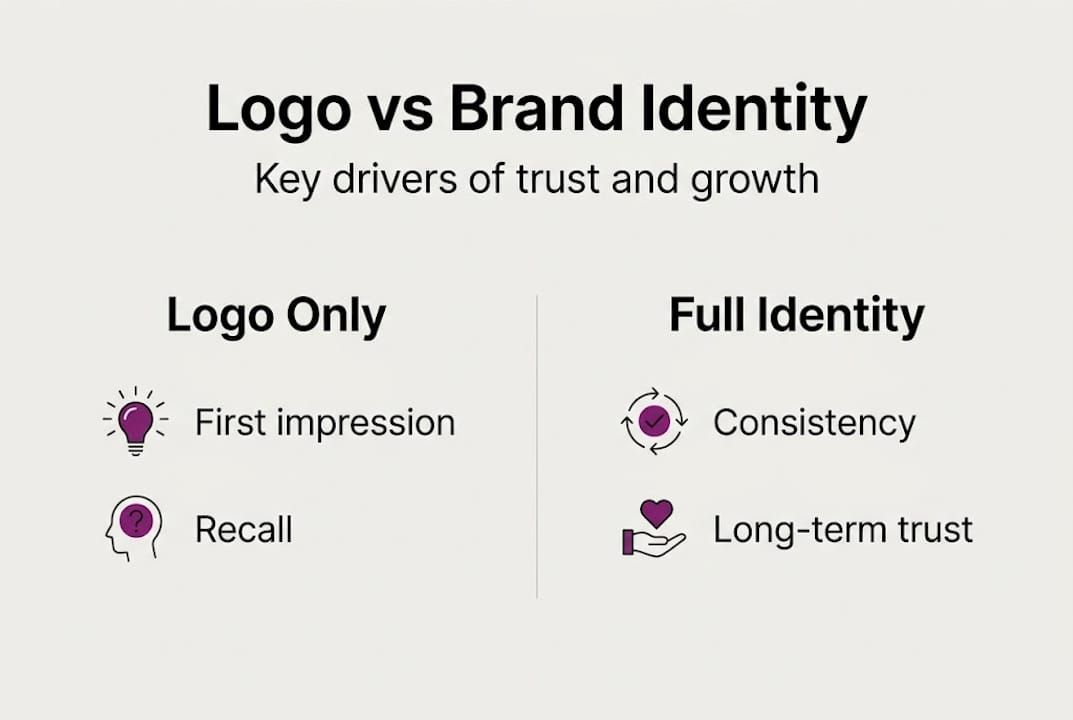
| Element | Logo only | Full brand identity |
|---|---|---|
| First impression | Strong | Strong |
| Customer recall | Moderate | High |
| Trust over time | Limited | Lasting |
| Message clarity | Partial | Complete |
| Revenue impact | Foundational | Compounding |
If you are unsure whether your current visual identity is working for or against you, exploring your brand refresh readiness is a smart first move. And if you have broader questions about what branding actually involves, the branding FAQs on our site cover the most common ones we hear from SMBs.
Pro Tip: Investing in a great logo and then presenting it inconsistently across channels cuts your return significantly. Treat brand consistency as part of the logo investment itself, not as a separate project to tackle later.
Industry differences and when to invest in a professional logo
Not every business needs the same logo strategy at the same time. Context matters here.
The logo's role shifts depending on your industry. Education-focused businesses tend to rely on icon-heavy, approachable designs that signal safety and creativity. Jewelry brands favor clean horizontal layouts with refined typography to communicate luxury. Legal firms prioritize typographic weight and restrained color to project authority and trustworthiness. These are not random preferences; they are trust signals shaped by customer expectations in each space.
The industry trust variance across business categories reaches up to 35%, which means the stakes of your logo choice are significantly higher in some fields than others. A mediocre logo in a low-trust industry can actively cost you business.
That said, DIY and AI tools are a legitimate starting point under the right conditions. Here is how to think about it:
Stay with DIY when:
- You are in an early testing phase and have not validated your business model yet
- Your budget is genuinely tight and revenue is not yet consistent
- Your brand is not yet customer-facing at scale
Invest in a custom logo when:
- You are ready to trademark your brand
- You are entering a new market or expanding your customer base
- Your current logo is limiting how you present your business
- You want your brand to attract a premium-tier customer
Here are the steps to move from DIY to a professional logo:
- Audit your current logo across all your real-world touchpoints.
- Identify where it breaks down: small sizes, dark backgrounds, print materials.
- Define your target customer and what they need to feel to trust you.
- Brief a professional designer with those insights, not just aesthetic preferences.
- Review the full deliverable package: files, colors, usage guidelines.
A quick fact worth knowing: symmetrical logos are rated 15% more trustworthy by consumers, which is a simple design principle that professionals apply automatically and DIY tools often miss.
If you are evaluating the logo upgrade ROI or still deciding whether to hire someone, this resource on finding a logo designer walks through what to look for and what questions to ask.
A fresh take: Why logo design is critical but not everything
Here is the honest truth we share with every client who comes to us: your logo is your first handshake, but it is not your whole résumé.
We have worked with businesses whose logos were genuinely rough. Old clip art, mismatched fonts, colors that clashed. And some of them were thriving, because their service was outstanding and their customers loved them. The logo was not stopping growth; it just was not helping it reach its ceiling.
Then they upgraded. New markets opened up. Partnerships that previously felt out of reach became possible. The logo did not create that success. It gave the existing success a vehicle to travel further.
That is the nuance most business owners miss. A logo cannot outrun a poor reputation. But a strong logo can amplify a great one. These real logo stories show exactly how that plays out in practice.
So invest wisely. Do not pour money into a logo and neglect the product, the service, or the experience. But do not dismiss the logo as vanity either. It is a legitimate growth tool when the foundation is solid.
Ready to boost your brand with a logo that works?
If this article has shifted how you think about your logo, you are already ahead of most SMBs. Knowing the why behind good design makes every investment decision clearer.
At Mycali Designs, we build logos and professional branding solutions that do real work for your business. Our process is consultative and strategic, not just creative. We start by understanding your goals, your audience, and your competitive landscape. Then we design with purpose. Whether you need a first logo or a brand refresh, explore our logo services to see how we approach it and what outcomes our clients experience. Let's build something that actually moves the needle.
Frequently asked questions
Do logos really impact small business customer trust?
Yes. 65% of consumers base their first impressions on company logos, and a professionally designed logo can boost trust by up to 40%, making it one of the highest-impact visual assets a small business owns.
How much should I budget for a logo as a small business?
DIY and AI tools work fine in early business stages, but a custom logo delivers significantly more credibility and compound ROI as your customer base and revenue grow.
Is logo color as important as design or name?
Not quite. Corporate name and design influence brand reputation more than color does, though certain industries benefit from specific color associations tied to customer expectations.
Can a logo compensate for a weak product or service?
No. A logo attracts attention and builds initial credibility, but it cannot replace the full brand experience, consistent service quality, or a product that genuinely delivers on its promise.
Recommended
Recent Posts