




The Role of Design in Manufacturing: A 2026 Guide
The Role of Design in Manufacturing: A 2026 Guide
TL;DR:
- Design for Manufacturing aligns product design with production capabilities to reduce costs, defects, and build customer trust. Early integration of manufacturing considerations significantly lowers lifetime costs and improves product quality, brand perception, and assembly efficiency. Organizational culture and collaboration are the primary challenges, but incremental adoption of design strategies can overcome these barriers effectively.
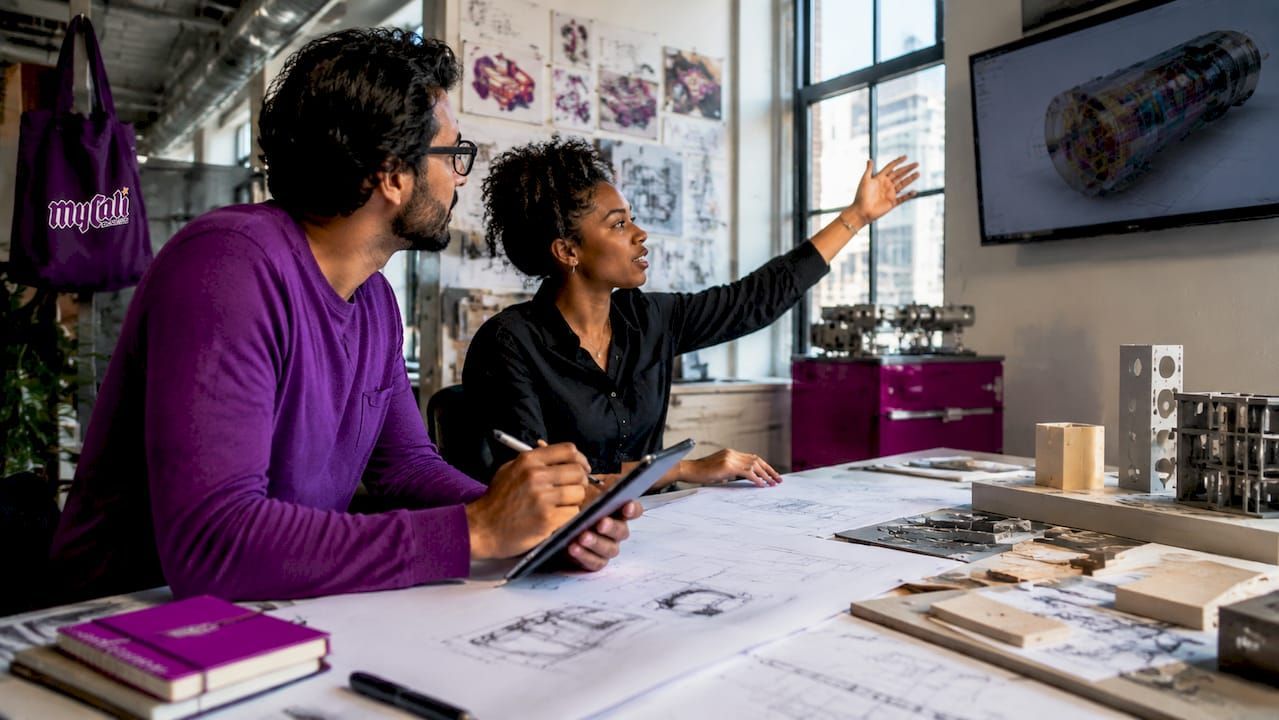
Design for Manufacturing (DFM) is the strategic practice of aligning product design with real production capabilities to control costs, reduce defects, and build products customers trust. The role of design in manufacturing reaches far beyond aesthetics. It determines how efficiently a product moves from concept to finished goods, how much it costs to assemble, and how customers perceive quality the moment they hold it. Frameworks like DFMA (Design for Manufacture and Assembly), developed and refined by organizations including the Lean Enterprise Institute, treat design not as a creative afterthought but as the primary lever for production success. Get design right early, and everything downstream gets easier.
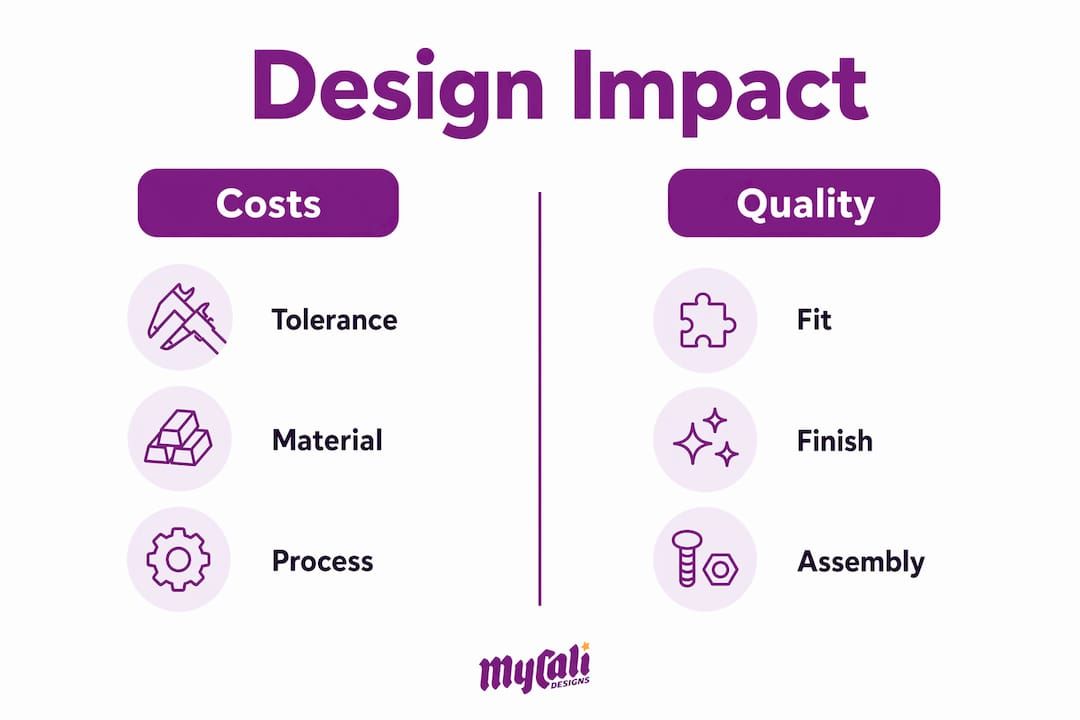
How the role of design in manufacturing shapes costs and quality
The most consequential design decisions happen before a single part is machined. 70 to 80% of manufacturing cost is locked in by the time a design is finalized. That means the geometry you choose, the tolerances you specify, and the materials you select in the design phase determine the majority of what production will cost. Changing those decisions after tooling is cut or a production line is configured is expensive and slow.

This is why DFM is most effective when applied early. DFM works best when design assumptions are still fluid and teams can align geometry, tolerances, materials, finishes, and features with actual production capabilities rather than retrofitting adjustments after the fact. The difference between a product designed with manufacturing in mind and one designed without it is often measured in months of ramp-up time and millions of dollars in warranty costs.
Consider what early integration looks like in practice:
- Tolerance specification: Tighter is not always better. Specifying tolerances tighter than a process can reliably hold drives up scrap rates and inspection costs without improving the product.
- Material selection: Choosing a material that is difficult to source or machine adds lead time and cost at every production run.
- Feature complexity: Undercuts, thin walls, and non-standard thread sizes each add machining time or require specialized tooling.
- Assembly sequence: Products designed without considering how they will be assembled often require awkward orientations, multiple operators, or custom fixtures.
| Design decision | Cost impact if ignored |
|---|---|
| Tolerance over-specification | Higher scrap rates, increased inspection labor |
| Poor material selection | Supply chain delays, machining inefficiency |
| Excessive feature complexity | Longer cycle times, specialized tooling costs |
| Assembly sequence not considered | More operators, higher error rates |
Pro Tip: Bring your manufacturing team into design reviews before the CAD model is finalized. One hour of early feedback prevents ten hours of late-stage redesign.
What design strategies actually improve manufacturability?
Design for Assembly (DFA) is the most direct path to reducing assembly complexity. The principle is straightforward: fewer parts mean fewer opportunities for error, less assembly time, and lower labor cost. IDEXX Laboratories reduced parts from 183 to 31 and cut assembly time by 75% after applying DFA principles to a product redesign. That is not a marginal improvement. It is a structural change in how the product is built.
Beyond part count reduction, the following strategies consistently deliver measurable results across manufacturing processes:
- Eliminate torque-specified fasteners where possible. Every fastener that requires a specific torque value adds a quality check and a potential failure point.
- Design parts for self-location. Parts that locate themselves during assembly reduce operator dependence and variation.
- Standardize components. Using the same screw, bracket, or connector across multiple products reduces inventory complexity and purchasing cost.
- Design for top-down assembly. Gravity-assisted assembly is faster and less error-prone than lateral or inverted assembly orientations.
- Apply process-specific guidelines. Injection-molded parts need draft angles and uniform wall thickness. Machined parts need accessible tool paths. Additive parts need minimized support structures.
The impact of design on production also varies significantly between traditional and additive manufacturing. In additive manufacturing, multi-objective optimization that accounts for build height, surface area, overhang, and support volume cuts material use by 11 to 16% and print time by 12 to 54% compared to single-variable approaches. That finding matters because many manufacturers applying additive processes still optimize for one variable at a time, leaving significant efficiency on the table.
| Process | Key design driver | Common mistake |
|---|---|---|
| Injection molding | Draft angles, wall uniformity | Ignoring sink marks and warp |
| CNC machining | Tool access, feature depth | Over-tolerancing standard features |
| Additive manufacturing | Build orientation, support volume | Optimizing only for overhang |
| Sheet metal fabrication | Bend radius, hole placement | Designing bends too close to edges |
Pro Tip: Use tolerance stack analysis tools before finalizing assemblies. A single misaligned tolerance chain can cause fit failures across an entire production run.
How design affects product appeal and brand perception
Customers do not read engineering drawings. They pick up a product, feel whether the lid closes cleanly, notice whether the finish is consistent, and decide in seconds whether it feels like quality. Dimensional control shifts design focus from nominal geometry to managing variation, which directly improves fit, feel, and finish. GE Appliances reported millions saved through optimized fit and finish platforms driven by dimensional control design approaches. That saving came not from cutting costs but from designing products that held their quality consistently across production runs.
The importance of design in industry goes beyond function. Consider what customers actually experience:
- Fit and finish consistency: A product that looks and feels the same across every unit signals manufacturing discipline and builds trust.
- Surface quality: Parting lines, sink marks, and uneven textures communicate poor process control even when the product functions correctly.
- Ergonomic alignment: Products designed with human factors in mind feel intuitive. Products designed without them feel awkward, regardless of technical performance.
- Packaging coherence: The design of the product and its packaging together form the first physical brand impression. Misalignment between the two undermines both.
Tightening tolerances alone is less effective than managing how parts locate and assemble to control variation. This is a counterintuitive insight that many manufacturers miss. The goal is not to make every part perfect in isolation. The goal is to design assemblies that produce consistent results even when individual parts vary within acceptable limits. That approach reduces operator dependence, lowers warranty claims, and produces the kind of product consistency that customers associate with strong brands.
Your manufacturing brand strategy depends on this connection. Design decisions made on the production floor have a direct line to how your brand is perceived in the market.
What challenges do manufacturers face when implementing design strategies?
The barriers to embedding DFM and DFA into manufacturing workflows are more often organizational and economic than technical. Most manufacturers understand the principles. The harder problem is building the internal culture and processes that make those principles routine rather than exceptional.
Common barriers include:
- Sequential workflows: When design and manufacturing teams work in separate phases, manufacturing engineers see the design too late to influence it meaningfully.
- Schedule pressure: Compressed timelines push teams to finalize designs before manufacturing input is gathered, locking in avoidable costs.
- Siloed expertise: Design engineers optimizing for function and manufacturing engineers optimizing for process efficiency often work toward different goals without a shared framework.
- Upfront investment resistance: DFM analysis, tolerance stack tools, and rapid prototyping require budget before production starts, which can be difficult to justify without clear ROI data.
DFMA replaces sequential workflows with concurrent engineering, requiring ongoing collaboration between design, quality, and supply chain teams from the earliest stages. Manufacturing design engineers play a central role in this model. They integrate customer requirements, CAD, supply chain, and factory realities to reduce costly redesigns and improve production stability. Think of them as the connective tissue between what a product needs to be and what a factory can reliably produce.
The most practical path forward for most manufacturers is incremental adoption. Start with a DFM checklist applied at the first design review. Add tolerance stack analysis before tooling sign-off. Introduce DFA scoring for new product introductions. Each step builds organizational muscle without requiring a complete process overhaul.
Pro Tip: Assign a manufacturing design engineer as a standing member of every new product development team. Their early involvement pays back in reduced engineering change orders and faster production ramp-up.
Key takeaways
Design for Manufacturing and Assembly is the single most cost-effective investment a manufacturer can make, because it locks in efficiency, quality, and brand perception before production ever begins.
| Point | Details |
|---|---|
| Cost is set early | 70 to 80% of manufacturing cost is determined at design finalization, not on the production floor. |
| DFA reduces complexity | IDEXX Laboratories cut parts from 183 to 31 and reduced assembly time by 75% using DFA principles. |
| Variation management beats tight tolerances | Designing for consistent assembly outperforms tightening individual part tolerances for quality outcomes. |
| Organizational barriers are the real obstacle | Most DFM failures are cultural and economic, not technical. Incremental adoption is the practical fix. |
| Design drives brand perception | Consistent fit, finish, and feel are what customers interpret as quality and associate with brand trust. |
Why design integration is the competitive edge most manufacturers overlook
I have worked with manufacturers who treat design as a handoff. The product designer finishes, throws the files over the wall, and manufacturing figures it out. That model is expensive, and the costs are often invisible because they show up as rework, warranty claims, and slow ramp-ups rather than a single line item anyone can point to.
The manufacturers who consistently outperform their competitors do something different. They treat design as a shared responsibility. Their manufacturing engineers are in the room when geometry decisions are made. Their quality teams review tolerances before tooling is ordered. Their supply chain teams flag material risks before they become production delays. That is not a complicated process. It is a cultural decision to treat design as a production tool, not a creative output.
What I find most underestimated is the brand dimension. Manufacturers often separate "product design" from "brand design" as though they are unrelated disciplines. They are not. The visual identity of your product, from its surface finish to its packaging to its logo, is the customer-facing expression of every manufacturing decision you made. A product that holds its quality across production runs builds brand equity automatically. A product that varies does the opposite, no matter how good your marketing is.
The manufacturers who win in 2026 are the ones who stop treating design as a cost center and start treating it as a value creation system. That shift does not require a massive investment. It requires the right people talking to each other at the right time.
— Cesar
How Mycalidesigns helps manufacturers build stronger brands through design
At Mycalidesigns, we work with manufacturers and business owners who understand that production quality and brand identity are two sides of the same coin. Your product may be engineered to perform, but if your brand does not communicate that quality clearly, you are leaving market share on the table. We offer brand identity and logo design services built specifically to align with the realities of manufacturing businesses. From logo development to full branding systems, we help you present your business with the same precision you bring to your production process. If you are ready to align your design strategy with your brand goals, explore our full service offerings and see how we can support your growth.
FAQ
What is Design for Manufacturing (DFM)?
DFM is the practice of designing products with real production capabilities in mind, including geometry, tolerances, materials, and assembly sequences, to reduce cost and improve quality before production begins.
How does design affect manufacturing costs?
70 to 80% of manufacturing and lifecycle cost is determined by the time a design is finalized. Early design decisions on materials, tolerances, and features have a greater cost impact than any optimization made after production starts.
What is the difference between DFM and DFA?
DFM focuses on designing parts that are easy to produce within a given manufacturing process. DFA focuses on designing assemblies that are easy and fast to put together, typically by reducing part count and simplifying assembly sequences.
How does product design influence brand perception?
Consistent fit, finish, and feel across production runs signal manufacturing discipline to customers. GE Appliances linked dimensional control improvements to millions in savings and stronger product quality perception.
What is the biggest barrier to implementing DFM in manufacturing?
The primary barriers are organizational and economic rather than technical. Sequential workflows and schedule pressure prevent manufacturing teams from influencing design early enough to make a meaningful difference.
Recommended
Recent Posts