




Why Use Digital Marketing in Manufacturing: 2026 Guide
Why Use Digital Marketing in Manufacturing: 2026 Guide

TL;DR:
- Digital marketing in manufacturing leverages SEO, LinkedIn, and account-based strategies to generate quality leads and shorten sales cycles. It offers significant advantages over traditional methods by building technical credibility and expanding into new markets. Effective implementation requires targeted content, aligned KPIs, and digital integration with trade shows to maximize results.
Digital marketing in manufacturing is defined as the use of targeted online channels, including SEO, LinkedIn, account-based marketing (ABM), and email automation, to generate qualified leads, build brand credibility, and accelerate industrial sales cycles. Manufacturers who rely solely on trade shows and referrals are leaving measurable pipeline on the table. SEO drives 53% of organic website traffic, making it the single largest source of inbound leads for industrial companies. Understanding why use digital marketing in manufacturing starts with one fact: your buyers are researching online long before they ever contact your sales team.
What are the top benefits of digital marketing in manufacturing?
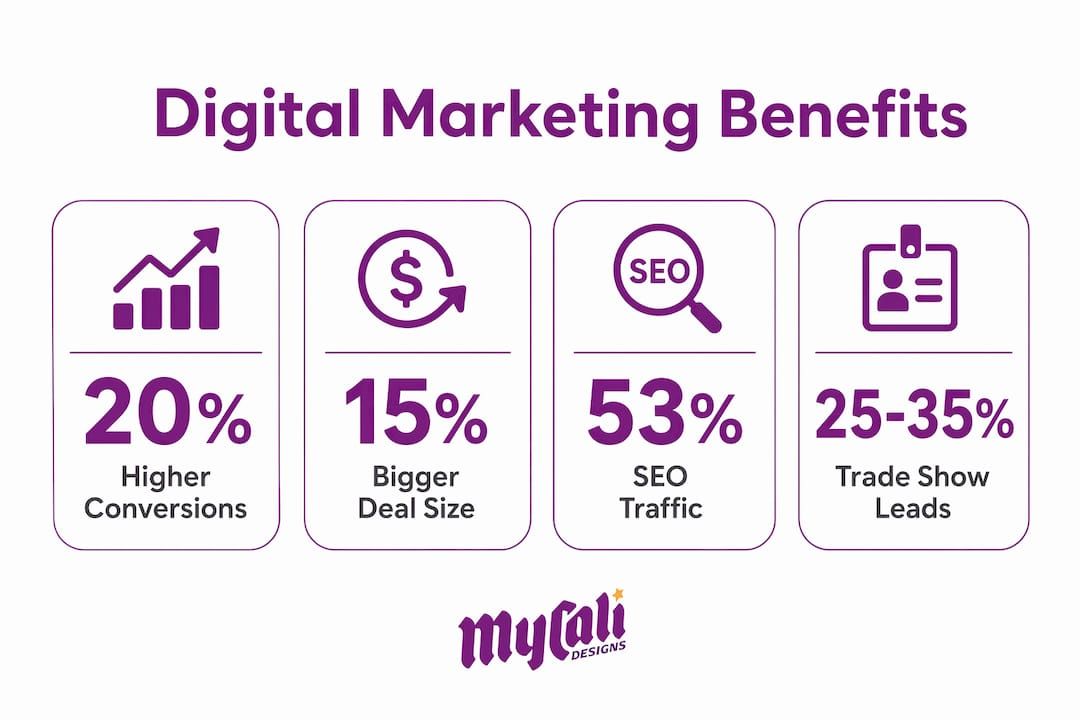
The benefits of digital marketing in manufacturing go well beyond brand awareness. They directly affect lead quality, sales velocity, and your ability to enter new markets without a physical presence.
Here is what the data shows:
- Higher conversion rates. Manufacturers integrating email marketing with CRM tools see a 15–20% conversion increase. That is not a marginal gain. It means your sales team spends time on prospects who are already warmed up.
- Better lead quality through technical content. Whitepapers, capability videos, and specification sheets attract engineers and procurement managers who are actively evaluating suppliers. These buyers convert at significantly higher rates than cold outreach targets.
- Market expansion without geographic limits. Analytics tools like Google Analytics 4 and HubSpot let you identify demand signals in new regions before committing sales resources. You can test a new vertical with a targeted content campaign before hiring a regional rep.
- Competitive advantage over traditional-only firms. Manufacturers who have not invested in digital brand presence are invisible to buyers who start their vendor research on Google or LinkedIn.
Account-based marketing delivers 20% higher conversion rates and a 15% increase in deal size for manufacturers who use it. That combination of volume and value is what separates digital marketing from traditional advertising, which cannot be personalized at scale.
Pro Tip: Start with one digital channel, measure it for 90 days, then expand. Manufacturers who try to run SEO, LinkedIn, email, and paid ads simultaneously without a clear attribution model waste budget and burn out their teams.
How does digital marketing strategy differ for manufacturing vs. other B2B sectors?
Manufacturing marketing is not B2B SaaS marketing with different logos. The structural differences are significant, and applying the wrong playbook is one of the most common manufacturer mistakes in digital strategy.
The table below captures the core differences:
| Factor | Manufacturing | SaaS / General B2B |
|---|---|---|
| Sales cycle length | 6–18 months | 1–6 months |
| Buying committee size | 8–12+ stakeholders | 2–5 stakeholders |
| Content type | Capability pages, certifications, tolerances | Case studies, demos, pricing pages |
| Lead attribution | Signal-based, long-window ABM | Last-click or short-window models |
| Trust signals | Technical precision, ISO certifications | Reviews, G2 ratings, free trials |
The 6–18 month sales cycle means that a buyer who downloads your whitepaper today may not issue an RFQ for another year. Standard 30-day attribution windows will make your best campaigns look like failures. Manufacturers benefit from signal-based ABM models that track industrial triggers like reshoring announcements, executive hires, and facility expansions rather than simple page views.
Engineers and procurement managers evaluate credibility through precise technical content. Fluffy marketing copy with no specifications, tolerances, or certifications does not build trust with these buyers. It signals that you do not understand their world. The importance of online marketing in industry is directly tied to how well your content speaks the buyer's technical language.
Pro Tip: Build separate content tracks for each stakeholder in the buying committee. The plant manager cares about uptime and cost. The engineer cares about tolerances and material certifications. The procurement lead cares about lead times and vendor risk. One generic brochure serves none of them.
Which digital marketing channels drive results in manufacturing?
The most effective digital marketing strategies for manufacturers concentrate on channels where technical buyers actually spend time and where content depth is rewarded.

SEO and capability pages are the foundation. Specification-level long-tail keywords outperform broad category terms for lead quality. A search for "CNC machined aluminum aerospace bracket tolerances" signals a buyer who knows exactly what they need. Ranking for that term puts you in front of a qualified prospect at the moment of intent. Detailed capability pages convert to RFQs at 4–7x the rate of generic product pages. That multiplier alone justifies the investment in technical content development.
LinkedIn advertising targets engineering, procurement, and operations personas by job title, company size, and industry. LinkedIn CPLs of $250–$350 are high compared to consumer channels, but the pipeline economics work when your average contract value is $50,000 or more. One closed deal from a LinkedIn campaign can return 50x the ad spend.
Email automation and CRM integration close the loop between marketing and sales. Automated email sequences triggered by buyer behavior achieve over 77% lead conversion success rates. Pair that with marketing automation, which delivers a 29% increase in lead conversion rates and 25% faster sales cycles, and you have a system that works even when your sales team is at a trade show.
Trade show digital integration is the channel most manufacturers underuse. Trade shows generate 25–35% of manufacturing pipeline, but integrating digital pre-show, at-show, and post-show campaigns boosts conversion to 15–22%. A targeted LinkedIn campaign before the show, a lead capture system at the booth, and an automated follow-up sequence after the event turn a three-day event into a 90-day pipeline engine.
What are common pitfalls manufacturers should avoid?
Most manufacturers who struggle with digital marketing are not failing because of budget. They are failing because of strategy errors that are entirely avoidable.
- Targeting broad keywords. Bidding on "metal fabrication" or "industrial equipment" attracts researchers, students, and competitors, not buyers. Narrow your keyword strategy to specification-level terms that signal purchase intent.
- Gating all technical content. Requiring a form fill to access every datasheet or capability document pushes buyers to competitors who publish openly. Gate premium content like custom engineering guides. Publish standard specs freely.
- Underestimating the buying committee. Sending one email sequence to one contact at a target account ignores the reality that 8–12 stakeholders influence the final decision. Your campaign needs to reach the engineer, the plant manager, and the procurement lead simultaneously.
- Ignoring distributor and channel partner alignment. If your distributors are running their own digital campaigns with inconsistent messaging, you are competing against yourself. Align your digital assets, co-branded content, and lead routing with your channel partners.
- No post-trade show follow-up system. Collecting business cards at a trade show and emailing them two weeks later is not a follow-up strategy. Buyers make decisions quickly after events. A 48-hour automated sequence with relevant technical content is the minimum standard.
Pro Tip: Audit your existing website for pages that rank but do not convert. A capability page that attracts 500 monthly visitors but generates zero RFQ submissions is a content problem, not a traffic problem. Add certifications, tolerances, lead times, and a clear call to action.
How can manufacturers implement digital marketing effectively in 2026?
Practical implementation of digital marketing strategies for manufacturers requires aligning your marketing timeline and KPIs with the reality of industrial buying cycles. Here is a structured approach:
- Set KPIs that match your sales cycle. Measure pipeline contribution, not just leads. Track metrics like marketing-qualified accounts, RFQ volume, and influenced revenue over 12-month windows rather than monthly lead counts.
- Build technical capability pages first. Before investing in paid ads or LinkedIn campaigns, make sure your website has pages with detailed specs, certifications, tolerances, and process descriptions. These pages are the destination for all your traffic. Without them, every campaign underperforms.
- Deploy behavior-triggered email sequences. Use platforms like HubSpot, Marketo, or Pardot to trigger email sequences based on specific buyer actions, such as downloading a datasheet or visiting your capability page three times. This is how you nurture leads effectively across a long sales cycle without manual follow-up.
- Invest in ABM for high-value target accounts. Identify your top 50 to 100 target accounts and build personalized outreach sequences that include LinkedIn ads, direct mail, and sales touchpoints. ABM is not a spray-and-pray approach. It is a precision strategy for your highest-priority opportunities.
- Integrate digital campaigns with trade show schedules. Build a 30-day pre-show LinkedIn campaign to book meetings, a lead capture workflow for the event itself, and a 14-day post-show email sequence. This turns your trade show investment into a measurable digital funnel.
- Use analytics to justify and optimize spend. Tools like Google Analytics 4, Salesforce, and LinkedIn Campaign Manager give you the data to connect marketing activity to pipeline. Review performance monthly and reallocate budget to the channels producing the highest-quality RFQs.
Understanding search engine visibility is a prerequisite for any SEO investment. Manufacturers who understand how Google evaluates technical content will build pages that rank and convert, not just pages that exist.
Key takeaways
Digital marketing in manufacturing works because it aligns technical content, precise targeting, and long-cycle nurturing to reach the right stakeholders at every stage of a complex industrial buying process.
| Point | Details |
|---|---|
| SEO is the top traffic driver | SEO drives 53% of organic traffic; prioritize specification-level keywords over broad terms. |
| ABM outperforms generic campaigns | Account-based marketing delivers 20% higher conversion rates and 15% larger deal sizes. |
| Automation accelerates long cycles | Marketing automation produces 29% more conversions and 25% faster sales cycles. |
| Technical content converts | Capability pages with specs and certifications convert to RFQs at 4–7x the rate of generic pages. |
| Trade shows need digital support | Integrating digital campaigns with trade shows boosts event conversion rates to 15–22%. |
What I've learned about digital marketing in manufacturing
From working with manufacturers and production-focused businesses at Mycalidesigns, one pattern stands out clearly. The manufacturers who struggle with digital marketing are not short on budget. They are short on specificity. They publish content that could describe any company in their category, and then wonder why their website generates inquiries from the wrong buyers.
The manufacturers who win are the ones who treat their website like a technical document. Every capability page reads like an engineering brief. Every case study includes actual tolerances, materials, and cycle times. That level of detail does not just help with SEO. It builds the kind of trust that makes a procurement manager comfortable sending an RFQ to a company they have never met in person.
I also think the industry underestimates how much digital presence extends the value of trade shows. Most manufacturers treat their booth and their website as separate investments. The ones who connect them, running LinkedIn campaigns before the show, capturing leads digitally at the event, and following up with automated sequences afterward, consistently report better pipeline from the same trade show budget.
The manufacturing brand strategy conversation has shifted. Digital is no longer experimental. 97% of manufacturers now identify scaling digital tools as a critical business priority. The question is not whether to invest in digital marketing. The question is whether your digital presence is precise enough to earn the trust of a technical buyer who has never heard of you.
— Cesar
How Mycalidesigns helps manufacturers grow online
Manufacturers need more than a website. They need a digital presence that earns the trust of engineers, procurement managers, and plant directors before a single sales call happens.
At Mycalidesigns, we build custom websites designed specifically for manufacturers, with capability pages that rank on Google and convert visitors into RFQ submissions. We also develop brand identity systems and digital marketing programs that align with your sales cycle, not a generic B2B template. If you are ready to turn your digital presence into a lead generation asset, we are ready to help you build it.
FAQ
Why should manufacturers use digital marketing?
Digital marketing gives manufacturers a scalable way to generate qualified leads, build technical credibility, and reach new markets without relying solely on trade shows or referrals. SEO alone drives 53% of organic website traffic, making it the most cost-effective long-term lead source for industrial companies.
How long does digital marketing take to work for manufacturers?
Results depend on the channel. SEO typically takes 6–12 months to produce consistent organic traffic, while LinkedIn ads and email automation can generate pipeline within 30–60 days. Aligning your KPIs with the 6–18 month industrial sales cycle is critical for accurate performance measurement.
What content works best for manufacturing digital marketing?
Capability pages with detailed specifications, certifications, tolerances, and process descriptions convert to RFQs at 4–7x the rate of generic product pages. Technical whitepapers, process videos, and case studies with real project data are the next most effective content types for industrial buyers.
Is account-based marketing worth it for manufacturers?
Yes. Manufacturers using ABM report 20% higher conversion rates and a 15% increase in deal size compared to broad-based campaigns. ABM is particularly effective for manufacturers targeting a defined list of high-value accounts where personalized outreach justifies the investment.
How does digital marketing support trade show investment?
Digital pre-show campaigns on LinkedIn drive booth traffic and pre-booked meetings. Post-show automated email sequences follow up with leads within 48 hours, which is the window when buyer intent is highest. Integrated digital and trade show motions consistently convert at 15–22%, compared to lower rates from trade shows alone.
Recommended
Recent Posts