



Visual branding process: 5-step guide for SMB success
Visual branding process: 5-step guide for SMB success

Getting noticed in a crowded market is hard. Earning customer trust once you do? Even harder. Many small and medium-sized business owners invest in a logo, pick some colors, and hope it all comes together. It rarely does without a structured plan. The visual branding process for SMBs typically follows a 5 to 9 step methodology, starting with research and strategy, moving through design, and ending with brand guidelines that keep everything consistent. This guide walks you through each phase, the tools that make it manageable, and the pitfalls that quietly kill brand credibility before you even realize it.
Table of Contents
- What is the visual branding process?
- Step-by-step guide: Implementing your visual branding?
- Essential tools and resources for SMB visual branding?
- Avoiding common pitfalls and ensuring consistency?
- Why most SMB visual branding fails (and how yours can succeed)?
- Elevate your brand with professional help?
- Frequently asked questions?
Key Takeaways
| Point | Details |
|---|---|
| Structured steps matter | A clear visual branding process helps SMBs go from invisible to unforgettable. |
| Consistency is key | Brand visuals used consistently across platforms can increase recognition by up to 80%. |
| Leverage smart tools | Digital tools like Canva make pro-quality design accessible to small businesses. |
| Avoid common mistakes | Following brand guidelines helps your team avoid costly errors and build trust. |
What is the visual branding process?
Visual branding is more than a pretty logo. It is the full system of visual elements that communicate who you are, what you stand for, and why customers should choose you over a competitor. The visual branding process is the structured sequence of steps you follow to build that system intentionally rather than by accident.
For SMBs, this matters enormously. Without structure, branding decisions get made on the fly. Colors change between print and digital. Fonts vary from one social post to the next. Customers notice inconsistency even when they cannot name it, and it quietly erodes trust.
A well-executed process gives your brand a foundation. It ensures every touchpoint, from your website to your business card, tells the same story. Understanding branding basics is the first step toward making that happen.
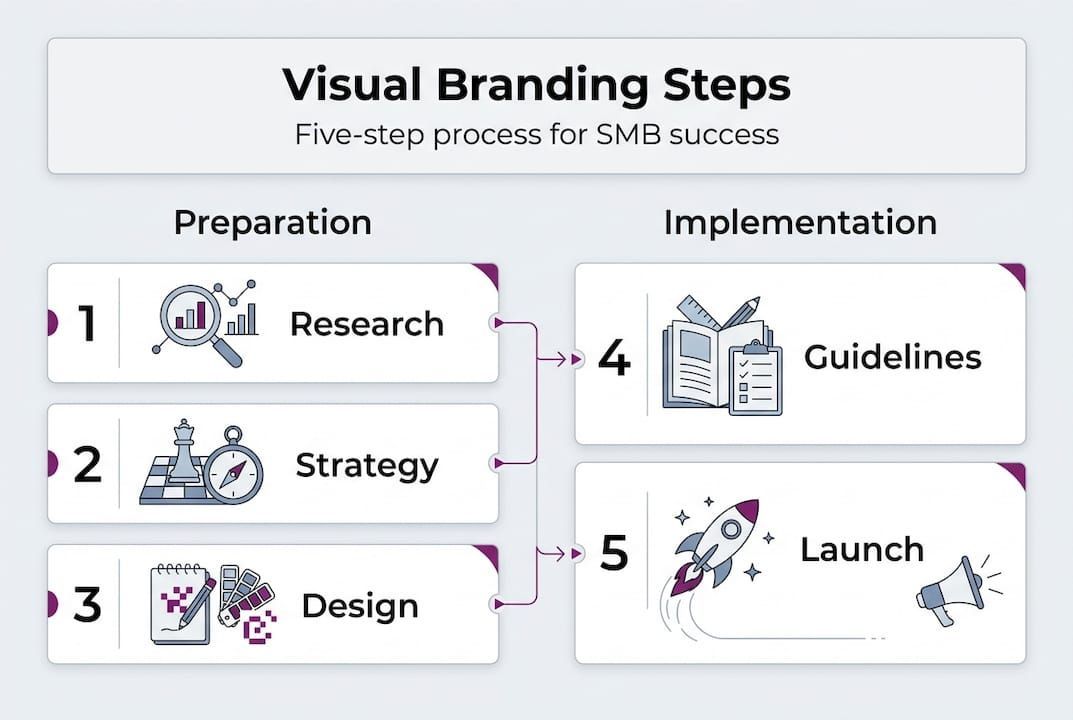
The process typically follows a 5 to 9 step methodology, and the core stages look like this:
| Stage | What happens |
|---|---|
| Research | Audience analysis, competitor review |
| Strategy | Positioning, brand personality, messaging |
| Visual design | Logo, color palette, typography, imagery |
| Brand guidelines | Documented rules for consistent use |
| Implementation | Applying visuals across all channels |
Before you start designing anything, it helps to assess where you currently stand. A brand readiness assessment can reveal gaps in your current identity and show you exactly where to focus first. Think of it as a health check before the real work begins.
The businesses that skip this structured approach often end up redoing everything within two years. Those that follow it build something that grows with them.
Step-by-step guide: Implementing your visual branding
Now that you know what the visual branding process is, it is time to break down each step and show you how to put it into action.
The five core steps are research and discovery, strategy and positioning, visual design, brand guidelines, and implementation. Here is how each one works in practice:
- Research and discovery. Start by studying your target audience and your competitors. What do your customers value? What visual language do competitors use? Where are the gaps you can own?
- Strategy and positioning. Define your brand personality. Are you bold and energetic, or calm and trustworthy? Your visual choices should reflect this positioning clearly.
- Visual design. This is where logo, color palette, typography, and imagery come together. Every choice should serve your strategy, not just look appealing. Investing in custom logo creation at this stage pays off for years.
- Brand guidelines. Document every visual rule. Specify exact colors using hex codes, list approved fonts and their uses, and show examples of correct and incorrect logo placement. This document is your brand's rulebook.
- Implementation. Roll out your visuals consistently across your website, social media, packaging, signage, and any other customer touchpoint.
Pro Tip: When building your color palette, limit yourself to two or three primary colors and one or two accent colors. More than that and your brand starts to feel scattered rather than cohesive.
| Approach | Outcome |
|---|---|
| Skipping research | Visuals that miss your audience entirely |
| Research-first design | Visuals that resonate and convert |
| No brand guidelines | Inconsistent application across channels |
| Documented guidelines | Consistent, professional brand presence |
Each step builds on the last. Rushing through research to get to the design phase is like building a house without a blueprint. You might finish faster, but something important will be off.

Essential tools and resources for SMB visual branding
You need more than just a plan. You need the right tools to keep your branding on track, even with a small team or a tight budget.
The good news is that affordable, powerful tools exist specifically for businesses in your position. Consistency across digital and print channels drives an 80% recognition boost, but only when you have the right systems in place to maintain it.
Here are the tools we recommend most often to SMB clients:
- Canva. A user-friendly design platform where you can store brand colors, upload fonts, and create templates your whole team can use. It lowers the barrier to consistent design significantly.
- Adobe Express. A step up from Canva with more control over design details. Good for businesses ready to invest a little more time in quality.
- Google Fonts. A free library of professional typefaces. Pair one serif and one sans-serif font for a clean, versatile typographic system.
- Coolors. A fast color palette generator that helps you build harmonious color combinations and export exact hex codes for consistent use.
- Unsplash and Pexels. Free, high-quality image libraries that let you source brand-aligned photography without a big budget.
Pro Tip: Even if you use Canva for day-to-day content, always reference your brand guidelines before creating anything new. Tools make execution easier, but guidelines prevent creative drift.
Using these tools effectively also extends to how you show up on social media. Social media branding is one of the highest-visibility areas where consistency either builds trust or quietly undermines it.
The right tools save time, reduce errors, and empower your team to produce on-brand content without needing a designer for every single task.
Avoiding common pitfalls and ensuring consistency
Even after you implement your branding, it is easy to slip up. Here is how to stay consistent and build lasting trust.
The most common mistakes we see SMBs make are not dramatic. They are small, gradual, and cumulative. A slightly different shade of blue here. A new font used just once there. Over time, these small deviations add up to a brand that feels disjointed and unprofessional.
Here are the pitfalls to watch for:
- Ignoring your brand guidelines. Creating a guidelines document and then never using it is one of the most common and costly mistakes. Your guidelines only work if your team actually follows them.
- Using low-resolution assets. Blurry logos and pixelated images signal to customers that quality is not a priority. Always maintain a library of high-resolution files in multiple formats.
- Letting platforms dictate your design. Social media templates are convenient, but defaulting to them without customization strips away your brand identity.
- Skipping the onboarding step. When new team members or contractors join, they need a brand orientation. Assume nothing.
- Avoiding regular brand audits. Set a recurring reminder to review your brand touchpoints quarterly. Catch drift before it becomes a pattern.
"Use tools like Canva for SMBs but govern with brand guidelines to prevent drift."
Getting team buy-in matters as much as having the right tools. When everyone understands why consistency matters, not just what the rules are, they are far more likely to follow through. For more guidance on building a solid brand foundation, explore our branding FAQs.
Why most SMB visual branding fails (and how yours can succeed)
With pitfalls laid out, here is a hard-won perspective on what truly determines SMB branding success.
After working with businesses across industries, we have seen a clear pattern. The brands that struggle are not the ones with the smallest budgets. They are the ones that treat branding as a one-time project rather than an ongoing commitment.
They invest in a beautiful logo, launch with energy, and then slowly drift. A new team member uses the wrong font. A seasonal promotion introduces colors that were never part of the palette. Six months later, the brand looks like it was designed by three different companies.
The uncomfortable truth is that simplicity and discipline outperform creativity and flash every single time. A straightforward logo applied with perfect consistency will always outperform an intricate design used carelessly.
We also see businesses skip the research phase because it feels slow. That shortcut almost always costs more time and money later when the visuals do not resonate with the intended audience.
Before any design work begins, assessing brand readiness is the most important thing you can do. It tells you what you actually need rather than what you think you need. That clarity is what separates brands that grow from brands that stall.
Elevate your brand with professional help
You do not have to go it alone. Building a visual brand that holds up across every customer touchpoint takes strategy, skill, and a clear process. That is exactly what we do at MyCali Designs.
We help SMBs move from scattered visuals to a cohesive brand identity that earns trust and drives growth. Whether you are starting from scratch or refreshing an existing brand, our professional branding services cover everything from strategy and logo design to full brand guidelines. Not sure where to start? Our branding FAQs are a great first stop. We are here to make the process clear, manageable, and built around your business goals.
Frequently asked questions
What are the core steps of the visual branding process for SMBs?
The main steps are research, strategy and positioning, visual design, creating brand guidelines, and implementing those visuals consistently. The visual branding process for SMBs typically follows a structured 5 to 9 step methodology depending on business complexity.
How does visual consistency help small businesses?
Consistent visuals boost brand recognition by up to 80% and signal professionalism that builds lasting customer trust over time.
What visual branding tools are most useful for SMBs?
Affordable tools like Canva, Adobe Express, and Google Fonts help SMBs manage branding design and maintain consistency without requiring a large budget or a full-time designer.
How often should a business revisit its brand guidelines?
Review your brand guidelines at least once a year to keep your visual identity aligned with your business growth and ensure nothing has drifted from the original standards.
Recommended
Recent Posts