




Why Update Brand Messaging for Business Growth
Why Update Brand Messaging for Business Growth
TL;DR:
- Updating brand messaging focuses on refining words, values, and story rather than visuals, which can enhance clarity and growth. Regular reviews, especially every six to twelve months, ensure messaging aligns with market shifts, audience changes, and business evolution. Strategic updates lead to higher revenue, faster sales, stronger loyalty, and better internal and external brand consistency.
Your logo might be sharp, your website polished, and your social media active. Yet something is still off. Customers are confused about what you actually offer, your sales conversations take longer than they should, and the leads coming in are not quite the right fit. The reason why you should update brand messaging often has nothing to do with visuals. It comes down to the words, values, and story behind your brand. For small to medium-sized businesses, this distinction matters more than most realize, and fixing it can change the trajectory of your growth.
Key takeaways
| Point | Details |
|---|---|
| Messaging goes beyond visuals | Brand messaging includes your mission, values, tone, and positioning — not just your logo or colors. |
| Structural triggers signal update time | Major market shifts, a new audience, or competitive changes are the clearest signs to refresh your message. |
| Updated messaging drives revenue | Companies with refreshed, consistent messaging report significantly higher revenue growth and profit margins. |
| Small updates often outperform rebrands | Focused messaging refinements typically deliver more clarity than dramatic, large-scale overhauls. |
| Consistency compounds over time | Aligning your team and all channels around one clear message builds trust faster than any single campaign. |
What brand messaging actually is
Most business owners think of branding as a visual exercise. Choose the colors, design the logo, pick the fonts, done. But brand messaging runs deeper than any of those elements. It is the collection of words, ideas, and emotions that define how your business communicates its value to the world.
At its core, brand messaging comprises your mission, vision, positioning, differentiators, and value proposition. Together, these create both an emotional and rational connection with customers. Think of it as the script your entire business follows, whether that is a sales rep on a call, a post on Instagram, or a line on your homepage.
Here is what a complete brand messaging framework typically includes:
- Mission statement: Why your business exists beyond making money
- Vision: Where your business is headed and what it is building toward
- Value proposition: The specific benefit you deliver that competitors do not
- Brand voice and tone: How you sound, whether that is authoritative, warm, playful, or direct
- Key differentiators: What makes you the right choice over alternatives
- Tagline or slogan: A memorable, clear phrase that echoes your core message in the audience's mind
When these elements are aligned and current, your business communicates with clarity and purpose. When they drift out of date, you start losing people at every touchpoint. Without a clear brand messaging framework, vague communication confuses audiences and weakens your growth potential before you even get a chance to pitch.
Why and when to update your messaging

Here is something most marketing advice gets wrong. Businesses tend to update messaging in reaction to a bad quarter or a new competitor's campaign. That is the wrong trigger. The biggest reasons to evolve brand messaging are structural, not short-term. They include major market changes, an expanding audience, or a meaningful shift in your competitive space.
If any of the following situations apply to your business, it is time to assess your messaging:
- You have added new services or products that your current messaging does not reflect
- Your customer base has shifted and the people buying from you today are not who you built your message for originally
- A competitor has moved into your positioning and your differentiators no longer feel distinct
- Your team struggles to explain what you do consistently from one person to the next
- Leads are coming in misaligned with the work you actually want to do or the clients you want to serve
- You've outgrown your original story and your messaging still sounds like a startup when you are now an established business
The risk of ignoring these signals is real. Outdated messaging creates friction at every stage of your sales process. It costs you time explaining what should already be clear. It weakens your ability to attract the right talent. And it quietly erodes the trust of potential customers who cannot figure out whether you are the right fit.
Pro Tip: Q2 is the optimal time for small to medium businesses to refine brand strategy. You have real Q1 performance data to work with rather than January assumptions, and you can correct course before peak competition seasons hit. Pull your analytics, review what resonated, and use that information to shape your next messaging pass.
One more important distinction: updating your messaging is not the same as rebranding. A rebrand involves a full overhaul of identity, often including visual elements, name, and positioning. A messaging refresh is more surgical. It means sharpening your language, updating your value proposition, and making sure your story reflects where your business actually is today. You likely need the latter far more often than the former.
The real benefits of updating your messaging
The importance of brand messaging becomes clearest when you look at what updated messaging actually does to business performance. This is not a soft, theoretical benefit. The numbers are concrete.
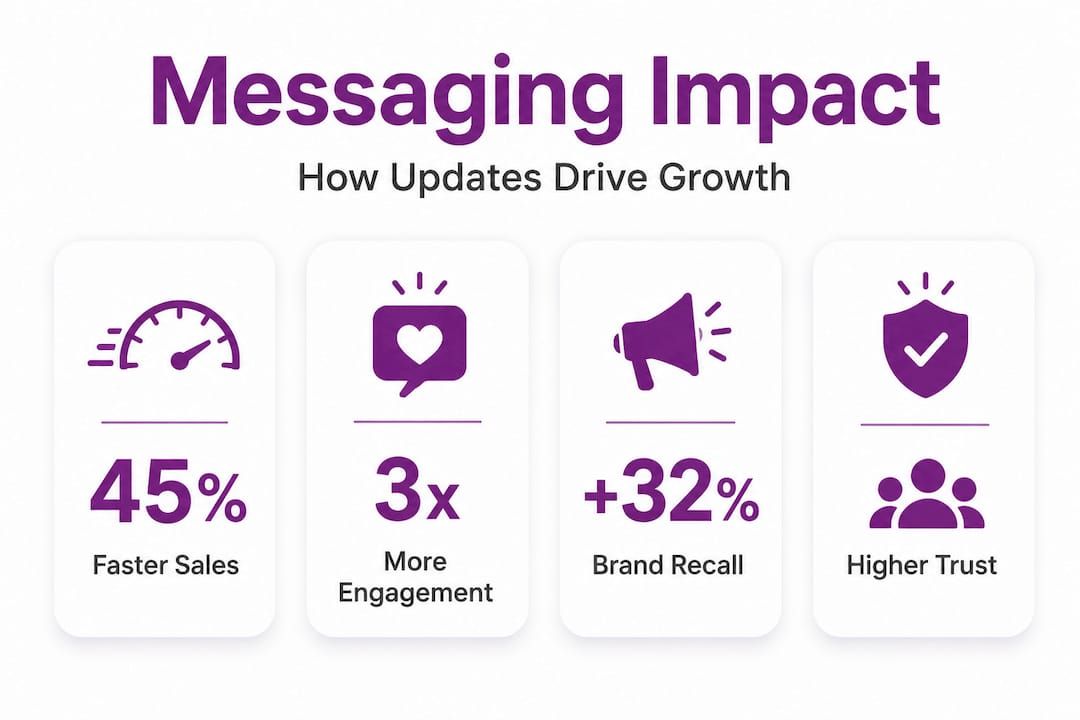
Companies that update their brand messaging strategically report 23% higher revenue growth and 18% higher profit margins compared to businesses carrying outdated messaging. That gap compounds over time. Clear messaging means your customers know exactly why they should choose you, and that confidence translates directly into buying decisions.
Here is how the benefits of updating messaging play out in practice:
- Faster sales cycles: A clear, focused brand message reduces confusion and shortens close times by helping customers immediately understand your value. Sales teams spend less time explaining and more time closing.
- Stronger customer loyalty: When your message consistently reflects your values, customers feel they know who they are buying from. That trust becomes a reason to return.
- Better internal alignment: Your team delivers a consistent experience when everyone is working from the same messaging foundation. This matters whether you have five employees or fifty.
- Attracts the right talent: Candidates evaluate companies based on how they communicate their purpose. Clear, current messaging signals a business that knows where it is going.
- Competitive differentiation: Brand consistency across channels signals professionalism and builds authority in your category over time.
The impact of brand messaging changes is not always immediate. But the businesses that refresh and align their message thoughtfully tend to pull ahead steadily while their competitors stand still.
How to improve your brand messaging
Knowing that you need to update is one thing. Knowing how to do it without disrupting everything is another. The good news is that small, focused messaging adjustments often outperform large-scale rebrands. You do not need to tear everything down. You need to sharpen what exists and rebuild from what is already working.
Here is a practical comparison of the two most common approaches:
| Approach | Best for | What changes | Timeline |
|---|---|---|---|
| Messaging refinement | Businesses that have evolved but still serve a similar audience | Language, tone, value proposition, key differentiators | 4 to 8 weeks |
| Full brand repositioning | Businesses entering a new market or targeting a different customer | Identity, positioning, name, visuals, and messaging together | 3 to 6 months |
For most SMBs, a messaging refinement is the right call. Here is how to approach it without losing momentum:
Start with an audit. Review every place your brand communicates, your website, your proposals, your email signatures, your social profiles, and your team's verbal pitch. Note where the language is inconsistent, outdated, or vague.
Gather feedback from both sides. Talk to your best current customers about why they chose you and how they describe you. Then ask your team how they explain what the business does. The gaps between those two answers are where your messaging work lives.
Identify what is working and what is not. Use your actual performance data. Which content drives the most engagement? Which service pages convert? Which messaging attracts the clients you want versus the ones that drain you?
Sharpen your focus. Resist the urge to say everything to everyone. The businesses with the clearest messages are the ones that have made specific choices about who they serve and why that matters.
Test before you fully commit. Run updated messaging through a few marketing channels, email campaigns, landing pages, or paid ads, and measure the response before rolling it out everywhere.
Pro Tip: Inconsistent messaging across channels causes brand dilution and erodes customer trust. Build a simple one-page message guide that captures your core message, tone, and key phrases, and share it with every person who represents your business. It is one of the highest-leverage documents you will ever create.
My take on why SMBs wait too long
I have worked with a lot of small and medium-sized business owners over the years, and one pattern keeps showing up. The business has grown, the offer has matured, the customers have changed. But the messaging is still stuck in year one. The owner knows it feels off, but updating it feels overwhelming or low priority compared to everything else.
The hidden cost of that delay is what I want business owners to understand. Every week you run on outdated messaging, you are leaving money in qualified leads who could not connect the dots. You are burning time in sales calls spent explaining what should already be clear. And you are quietly giving ground to competitors whose message happens to be sharper, even if their actual service is not better than yours.
What I have seen work best is this: treat messaging like a living part of your business, not a one-time project. You do not need to overhaul everything every year. But a structured review, tied to real data and honest feedback, every six to twelve months keeps you from drifting too far from where your business and your market actually are.
The businesses I have seen grow most confidently are not the ones with the biggest budgets. They are the ones where every touchpoint, from the homepage headline to the way the owner describes the business at a networking event, tells the same clear story. That kind of alignment does not happen by accident. It takes intention and a willingness to keep refining.
— Cesar
Ready to refresh your brand message?
At Mycalidesigns, we help small and medium-sized businesses get their brand working harder through strategic branding and design. Whether you need a complete brand identity built from the ground up or a focused refresh of your messaging and visuals, our team brings both creative expertise and business strategy to every project.
We have helped businesses across industries clarify their message, sharpen their positioning, and show up consistently across every channel. If you are ready to stop guessing and start communicating with confidence, explore our full branding services or get your questions answered through our branding FAQ. We would be glad to help you figure out the right next step for your business.
FAQ
What is brand messaging and why does it matter?
Brand messaging is the combination of your mission, value proposition, tone, and differentiators that defines how your business communicates to customers. Clear messaging builds trust, shortens sales cycles, and drives more consistent revenue growth.
When should a small business update its brand messaging?
Update your messaging when your services have expanded, your audience has shifted, or your current language no longer reflects where your business actually is. Q2 is a strong time to make these adjustments using real performance data from Q1.
Is updating brand messaging the same as rebranding?
No. A messaging refresh focuses on sharpening your language, value proposition, and tone without a full visual overhaul. A rebrand is a larger effort that typically includes identity, positioning, and visual elements together.
How does updated messaging impact sales performance?
Clear, focused brand messaging reduces confusion for potential buyers, which shortens the sales cycle and lowers close times. Sales teams spend less time explaining and more time converting qualified prospects.
How often should you review your brand messaging?
Most small to medium-sized businesses benefit from a structured messaging review every six to twelve months, tied to actual performance data. Major market or audience changes may call for an earlier review regardless of the calendar.
Recommended
Recent Posts