



Manufacturer Rebranding Checklist: Your 2026 Guide
Manufacturer Rebranding Checklist: Your 2026 Guide

TL;DR:
- A manufacturer rebranding involves detailed planning across strategy, assets, regulation, and operations to avoid costly delays. Testing messaging early in low-risk channels helps validate branding clarity before full implementation. A phased rollout tied to production schedules maintains consistency and minimizes operational disruption.
A manufacturer rebranding checklist is a structured set of tasks that aligns your strategy, design, messaging, and operations before a single new logo goes to print. Rebranding in manufacturing is far more complex than swapping out a wordmark. It touches regulatory filings, production schedules, packaging compliance, and every customer-facing touchpoint your business owns. Without a clear rebranding process checklist, manufacturers risk costly delays, inventory waste, and brand confusion across their supply chain. This guide breaks down each phase so you can execute your rebrand with confidence and minimal disruption.
What are the essential steps in a manufacturer rebranding checklist?
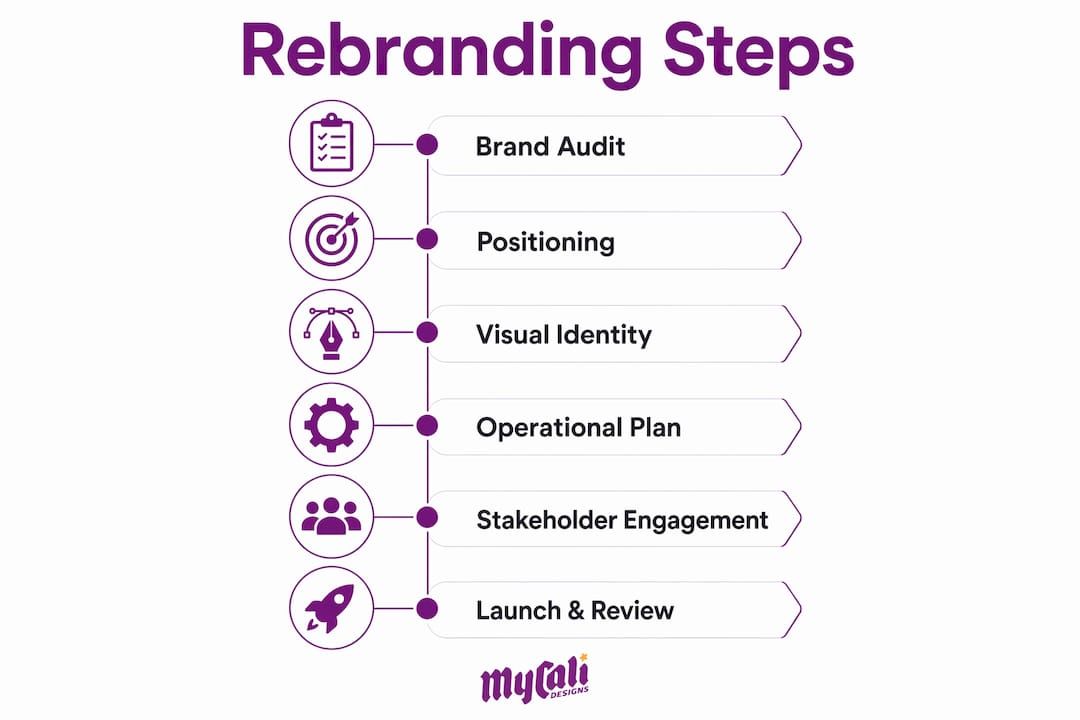
The first step in any rebranding strategy for manufacturers is a brand audit. Before you redesign anything, you need a clear picture of what you currently own. That means cataloging every brand asset: your logo files, packaging templates, signage specs, digital profiles, and legal trademarks. A thorough audit prevents the common mistake of discovering outdated assets mid-rollout.
Once the audit is complete, leadership must define a single, clear brand positioning claim. Effective positioning includes one primary claim and 4–5 operational facts that support it. This is not a marketing exercise. It requires your CEO or leadership team to make a definitive choice about what your company stands for and what it can prove.
The next priority is building a message architecture. A clear messaging structure articulates your primary claim and supporting proof points consistently across every channel. Think of it as a script your entire organization can follow, from sales calls to trade show booths.
- Complete a brand asset audit covering logos, packaging, signage, digital profiles, and legal filings.
- Define one positioning claim with 4–5 verifiable proof points, approved by leadership.
- Build a message architecture that connects your claim to customer needs.
- Test messaging in low-risk channels before the full rollout begins.
- Assign a Single Point of Contact (SPOC) to own the rebrand timeline and decisions.
Pro Tip: Test your new brand messaging in outbound email sequences or RFP responses before committing to a full launch. Real-world testing in low-stakes environments validates clarity without risking customer confusion.
A strong manufacturing brand strategy starts with positioning, not design. Get the words right before you touch the visuals.
How do you develop and update visual and verbal identity?
Visual brand identity combines your logo, color palette, typography, and verbal elements. Consistent application across all touchpoints builds recognition and emotional connection with your audience. For manufacturers, "all touchpoints" includes everything from your website header to the label on a shipping pallet.

Logo and visual system
Your logo must work at every scale. It needs to read clearly on a 2-inch product label and on a 20-foot warehouse banner. Design for the smallest application first, then scale up. Choose a color palette that holds up in print, on screen, and in industrial environments where colors can fade or shift under harsh lighting.
Typography follows the same logic. Pick two typefaces maximum: one for headlines and one for body text. More than two creates visual noise that weakens brand recognition over time.
Verbal identity and brand guidelines
Verbal identity covers your brand voice, tagline, and the tone your team uses in every written communication. Define it clearly. Is your brand direct and technical? Warm and collaborative? Pick one and document it.
A comprehensive brand guide is the single most important document your rebrand produces. It tells every employee, vendor, and agency partner exactly how to represent your brand. Without it, consistency falls apart within months.
- ✅ Logo files in all required formats (SVG, PNG, EPS, PDF)
- ✅ Primary and secondary color codes (HEX, CMYK, Pantone)
- ✅ Typography specs with licensed font files
- ✅ Brand voice description with do/don't examples
- ✅ Approved taglines and messaging hierarchy
- ✅ Usage rules for co-branding and partner materials
Pro Tip: Follow the visual identity process built specifically for manufacturers. It accounts for industrial print specs and digital applications that generic brand guides often miss.
What operational considerations must manufacturers address during rebranding?
A rebrand in manufacturing is more than a visual update. It impacts regulatory compliance, production schedules, and legal assets across your entire portfolio. This is where most manufacturer rebrands stall or go over budget.
Start with a portfolio-wide inventory audit. Capture every asset by type, location, regulatory status, production cycle, and legal entity. This audit shapes your budget, timeline, and program structure. Companies that skip it discover expensive surprises six months into the rollout.
Regulatory and compliance planning
Packaging regulatory filing costs can reach $10,000 per filing per country in life sciences sectors. Filing timelines vary significantly across bodies like the FDA, EMA, and Health Canada. Budget for this early and build filing deadlines into your master project schedule.
| Consideration | Key Action | Risk if Skipped |
|---|---|---|
| Regulatory filings | File with FDA, EMA, or Health Canada early | Delays of 6–18 months |
| Inventory audit | Capture all assets by location and cycle | Budget overruns |
| Production alignment | Tie rollout to scheduled maintenance windows | Costly downtime |
| Inventory strategy | Use deplete-and-replace, not scrap | Millions in waste |
| Legal entities | Update trademarks and contracts | Compliance gaps |
Phased rollout and inventory strategy
A phased rollout strategy distributes changes like factory signage and vehicle branding over several years, tied to scheduled maintenance. This approach cuts cost and complexity dramatically compared to a big-bang launch. The deplete-and-replace inventory method is the preferred approach at scale. Scrapping existing materials can cost millions across a large manufacturing portfolio.
- Audit your full asset inventory before setting any timeline or budget.
- File regulatory paperwork as early as possible in the process.
- Align new packaging rollout with production cycle changeovers.
- Implement deplete-and-replace for existing labeled inventory.
- Build a program management layer that sits above individual workstreams.
How do you engage stakeholders for a successful rebrand?
Internal communication is the most underestimated part of the rebranding process. A company-wide announcement and a clearly assigned rebranding point person prevent approval bottlenecks and keep momentum through every rollout phase. When employees do not understand the rebrand, they send mixed messages to customers and partners.
Assign clear roles before the rollout begins. Your SPOC owns the timeline. Department heads own their asset categories. Vendors and agency partners receive a briefing document and updated brand guidelines before any new materials go into production.
Knowing your readiness for a rebrand before you start stakeholder communication saves significant time. If leadership has not aligned on positioning, no amount of employee training will fix the confusion downstream.
- ✅ Hold a company-wide kickoff meeting to explain the rebrand rationale
- ✅ Distribute the new brand guide to all departments and key vendors
- ✅ Update your website, email signatures, and social profiles on launch day
- ✅ Brief distributors and retail partners with a transition timeline
- ✅ Identify internal brand champions who reinforce messaging in their teams
- ✅ Set a review checkpoint at 30, 60, and 90 days post-launch
External stakeholders need a clear transition timeline. Customers and distributors should receive advance notice of packaging changes, especially in regulated industries where label changes affect product identification. Pair your marketing automation checklist with your rebrand communication plan to keep outreach consistent and on schedule.
What are common pitfalls in the manufacturer rebranding process?
The biggest mistake manufacturers make is treating a rebrand as a marketing project. Leadership must direct the positioning decision. When marketing owns the claim without executive buy-in, the positioning shifts with every campaign and never sticks.
Rushed rollouts create a second major problem. A big-bang launch that changes all assets simultaneously creates operational chaos and leaves no room for corrections. Phased rollouts give you time to catch errors before they multiply across thousands of SKUs.
- ✅ Avoid launching before regulatory filings are approved
- ✅ Do not skip the asset inventory audit to save time upfront
- ✅ Never let positioning be defined by marketing jargon alone
- ✅ Do not assume vendors will update their materials without explicit instruction
- ✅ Measure brand consistency at every touchpoint after launch, not just at launch
Inconsistent implementation is the silent killer of manufacturer rebrands. One division uses the old logo. A distributor prints the old tagline on a trade show banner. A product label ships with the previous color code. Each inconsistency erodes the credibility the rebrand was meant to build.
Pro Tip: Build a post-launch brand audit into your 90-day plan. Assign someone to review every customer-facing touchpoint and flag inconsistencies before they become the new normal.
Key Takeaways
A successful manufacturer rebrand requires leadership-driven positioning, a full asset inventory audit, and a phased rollout tied to production cycles.
| Point | Details |
|---|---|
| Start with a brand audit | Catalog every asset by type, location, and regulatory status before setting scope or budget. |
| Leadership owns positioning | One clear, verifiable brand claim must come from the top, not from a marketing brief. |
| Plan for regulatory costs | Filing costs can reach $10,000 per country; build this into your timeline and budget early. |
| Use phased rollout | Tie asset changes to scheduled maintenance windows to cut cost and avoid operational disruption. |
| Document everything | A comprehensive brand guide is the single deliverable that protects consistency after launch. |
What I have learned from managing manufacturer rebrands
The manufacturers who execute rebrands well share one trait: their leadership made a hard decision early. They chose one positioning claim and refused to dilute it with committee input. Too many cooks in the kitchen is not just a project management problem. In a rebrand, it produces positioning that says everything and means nothing.
The asset inventory audit is the step most teams want to skip because it feels administrative. Every time a team skips it, they pay for it later with budget overruns and missed regulatory deadlines. I have seen companies discover thousands of labeled SKUs they had no plan for, weeks before a planned launch date.
Testing messaging before the full rollout is the move that separates confident rebrands from chaotic ones. A few targeted email campaigns or RFP responses will tell you more about whether your new positioning lands than any internal focus group. Real customers respond to real messages, and their reactions are data you cannot fake.
Finally, the rebrand does not end on launch day. The 90-day post-launch period is where consistency either holds or falls apart. Assign someone to own that window. Check every touchpoint. Fix what is broken before it becomes the default.
— Cesar
How Mycalidesigns supports your manufacturer rebranding strategy
Executing a manufacturer rebrand requires more than a new logo file. It requires a design partner who understands production constraints, brand consistency across industrial touchpoints, and the operational reality of phased rollouts.
Mycalidesigns works with manufacturers and business owners to build logo and branding systems that hold up across every application, from packaging labels to digital profiles. Our team brings brand strategy consultation, visual identity development, and print-ready design together in one place. We understand that your rebrand has to work in the real world, not just on a mood board. If you are ready to build a brand that supports your growth, our full branding and design services are built for exactly that.
FAQ
What is a manufacturer rebranding checklist?
A manufacturer rebranding checklist is a structured list of tasks covering brand audit, positioning, visual identity, regulatory compliance, and rollout planning. It keeps complex rebrands on track and prevents costly oversights.
How long does a manufacturer rebrand take?
Timelines vary by portfolio size and regulatory requirements, but most manufacturer rebrands span 12–36 months. Regulatory filings alone can add 6–18 months in life sciences sectors.
Why does leadership need to own brand positioning?
Positioning requires one clear, verifiable claim that the entire organization can support. When marketing defines positioning without executive alignment, the message shifts with every campaign and never builds lasting recognition.
What is a deplete-and-replace inventory strategy?
Deplete-and-replace means using existing labeled inventory until it runs out, then introducing new branded materials at the next production run. This avoids scrapping materials, which can cost millions at scale.
When should manufacturers test new brand messaging?
Test new messaging in low-risk channels such as outbound email sequences or RFP responses before the full launch. This validates whether your positioning resonates with real customers before you commit to a full rollout.
Recommended
Recent Posts