




What Is Service Marketing? A Guide for Business Owners
What Is Service Marketing? A Guide for Business Owners

TL;DR:
- Service marketing involves building trust and demonstrating value for intangible offerings. It requires emphasizing proof, outcomes, and the full customer experience to close the trust gap. Applying the 7P framework and maintaining patience with SEO help long-term success.
Service marketing is defined as the strategic promotion and delivery of intangible services by building trust, communicating value, and nurturing customer relationships over time. Unlike product marketing, you cannot hand a customer a sample of your consulting, design work, or legal advice before they commit. That gap between promise and proof is the central challenge every service business faces. Understanding service marketing means understanding how to close that gap with the right framework, the right messages, and the right proof at every stage of the buyer's journey.
What is service marketing and how does it differ from product marketing?
Service marketing is the practice of promoting offerings that buyers cannot see, touch, or test before purchase. This creates what marketing professionals call the "trust gap." Buyers cannot store, test, or inspect services before committing, which makes the purchase decision feel riskier than buying a physical product.
Four characteristics separate services from products and shape every marketing decision you make:
- Intangibility. Services have no physical form. A law firm sells advice, not a box.
- Inseparability. The service is produced and consumed at the same time. A haircut happens while the stylist works.
- Perishability. An unsold hour of consulting cannot be stored and sold tomorrow.
- Heterogeneity. Every service delivery varies slightly because people, not machines, deliver it.
These four traits explain why product marketing tactics often fall flat for service businesses. Listing features works when a buyer can hold the product. For services, buyers need to see outcomes and hear from people who have already taken the risk. Social proof, case studies, and testimonials carry far more weight than a feature list. Decision cycles are also longer because buyers often need to justify the purchase to a committee, not just themselves.
Pro Tip: When writing service marketing copy, replace every feature claim with an outcome statement. "We offer weekly check-ins" becomes "Clients reduce project delays by keeping every stakeholder aligned."

What are the 7Ps of the service marketing mix?
The traditional marketing mix covers four elements: Product, Price, Place, and Promotion. Those four work well for physical goods. For services, the 7P model is the standard framework, extending the original four to include People, Process, and Physical Evidence.
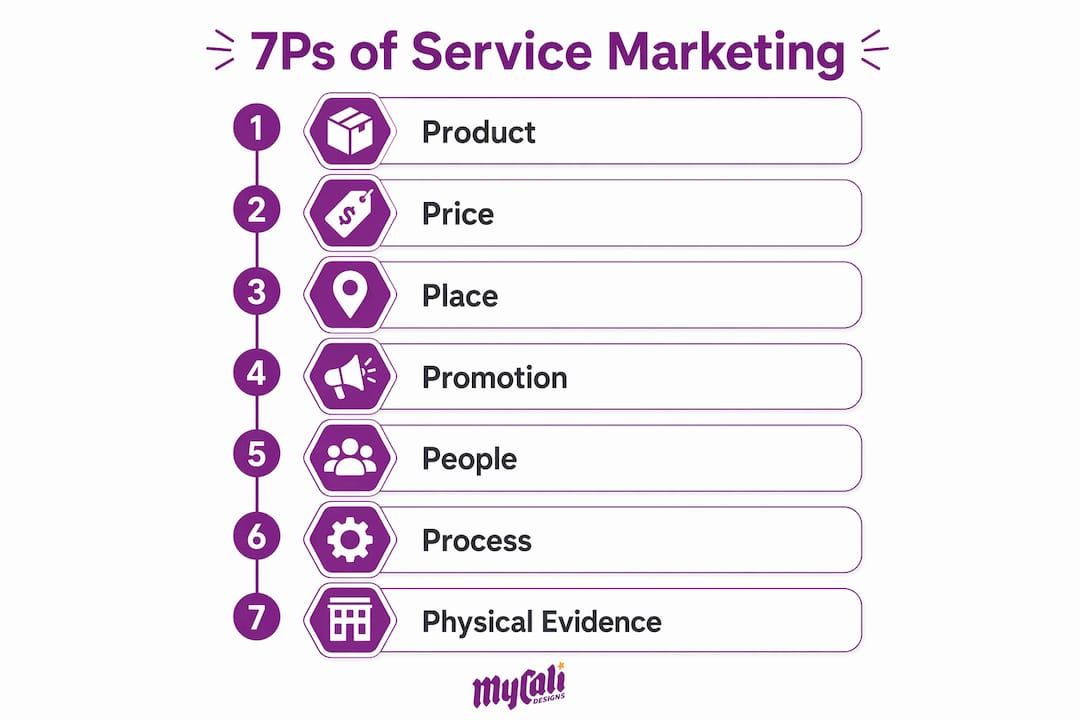
| Element | What it covers | Service example |
|---|---|---|
| Product | The service itself and its core value | Brand identity design package |
| Price | Pricing model and perceived value | Project-based or retainer pricing |
| Place | Where and how the service is delivered | Remote, in-person, or hybrid delivery |
| Promotion | Channels and messages used to attract buyers | SEO, social media, email campaigns |
| People | The team delivering the service | Designers, account managers, consultants |
| Process | The steps and systems behind delivery | Onboarding workflow, revision process |
| Physical Evidence | Tangible cues that signal quality | Portfolio, office space, branded materials |
The three added elements address the core problem of intangibility directly. People, Physical Evidence, and Process determine service success and longevity because they give buyers something concrete to evaluate before and during delivery. A polished portfolio, a clear onboarding process, and a knowledgeable team all reduce perceived risk.
Physical Evidence deserves special attention. It includes every tangible cue a buyer encounters, from your website design to the quality of a proposal document. These cues signal whether your service will meet expectations. A poorly designed website tells a prospective client that your attention to detail may be equally poor.
Pro Tip: Audit your Physical Evidence before launching any campaign. Walk through your website, proposal template, and email signature as if you are a first-time buyer. Every weak visual or unclear message costs you trust.
How do effective service marketing strategies build trust?
Trust is the currency of service marketing. Marketing must support long sales cycles and help buyers justify decisions internally through proof and outcomes, not just generate leads at the top of the funnel.
The most effective service marketing strategies share three priorities:
- Lead with the problem, not the service. Top service brands focus on the problems they solve and provide content that helps risk-averse buyers make the case internally. A blog post titled "Why Your Brand Looks Unprofessional and What to Do About It" attracts a buyer far more effectively than "We Offer Logo Design."
- Replace generic claims with specific proof. Generic value propositions fail in service marketing. "We help you grow" means nothing. A case study showing a client's website traffic doubled in six months means everything.
- Balance automation with authentic human engagement. The founder's personal brand often remains the primary trust mechanism in high-expertise services. Automated email sequences nurture leads efficiently, but a personal video message or a direct reply from the founder closes deals that automation cannot.
Supporting tactics that reinforce trust include:
- Publishing client testimonials on every key landing page
- Creating before-and-after case studies with measurable results
- Using digital branding strategies that signal consistency and professionalism across every channel
- Building an email nurture sequence that educates buyers over weeks, not days
- Showing your process publicly so buyers know exactly what working with you looks like
Service marketing manages the full customer experience, from first contact to post-service follow-up. Every touchpoint shapes trust and satisfaction. That means your invoice, your follow-up email, and your offboarding process are all part of your marketing.
Pro Tip: Build a "proof library" before you run any paid campaign. Collect three to five client results with specific numbers, three testimonials with full names and company titles, and one detailed case study. Campaigns built on proof convert at a higher rate than campaigns built on claims.
What common pitfalls should service marketers avoid?
Most service marketing failures trace back to a small set of repeatable mistakes. Recognizing them early saves significant time and budget.
- Generic messaging. "We deliver results" and "We are passionate about your success" are invisible. Buyers read dozens of these claims daily and remember none of them. Specific proof, named clients, and real numbers cut through.
- Expecting fast SEO results. SEO results for service businesses compound after about four months. Businesses that quit after 60 days never see the return. Patience is not optional; it is part of the strategy.
- Ignoring the founder's brand. In professional services, people buy people before they buy companies. A founder who never appears in content, never shares opinions, and never shows their face online leaves a trust vacuum that no amount of advertising can fill.
- Stopping at lead generation. Service marketing metrics differ from product marketing and require ongoing support for sales during long decision cycles. Marketing's job does not end when a lead fills out a form.
- Skipping feedback loops. Client feedback after each project reveals what your marketing should say next. Ignoring it means your messaging stays generic while your competitors get more specific.
Measuring success in service marketing requires metrics that match longer decision cycles. Track lead quality, not just lead volume. Monitor engagement rates on nurture emails. Measure proposal-to-close ratios. These numbers tell you whether your trust-building is working far better than raw traffic figures.
How can businesses apply service marketing principles today?
Applying service marketing principles does not require a complete overhaul. It requires a clear system where positioning, content, brand, and proof work together.
- Define your outcome clearly. State the specific result a client achieves by working with you. Not "better branding" but "a brand identity that makes enterprise clients take you seriously in the first meeting."
- Map your 7Ps. Use the 7P framework as a planning tool to identify gaps. If your Process is unclear to buyers, document and publish it. If your Physical Evidence is weak, invest in design before you invest in ads.
- Build your proof library first. Campaigns built on specific client results outperform campaigns built on claims every time.
- Invest in service business branding that signals trust. Your logo, website, and visual identity are Physical Evidence. They either build confidence or undermine it.
- Commit to SEO for the long term. Publish consistently, target the questions your buyers ask, and expect results after four months of steady effort, not four weeks.
- Personalize your outreach. Segment your audience by industry or problem type and tailor your messages. A one-size-fits-all email campaign treats every buyer the same. Buyers notice.
Authenticity in branding builds trust and drives growth over time. Service businesses that show their real process, real team, and real results consistently outperform those that hide behind polished but vague marketing language.
Key Takeaways
Service marketing succeeds when you replace generic claims with specific proof, apply the 7P framework to every buyer touchpoint, and commit to trust-building as a long-term process rather than a one-time campaign.
| Point | Details |
|---|---|
| Trust gap is the core challenge | Buyers cannot test services before purchase, so proof and social proof must do the selling. |
| The 7P model is the standard | People, Process, and Physical Evidence extend the 4Ps to address service-specific challenges. |
| Specific proof beats generic claims | Replace "we help you grow" with named client results and measurable outcomes. |
| SEO requires patience | Service business SEO compounds after roughly four months; early quitters miss the return. |
| Marketing supports the full cycle | Service marketing does not stop at lead generation. It must nurture buyers through long decision cycles. |
Why service marketing clicked for me once I stopped thinking like a product marketer
The biggest shift I made was stopping the habit of describing what I do and starting to describe what changes for the client. Service marketing felt complicated until I realized it is actually simpler than product marketing in one key way. There is no inventory, no shipping, no product defect. The only thing you are selling is confidence that you can deliver an outcome.
The 7P framework changed how I look at every client engagement. I stopped treating People, Process, and Physical Evidence as operational details and started treating them as marketing assets. A well-documented process is not just good project management. It is a trust signal that tells a nervous buyer exactly what to expect.
The hardest lesson was patience with SEO. The temptation to abandon content after two months of flat traffic is real. The businesses I have seen succeed online are the ones that kept publishing, kept refining their proof, and kept showing up. The compounding effect is real, but it requires surviving the period before it kicks in.
My honest advice: audit your Physical Evidence before you spend a dollar on advertising. If your website looks like it was built in a hurry, your ads will send buyers to a page that destroys the trust your ad just built. Fix the foundation first.
— Cesar
How Mycalidesigns supports your service marketing goals
Mycalidesigns works with service businesses that need their brand to do real work, not just look good. A professional logo and a well-built website are Physical Evidence. They tell every prospective client whether you are worth trusting before a single conversation happens.
We offer logo design and business branding that gives your service business a visual identity built for trust. Our website and SEO services support the long-term lead generation strategy your service business needs. Whether you are starting from scratch or rebuilding a brand that no longer reflects your expertise, we build the foundation that makes your marketing work.
FAQ
What is the service marketing definition?
Service marketing is the promotion and delivery of intangible offerings by building trust, communicating value, and managing the full customer experience from first contact through post-service follow-up.
Why does service marketing require a different approach?
Services are intangible, inseparable from their delivery, perishable, and variable in quality. These characteristics create a trust gap that product marketing tactics like feature lists and free samples cannot close.
What are the 7Ps of service marketing?
The 7Ps are Product, Price, Place, Promotion, People, Process, and Physical Evidence. The last three extend the traditional 4P model to address the unique challenges of marketing services.
How long does SEO take for a service business?
SEO results for service businesses typically compound after about four months of consistent effort. Businesses that maintain steady publishing and optimization through the early months see sustainable lead flow later.
What is the most common service marketing mistake?
The most common mistake is using generic value propositions like "we deliver results" instead of specific client outcomes and case studies. Proof-based messaging consistently outperforms claim-based messaging in service marketing.
Recommended
Recent Posts