




Explaining Creative Direction for Marketers and Owners
Explaining Creative Direction for Marketers and Owners

TL;DR:
- Creative direction translates brand strategy into specific aesthetic and tonal decisions.
- It provides a unified framework to ensure consistent branding across projects and teams.
Creative direction is defined as the structured process of translating brand strategy into specific, repeatable aesthetic and tonal decisions that guide every creative output. It sits between the "why" of brand strategy and the "what" of individual deliverables. Without it, campaigns drift, teams second-guess each other, and your brand looks different every quarter. Explaining creative direction clearly is the first step toward fixing that. The four-axis framework is the 2026 standard for operationalizing creative direction, and it gives marketing professionals and business owners a concrete tool to align teams under one unified brand vision.
What are the core concepts behind creative direction?
Creative direction is not a mood board. It is a structured framework that defines how your brand thinks, sounds, and feels across every project. The four-axis framework organizes creative direction into four measurable dimensions that any team member can reference and apply.

| Axis | What It Defines | Example Positions |
|---|---|---|
| Tone register | How formal or casual the brand voice is | Corporate and precise vs. warm and conversational |
| Aesthetic philosophy | The visual language and design sensibility | Minimalist and geometric vs. expressive and layered |
| Audience relationship | How the brand positions itself relative to the reader | Peer-to-peer vs. expert-to-student |
| Sensory ambition | The emotional intensity and richness of the creative output | Understated and calm vs. bold and immersive |
Each axis forces a deliberate choice. That specificity is what separates creative direction from a vague brand guideline that says "be modern and approachable." A brand guideline tells you what to value. Creative direction tells you exactly how to express it on a given project.
The four axes also work together. A brand with a peer-to-peer audience relationship and a warm tone register will produce very different copy and visuals than one with an expert-to-student relationship and a formal register. When all four axes align, the output feels coherent. When they conflict, the work feels off, even if no one can explain why.
Pro Tip: Map your brand's position on each axis before briefing any creative team. Even a one-sentence description per axis cuts revision cycles significantly.
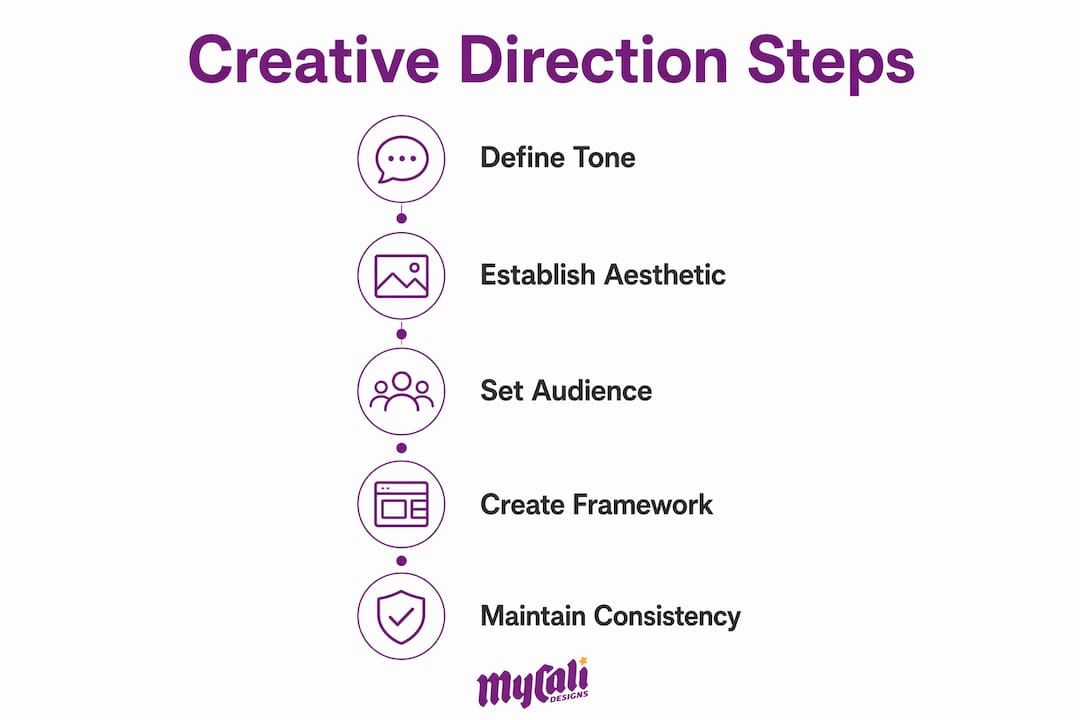
A single creative direction artifact guides tone, visual style, audience approach, and emotional engagement for consistent output across platforms. Think of it as a living document your team consults before making any creative decision, not a policy manual they read once and forget.
How does creative direction differ from brand strategy and creative briefs?
These three concepts are related but they serve different functions. Confusing them is one of the most common reasons creative projects stall or produce inconsistent results.
Brand strategy is the foundation. It defines your positioning, your core values, and the promise you make to your audience. It answers the question "Who are we and why do we matter?" Brand strategy changes rarely. It is the bedrock everything else sits on.
Creative briefs are operational documents. They define the scope, deliverables, timeline, and budget for a specific project. A creative brief answers "What are we making, for whom, and by when?" It is a kickoff document, not a creative guide.
Creative direction lives between the two. Creative direction translates brand strategy into project-specific aesthetic decisions. It answers "How should this particular piece look, feel, and sound given our brand values and this project's goals?" It is dynamic and project-specific, not static like a brand guideline.
Here is a practical way to see the difference:
- Brand strategy says: "We are a trustworthy, community-focused financial services company."
- The creative brief says: "We need a social media campaign for our new savings account, launching in six weeks, with a budget of $8,000."
- Creative direction says: "This campaign uses warm photography of real families, conversational copy in the second person, and avoids stock imagery, financial jargon, and dark color palettes."
Notice that last point. A formal rejection list is one of the most underused tools in creative direction. It explicitly states what is not allowed, which gives designers and writers the freedom to make autonomous decisions without constant approval loops. Rejection lists are more useful than positive directives because they remove ambiguity at the edges of creative judgment.
Understanding design strategies for brand growth helps you see how creative direction fits into a larger system of brand decisions that compound over time.
What are practical steps for implementing creative direction?
Putting creative direction into practice requires a structured approach. The good news is that the four-axis framework gives you a repeatable process you can apply to any project.
-
Name the project and define the objective. Write one sentence that describes what success looks like. Vague objectives produce vague creative work. A structured brief starts with clarity on purpose before any aesthetic decisions are made.
-
Define your audience relationship for this project. Knowing your audience is not enough. You need to know how your brand relates to them in this specific context. Are you a peer sharing a discovery, or an expert offering guidance? This shapes every word and image choice. Reviewing audience identification methods helps you set this axis with precision.
-
Set your four-axis positions. Write one to two sentences for each axis. Be specific. "Warm" is not specific. "Conversational, first-name-basis tone that avoids corporate acronyms" is specific.
-
Build your rejection list. List at least five things this project must not do, show, or say. Include visual elements, copy styles, and emotional tones that are off-brand for this context. This is the step most teams skip, and it is the step that prevents the most expensive revisions.
-
Distribute and reference the brief consistently. Every person touching the project, from copywriters to photographers to social media managers, should consult the same document before making decisions. The role of design in marketing shows why consistent reference points matter across every channel.
Pro Tip: Review your creative direction brief at the halfway point of any project. Teams drift. A mid-project check against the four axes catches misalignment before it becomes expensive to fix.
One context that makes this urgency concrete: creative director tenures in fashion and design averaged less than 12 months as of 2026. That rapid turnover means brand teams cannot rely on institutional memory. A documented creative direction framework preserves the vision even when leadership changes.
How does creative direction impact brand coherence and marketing effectiveness?
Strong creative direction produces measurable results in brand recognition and audience trust. The mechanism is simple. Consistent, aligned messaging across every touchpoint trains your audience to recognize and trust your brand faster.
"Brands with strong creative direction achieve better audience engagement and clearer positioning in competitive markets. Creative direction improves brand recognition and emotional connection by maintaining consistent, aligned messaging and aesthetics." Source: Liquid Agency
That quote captures the core business case. Brand drift, the gradual inconsistency that happens when different teams interpret brand guidelines differently, is one of the most common and costly problems in marketing. A single creative direction artifact reduces brand drift by giving every team member a shared reference point.
Creative direction also builds emotional resonance. When your tone, visuals, and audience relationship are consistent, your brand starts to feel familiar. Familiarity builds trust. Trust drives purchase decisions. This is not a soft benefit. It is the mechanism behind brand equity.
The content marketing process for agencies shows how creative direction integrates with broader content workflows to keep messaging aligned across campaigns, channels, and collaborators.
Finally, creative direction separates the big-picture vision from specific visual executions. Creative direction manages the overall vision, while art direction handles individual visual decisions within that vision. Keeping those roles distinct prevents the "design by committee" problem where every stakeholder pulls the work in a different direction.
Key Takeaways
Strong creative direction is the single most effective tool for maintaining brand coherence, reducing revision cycles, and building audience trust across every marketing touchpoint.
| Point | Details |
|---|---|
| Use the four-axis framework | Define tone, aesthetic, audience relationship, and sensory ambition for every project. |
| Build a rejection list | Explicitly state what is not allowed to give creatives autonomous decision-making power. |
| Separate creative direction from brand strategy | Brand strategy sets values; creative direction translates them into project-specific choices. |
| Document everything in one artifact | A single living brief reduces brand drift and keeps all team members aligned. |
| Act fast given leadership turnover | With creative director tenures averaging under 12 months, documented frameworks preserve brand vision. |
Why I think most brands underestimate creative direction
After working with businesses across industries, I have noticed a consistent pattern. Most organizations invest in brand strategy and then skip directly to execution. They produce a brand guideline document, hand it to a designer, and expect coherent output. It rarely works that way.
The missing layer is always creative direction. Brand guidelines tell you what your brand values. Creative direction tells you how to express those values when you are building a specific campaign, launching a product, or redesigning a website. Without that translation layer, every project becomes a negotiation between stakeholders with different interpretations of the same guidelines.
The four-axis framework changed how I think about this problem. It gives teams a shared vocabulary. When a client says "this feels off," we can now ask: "Which axis is misaligned?" That question turns a subjective feeling into a solvable problem.
The rejection list is the piece I push hardest in every engagement. Telling a creative team what not to do is more powerful than telling them what to do. It removes the fear of making a wrong choice and replaces it with confidence. That confidence shows up in the work.
The future of creative direction is faster and more documented. As teams grow, as leadership turns over, and as brands produce more content across more channels, the brands that win will be the ones with clear, written creative direction that any team member can pick up and apply on day one.
— Cesar
How Mycalidesigns helps you define and execute creative direction
Mycalidesigns works with businesses that need more than a logo. We build the full creative direction framework that keeps your brand consistent across every campaign, channel, and team member. From brand identity development to digital marketing execution, we translate your brand strategy into specific, repeatable creative decisions your team can actually use.
If your brand looks different every quarter, or if your creative team spends more time in revision than in production, creative direction is the fix. Mycalidesigns has helped businesses of all sizes build the frameworks that make consistent, professional creative output the norm rather than the exception. Reach out to start the conversation.
FAQ
What is creative direction in simple terms?
Creative direction is the process of translating brand strategy into specific visual, tonal, and emotional decisions that guide every creative project. It sits between brand strategy and individual deliverables.
How does creative direction differ from art direction?
Creative direction manages the overall vision and strategy, while art direction focuses on specific visual executions within a single project or campaign. They are complementary but distinct roles.
What is the four-axis framework for creative direction?
The four-axis framework organizes creative direction around tone register, aesthetic philosophy, audience relationship, and sensory ambition. Each axis defines a specific dimension of how a brand expresses itself.
Why is a rejection list important in a creative brief?
A rejection list explicitly states what a project must not include, giving creative teams the freedom to make autonomous decisions without constant approval. It prevents misalignment more effectively than positive directives alone.
How often should creative direction be updated?
Creative direction is a living document and should be reviewed at the start of each major project or campaign. It does not change as often as a creative brief, but it should evolve when brand strategy shifts or when entering a new market or audience segment.
Recommended
Recent Posts