




Manufacturing Marketing Terms Explained for Industry Pros
Manufacturing Marketing Terms Explained for Industry Pros

TL;DR:
- Manufacturing marketing terms include technical acronyms that help bridge production concepts and marketing communication. Mastery of these terms enables marketers to craft accurate, credible messaging that resonates with technical buyers. Using industry-specific language builds trust and improves campaign effectiveness across all channels.
Manufacturing marketing terms are defined as the specialized vocabulary, acronyms, and metrics that translate production and engineering concepts into language marketers can use to build campaigns, justify budgets, and engage buyers. Mastering this vocabulary is not optional for marketing professionals in the manufacturing sector. Terms like OEE (Overall Equipment Effectiveness), TCO (Total Cost of Ownership), and ROI appear in every serious conversation between marketing, engineering, procurement, and sales. Without fluency in this language, your messaging misses the mark with technical buyers and loses credibility with internal stakeholders. Getting manufacturing marketing terms explained clearly is the first step toward building campaigns that actually convert.
What are the key manufacturing marketing terms every marketer should know?
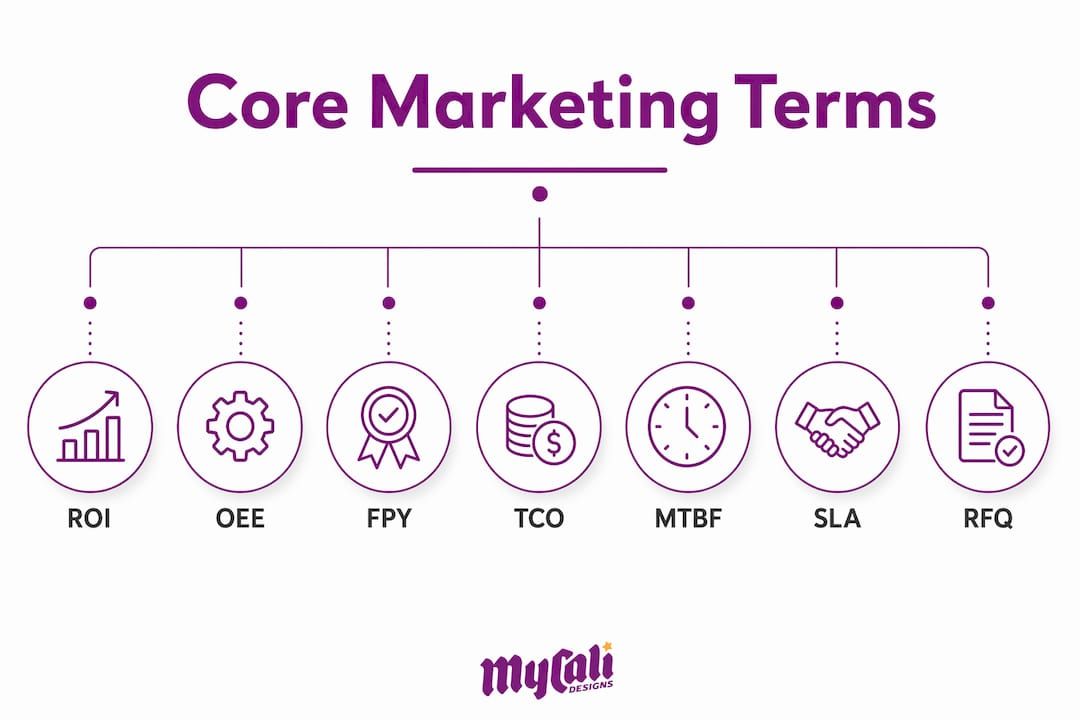
The most critical manufacturing marketing terms fall into three categories: financial metrics, quality metrics, and sales process terms. Each category serves a distinct purpose in your marketing work.

ROI, TCO, OEE, FPY, and MTBF are the core acronyms that marketing teams must understand to align with engineering and procurement. These terms appear in every RFQ response, product spec sheet, and executive presentation. Knowing them lets you write content that speaks directly to what buyers care about.
| Term | Definition | Marketing relevance |
|---|---|---|
| ROI (Return on Investment) | Net gain divided by cost of investment | Justifies campaign spend and product value propositions |
| TCO (Total Cost of Ownership) | Full cost of a product over its lifecycle | Positions your product against cheaper alternatives |
| OEE (Overall Equipment Effectiveness) | Measures availability, performance, and quality | Informs product positioning for efficiency-focused buyers |
| FPY (First Pass Yield) | Percentage of units produced correctly the first time | Supports quality claims in content and case studies |
| MTBF (Mean Time Between Failures) | Average time between equipment failures | Builds reliability messaging for maintenance-focused buyers |
| SLA (Service Level Agreement) | Contractual service performance standards | Shapes offer design and nurture sequences |
| RFQ (Request for Quotation) | Formal buyer request for pricing and specs | Signals high purchase intent for sales handoff |
| Installed Base Marketing | Campaigns targeting existing asset owners | Drives upsell, parts, and service campaigns |
Understanding OEE, for example, lets you write a product page that speaks to a plant manager's actual KPIs rather than generic "efficiency" claims. That specificity wins attention from technical buyers who filter out vague marketing language immediately.
Pro Tip: Build a one-page glossary of these terms and share it with your entire marketing team. When everyone uses the same vocabulary, your messaging stays consistent across every channel and touchpoint.
How does manufacturing marketing terminology differ from typical B2B marketing language?
Manufacturing marketing language operates at a different level of technical rigor than standard B2B marketing. Buyers evaluate products based on physical capabilities, safety certifications, and total cost of ownership. Software buyers rarely need to understand failure rates or yield percentages. Manufacturing buyers do, and they expect your marketing to reflect that.
The buying committee in manufacturing typically includes engineers, procurement officers, finance leads, and operations managers. Each role reads your content through a different lens. A procurement officer cares about TCO and SLA terms. A plant engineer cares about OEE and MTBF. Writing content that speaks to all of them requires fluency in manufacturing industry jargon that general B2B marketers simply do not develop.
Here is how manufacturing marketing differs from general B2B marketing:
- Sales cycles are longer. Manufacturing purchases often involve months of evaluation, multiple approvals, and formal RFQ processes. Content must support every stage.
- Content must be technically accurate. A wrong specification or misused metric destroys credibility instantly with an engineering audience.
- Evidence carries more weight than emotion. Case studies with real OEE improvements or FPY data outperform brand storytelling alone.
- Multiple buyer personas require separate messaging. The same product needs different content for a CFO reviewing TCO and an engineer reviewing MTBF.
- Trade shows remain significant. Physical demonstrations and in-person technical discussions still drive relationships in manufacturing, unlike pure software markets.
- Regulatory and safety language matters. ISO standards, CE markings, and OSHA compliance appear in marketing materials as trust signals, not just legal requirements.
General B2B marketing often relies on emotional benefits, social proof, and speed of adoption. Manufacturing marketing relies on proof, precision, and patience. That distinction shapes every piece of content you create.
What practical roles do manufacturing marketing terms play in buyer engagement?
Manufacturing marketing terms do more than fill glossaries. They drive campaign structure, segmentation logic, and content strategy. Terms like RFQ and Installed Base Marketing enable marketers to design precise offers and campaigns that match where buyers are in their decision process.
Installed base marketing is the clearest example of terminology driving strategy. Warranty dates, service history, and asset data become the triggers for campaigns targeting preventive maintenance offers, parts replenishment, and equipment upgrades. Marketing owns the segmentation and campaign execution. Sales owns the account follow-up. Service owns the timing signals. When your team understands these terms, the handoffs between departments become clean and deliberate rather than accidental.
Understanding OEE and FPY also changes how you write product content. A white paper that explains how your equipment improves OEE from 65% to 82% is far more persuasive to a plant manager than a generic claim about "better performance." Marketers who grasp terms like OEE, throughput, and Takt time gain credibility with engineering and procurement teams that generic marketers never achieve.
SLA terms shape your offer design directly. When you understand what an SLA commits a manufacturer to, you can build nurture sequences around service renewal windows, response time guarantees, and uptime commitments. Those sequences convert because they address real operational concerns, not abstract benefits.
ROI analysis is another area where terminology mastery pays off. Manufacturing marketing requires ROI analyses, spec sheets, and real-world case studies to address the multiple buyer personas involved. When your team can build a credible ROI model using actual production metrics, your content earns a seat at the table during procurement discussions.
Pro Tip: When writing case studies, always quantify results using the same metrics your buyers track internally. Replace "improved efficiency" with "increased OEE by 14 percentage points." That specificity is what gets your content shared inside a buying committee.
How to incorporate manufacturing marketing terms into your strategy
The most common mistake manufacturing marketers make is treating their work as primarily event-driven. Shifting to digital revenue marketing requires integrating industry-standard terms into content, SEO, and analytics to measure true ROI. Trade shows still matter, but they cannot be your only channel.
Start by building internal fluency before you build external content. Schedule monthly sessions where engineers or product managers walk your marketing team through key metrics. Ask them to explain what OEE means on the shop floor, not just in a textbook. That context changes how you write about it.
Here are the best practices for using manufacturing terms effectively in your marketing:
- Learn before you publish. Verify every technical term with an internal subject matter expert before it appears in a customer-facing document.
- Match terms to buyer personas. Use TCO and ROI language for finance and procurement. Use OEE, FPY, and MTBF language for engineering and operations.
- Build a living glossary. Maintain a shared document that your marketing team updates as new terms emerge from product launches or industry standards.
- Use terms in SEO content. Technical buyers search for specific metrics and standards. Content built around terms like ISO 22400 and OEE attracts high-intent traffic from engineers and procurement teams.
- Avoid jargon overload. Use technical terms where they add precision. Replace them with plain language where they create confusion for non-technical readers.
- Align with the buying journey. Early-stage content can introduce terms with definitions. Late-stage content should use terms fluently, assuming the buyer already knows them.
Digital channels reward this approach directly. A manufacturing social media strategy built around technical terms like OEE or Kaizen attracts engineers on LinkedIn who are actively researching solutions. A technical blog post that correctly uses Poka-yoke or SMED signals to readers that your brand understands their world. That signal builds trust faster than any brand promise. For a broader view of how digital marketing in manufacturing creates measurable growth, the principles of terminology-driven content apply across every channel.
Content marketing examples from high-performing brands consistently show that specificity beats generality. Manufacturing marketers who publish content with real metrics and named standards outperform those who publish vague thought leadership.
Key Takeaways
Manufacturing marketing terms are the foundation of credible, effective communication with technical buyers, and mastering them directly improves campaign performance, internal alignment, and marketing ROI.
| Point | Details |
|---|---|
| Core terms drive strategy | ROI, TCO, OEE, FPY, MTBF, SLA, and RFQ each shape specific marketing decisions and content types. |
| Technical rigor separates manufacturing marketing | Buyers evaluate physical capabilities and total cost, requiring evidence-based content over emotional appeals. |
| Installed base marketing needs terminology | Warranty dates and asset data trigger campaigns only when marketing teams understand what those data points mean. |
| Persona-matched language converts better | Finance buyers respond to TCO and ROI; engineering buyers respond to OEE, FPY, and MTBF. |
| Digital channels reward technical specificity | SEO content built around ISO standards and production metrics attracts high-intent buyers at the research stage. |
Why terminology fluency is the real competitive edge in manufacturing marketing
Most manufacturing marketers I work with underestimate how much their vocabulary signals competence to buyers. Engineers and procurement officers make fast judgments about whether a vendor's marketing team actually understands the product. When your content uses OEE correctly, cites MTBF in a reliability claim, or builds an ROI model with real production data, it tells the buyer that your company knows what it is selling.
The marketers who struggle most are the ones who treat manufacturing as just another B2B vertical. They apply general demand generation tactics without learning the language of the shop floor. The result is content that sounds polished but feels hollow to a plant manager who has spent 20 years tracking yield rates and downtime.
What I have found works is treating terminology as a trust-building tool, not a compliance exercise. When you use Kaizen correctly in a blog post or explain Takt time in a LinkedIn article, you are not just demonstrating knowledge. You are showing the buyer that you respect their expertise. That respect is the foundation of every long-term client relationship in manufacturing.
The other pitfall I see regularly is using terms without understanding their operational context. Writing that OEE "measures efficiency" is technically correct but practically useless. Writing that OEE reveals whether a machine's downtime, speed loss, or defect rate is the primary drag on output. That is the kind of interpretation that earns a second read from an engineering team. Build your manufacturing brand strategy around that level of specificity, and your marketing will stand apart from every generic competitor in your space.
— Cesar
How Mycalidesigns supports manufacturing brands with clear, credible messaging
Technically accurate brand messaging is not a nice-to-have in manufacturing. It is the difference between a buyer who trusts your content and one who moves on to a competitor who speaks their language.
Mycalidesigns works with manufacturing businesses to build brand identities and digital presences that reflect the precision and credibility your buyers expect. From logo design and branding that positions your company as a serious industry player, to website and SEO services built around the technical terms your buyers actually search for, we connect your marketing language to your business goals. If your current brand does not reflect the expertise your team brings to the shop floor, we can help you close that gap.
FAQ
What are manufacturing marketing terms?
Manufacturing marketing terms are specialized acronyms, metrics, and industry phrases that translate production and engineering concepts into marketing language. Examples include OEE, TCO, FPY, MTBF, RFQ, and Installed Base Marketing.
Why do marketers need to understand manufacturing industry jargon?
Manufacturing buyers include engineers, procurement officers, and operations managers who evaluate content based on technical accuracy. Marketers who use correct industry terminology build credibility and influence buying decisions more effectively than those who rely on generic B2B language.
What is installed base marketing in manufacturing?
Installed base marketing is a campaign strategy that uses existing customer asset data, including warranty dates and service history, to target owners of specific equipment with relevant offers for maintenance, parts, or upgrades.
How does OEE relate to marketing strategy?
OEE measures a machine's availability, performance, and quality rate. Marketers use OEE data in case studies and product positioning to demonstrate measurable efficiency gains that resonate with plant managers and engineering buyers.
How should manufacturing marketers avoid jargon overload?
Use technical terms where they add precision for a specific buyer persona, and replace them with plain language for broader audiences. Match the depth of terminology to the buyer's role and stage in the purchase process.
Recommended
Recent Posts