



What Is UX Design? A Business Guide for 2026
What Is UX Design? A Business Guide for 2026

TL;DR:
- UX design shapes every interaction to be useful, usable, and satisfying, directly impacting business revenue. It encompasses research, journey mapping, and testing to build products that meet real user needs efficiently. Structured metrics and early research ensure better outcomes, higher retention, and stronger competitive advantages.
User experience (UX) design is the process of shaping every interaction a person has with a product or service so that it feels useful, usable, and satisfying. The industry term is "user experience design," coined by cognitive scientist Don Norman in the 1990s, and it covers far more than visual appearance. It includes research, information architecture, interaction design, and usability testing. The global UX market is valued at $5.5 billion in 2026, growing at a 14.5% CAGR through 2030. That growth reflects how seriously businesses now treat the quality of their users' experience as a driver of revenue, not just satisfaction.
What is UX design and why does it matter?
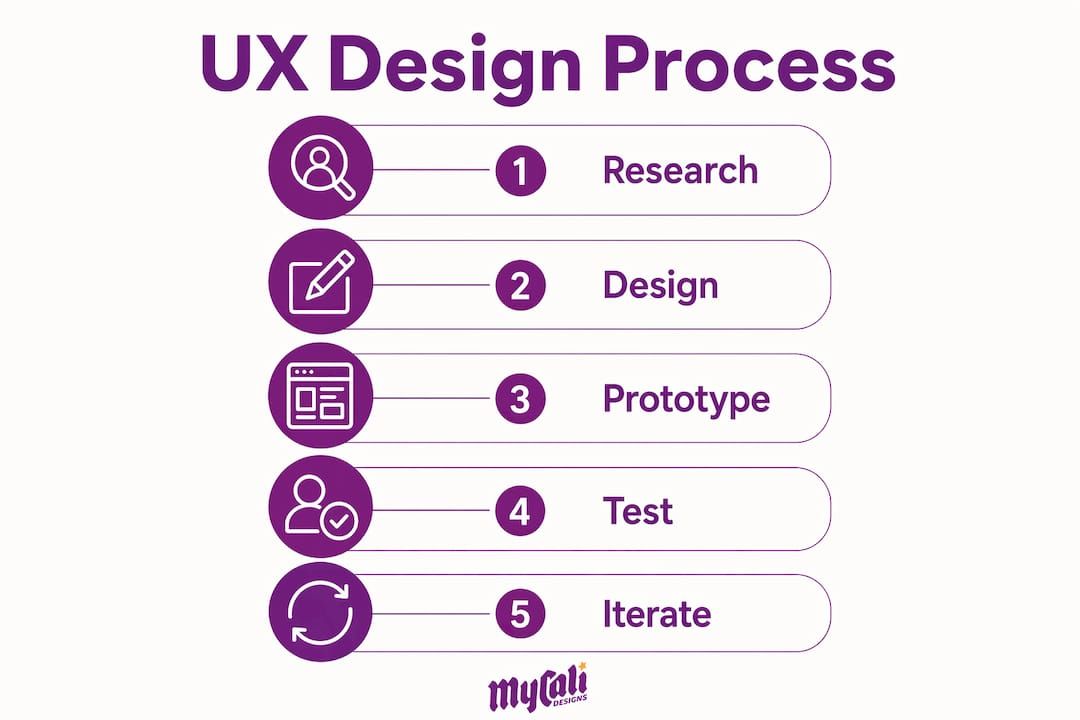
UX design is the discipline of understanding what users need and then building products that meet those needs with as little friction as possible. It draws from cognitive science, human-computer interaction, and behavioral psychology to make products feel intuitive. A UX designer does not just make things look good. They map the full path a user takes, from first contact to task completion, and remove every obstacle along the way.

The scope is broader than most teams expect. UX covers the entire user journey, including onboarding flows, error messages, and support documentation, not just interface visuals. That distinction matters because a product can look polished and still frustrate users at every turn. UX defines how a product works. UI defines how it looks. Both are necessary, but they are not the same thing.
The business case is direct. Every dollar invested in UX returns up to $100 in value by reducing support tickets, drop-offs, and refunds. That return comes from fixing problems before they reach customers, not after. For any team evaluating where to put design resources, UX is the highest-leverage starting point.
What are the core principles and components of UX design?
Three qualities define good user experience: usability, usefulness, and pleasure. A product is usable when people can complete tasks without confusion. It is useful when it solves a real problem. It is pleasurable when the interaction feels smooth and even enjoyable. All three must be present. A product that is useful but painful to use will lose customers to one that is easier, even if less capable.
The core components of UX design include:
- User research: Interviews, surveys, and behavioral observation that reveal what users actually need, not what teams assume they need.
- Information architecture: Organizing content and features so users can find what they want without thinking hard about where to look.
- Interaction design: Defining how users move through a product, including button behavior, navigation patterns, and feedback signals.
- Usability testing: Watching real users attempt real tasks to identify where they get stuck, confused, or frustrated.
- Accessibility: Designing for users with disabilities so the product works for the widest possible audience, including those using screen readers or keyboard navigation.
Frameworks like Google's HEART metrics and the System Usability Scale (SUS) give teams a structured way to measure UX quality. HEART stands for Happiness, Engagement, Adoption, Retention, and Task Success. SUS produces a single score from 0 to 100 that benchmarks usability against industry norms. Teams that use these structured metrics achieve better UX maturity and stronger business outcomes than those relying on gut feel alone.
Design Thinking is the most widely used process framework in UX. It offers a repeatable, cyclical approach that keeps teams focused on real user problems instead of assumed ones. Each cycle produces sharper insights and better solutions than the last.
Pro Tip: Start every design decision with a user research finding, not a stakeholder preference. When you can point to observed user behavior, you reduce friction in both the product and the approval process.
How does UX design differ from UI and product design?
The three disciplines overlap, but each has a distinct focus. Confusing them leads to misaligned teams, duplicated work, and products that look good but perform poorly.
| Discipline | Primary focus | Key activities |
|---|---|---|
| UX design | How the product feels and functions | Research, wireframing, usability testing, journey mapping |
| UI design | How the product looks | Visual hierarchy, color, typography, component styling |
| Product design | What the product is and why it exists | Strategy, roadmap, feature prioritization, market fit |
UX design asks: "Can users accomplish their goals?" UI design asks: "Does the interface look right?" Product design asks: "Are we building the right thing?" A strong product team needs all three perspectives working together. When one is missing, the gaps show up in user behavior: high drop-off rates, low engagement, or poor retention.
The clearest way to separate UX from UI is this: you can have excellent UX with a plain interface, and you can have a beautiful UI that delivers a terrible experience. A checkout flow with three clear steps and plain buttons outperforms a visually stunning checkout that buries the "confirm" button. Function drives experience. Aesthetics support it.
Understanding these differences helps teams assign work correctly, collaborate without stepping on each other, and make faster decisions. When everyone knows their lane, projects move forward instead of cycling through endless revisions.
What does the UX design process look like in practice?
The UX design process follows a cyclical structure, not a straight line. Stanford's 5-step Design Thinking model is the most recognized framework, and it maps directly to how effective UX teams work:
- Empathize: Conduct user interviews, field observations, and surveys to understand real behaviors and pain points. Skip assumptions entirely.
- Define: Synthesize research into a clear problem statement. A good problem statement names the user, their goal, and the obstacle in their way.
- Ideate: Generate a wide range of potential solutions before committing to any. Quantity first, quality second. Bad ideas often lead to good ones.
- Prototype: Build low-fidelity mockups or clickable wireframes that represent the solution. Prototypes are meant to be tested and discarded, not shipped.
- Test: Put the prototype in front of real users and observe. Document where they succeed, where they hesitate, and where they fail. Feed findings back into step one.
This cyclical process ensures teams stay connected to real user problems at every stage. Most products improve dramatically after just two or three full cycles because each round of testing reveals issues that no internal review would catch.
UX integrates into agile development by running one sprint ahead of engineering. Designers research and prototype while developers build the previous sprint's approved designs. This keeps the pipeline moving without forcing engineers to wait on design decisions or designers to rush untested work into production.
A/B testing adds another layer of rigor. Instead of debating which version of a page performs better, teams run both simultaneously and let user behavior decide. The design-in-conversions relationship is measurable, and A/B testing is the most direct way to prove it.
Pro Tip: Present UX findings to stakeholders using task success rates and SUS scores, not design screenshots. Data-backed UX metrics secure budget and buy-in far more effectively than aesthetics-based arguments.
Why is UX design critical for business growth?
The financial case for UX investment is no longer theoretical. Strong UX drives 200–400% improvements in conversion rates and can double revenue growth. Design-led companies deliver 228% higher returns to shareholders compared to industry peers. Those numbers reflect a compounding effect: better experience retains users, retained users spend more, and spending users refer others.
"Acquiring a new customer costs five to seven times more than retaining an existing one. UX investment directly reduces churn by making products worth staying with, not just worth trying."
UXmatters
The retention math alone justifies UX budgets. Investing in UX early avoids costly post-launch fixes and reduces customer acquisition costs five to seven times compared to retention. A product that works well from day one does not need expensive patches, workarounds, or customer service escalations to compensate for poor design.
Brand trust is another measurable outcome. A clean, functional interface signals that a company takes quality seriously. Users form trust judgments within seconds of landing on a product or website. Poor UX communicates carelessness, regardless of how good the underlying product actually is. Good UX communicates competence before a single word is read.
The adoption gap is real. 72% of Fortune 500 companies have dedicated UX teams, yet only 55% conduct UX testing. That gap means nearly half of large companies invest in UX talent without measuring whether it works. For smaller businesses and growing teams, that gap is an opportunity. Structured UX testing at any scale produces insights that competitors without testing programs simply do not have. Only 14% of companies have reached "optimized" UX maturity in 2026. Early adopters hold a genuine competitive advantage. You can learn more about how design drives retention and why that connection is worth building into your product strategy from the start.
Key Takeaways
UX design is a measurable business function that directly drives conversion, retention, and revenue when applied with structured research and iterative testing.
| Point | Details |
|---|---|
| UX vs. UI distinction | UX defines how a product works; UI defines how it looks. Both matter, but they are not interchangeable. |
| ROI is concrete | Every dollar invested in UX returns up to $100 by cutting support costs, drop-offs, and refunds. |
| Process is cyclical | The 5-step Design Thinking model keeps teams focused on real user problems through repeated research and testing. |
| Metrics secure buy-in | Task success rates and SUS scores persuade stakeholders more effectively than design screenshots. |
| Early investment wins | Fixing UX before launch costs far less than redesigning after users have already churned. |
UX design is not a cosmetic choice. Here's what I've learned.
The most persistent mistake I see businesses make is treating UX as the final polish on a product that is already built. Teams spend months developing features based on internal assumptions, then hand the result to a designer and ask for it to look better. That sequence produces expensive problems. The design cannot fix a product that was built around the wrong assumptions.
UX should be the first input, not the last. When research happens before a single line of code is written, teams build the right thing instead of building the wrong thing well. The difference in outcome is not marginal. It is the difference between a product users recommend and one they abandon after the first session.
I have also seen teams dismiss UX because they cannot immediately quantify it. That argument collapses the moment you present SUS scores, task completion rates, or session recordings to a room of stakeholders. Numbers change the conversation. Suddenly UX is not a preference. It is a performance metric. If your team is starting to adopt UX practices, begin with one round of usability testing on your most critical user flow. What you find will surprise you, and it will make the case for everything that comes next. You can also explore design's role in marketing to see how UX principles extend beyond the product itself.
— Cesar
How Mycalidesigns approaches UX-focused design
Good UX does not happen by accident. It requires design decisions grounded in how real users think and behave, applied consistently across every touchpoint your business owns.
Mycalidesigns builds websites and brand identities with that standard in mind. Every project starts with understanding your business goals and your customers, then translating that understanding into design that performs. Whether you need a brand identity system that builds trust at first glance or a custom website that converts visitors into customers, Mycalidesigns brings the same research-driven approach to every engagement. Professional design is not overhead. It is how businesses signal quality before a customer ever speaks to them.
FAQ
What is the definition of UX design?
UX design is the process of creating products and services that are useful, usable, and satisfying for the people who interact with them. It covers research, information architecture, interaction design, and usability testing across the full user journey.
What does a UX designer do day to day?
A UX designer conducts user research, builds wireframes and prototypes, runs usability tests, and translates findings into design improvements. The role sits between research and execution, connecting user needs to product decisions.
How does UX design improve business results?
Strong UX drives 200–400% improvements in conversion rates and reduces customer churn by making products worth staying with. Every dollar invested in UX returns up to $100 in value through fewer support tickets, lower drop-off rates, and higher retention.
What are the most important UX design principles?
The three core principles are usability, usefulness, and accessibility. A product must let users complete tasks without confusion, solve a real problem, and work for the widest possible range of users, including those with disabilities.
How do you measure UX design success?
Teams use Google's HEART metrics (Happiness, Engagement, Adoption, Retention, Task Success) and the System Usability Scale (SUS) to benchmark UX quality. Task success rates and SUS scores also serve as the most effective tools for securing stakeholder support and budget.
Recommended
Recent Posts