




What Is Brand Storytelling and Why It Matters
What Is Brand Storytelling and Why It Matters
TL;DR:
- Brand storytelling is a strategic and authentic use of narrative to connect your brand's identity with your customers' beliefs and aspirations. It emphasizes making the customer the hero, building emotional bonds that foster loyalty and higher lifetime value. Successful storytelling relies on clear structure, consistency, and genuine ownership by leadership, shaping perceptions beyond mere marketing tactics.
Most business owners think brand storytelling means writing a clever "About Us" page or posting behind-the-scenes content on social media. That framing misses the point entirely. What is brand storytelling, really? It is the deliberate practice of using narrative to connect your brand's identity to the beliefs, values, and aspirations of your customers. When done right, it is not a marketing add-on. It is the strategic foundation that shapes how your audience perceives you, trusts you, and chooses you over every competitor who sells something similar.
Key takeaways
| Point | Details |
|---|---|
| Storytelling is strategic, not tactical | Brand storytelling shapes your entire identity, not just individual campaigns or posts. |
| Emotional connection drives revenue | Emotionally connected customers deliver significantly higher lifetime value than satisfied-only customers. |
| Authenticity is non-negotiable | Stories misaligned with your actual brand values will backfire and damage trust. |
| Four pillars guide strong stories | People, Place, Purpose, and Plot form the backbone of any resonant brand narrative. |
| Consistency across touchpoints matters | Your brand story must be coherent whether someone reads your website, sees your ad, or meets you in person. |
What brand storytelling really means
Brand storytelling is not advertising dressed up in narrative clothing. It is the structured, intentional use of story to communicate who you are, what you believe in, and why any of that should matter to your customer. Think of it less like a campaign and more like a character: your brand has a backstory, a point of view, and a reason for existing that goes beyond what you sell.
Research supports this distinction clearly. A study of 217 SMEs confirms that storytelling strengthens brand management by connecting brand identity to customer perception across every major brand component. That is not a marketing outcome. That is a business outcome.
There are two layers to understand here:
- Strategic storytelling defines the brand as a whole. It answers: What do we stand for? What tension in our customer's life do we resolve? What is our origin and our destination?
- Tactical storytelling delivers specific narratives that support the strategy. A founder video, a customer testimonial, a product origin story. These are the chapters, not the book.
Aligning both layers is what creates consistent, credible brand messaging. Most brands only do the tactical work and wonder why their content feels scattered or forgettable.
"Brand storytelling bridges the gap between who your customers are today and who they want to become. The best brands act as a 'Band-Aid' for that gap, providing meaning alongside their product." — HBS Online
At its core, brand storytelling is about making your customer the hero. Your brand is the guide. That mental reframe alone will change how you write your homepage, structure your emails, and talk to prospects.
Why emotional connection is the real engine

Here is a number worth sitting with. Emotionally connected customers deliver 306% higher lifetime value and spend at roughly twice the rate of customers who are merely satisfied. Satisfaction is a floor. Emotional connection is where growth lives.
This distinction matters more than most marketers acknowledge. A satisfied customer got what they paid for. An emotionally connected customer feels understood, seen, and aligned with your brand's values. They come back not out of habit but out of identity. They tell their colleagues. They forgive a bad experience because they believe in you.
The role of storytelling in branding is precisely to build that emotional connection at scale. Stories create shared meaning. They trigger recognition. A customer who hears your origin story and thinks "that is exactly how I felt" has just formed a bond no discount program can replicate. Customers who are emotionally connected are four times more likely to return and spend again than those who are not.
And there is a practical measurement implication here too. Tracking emotional connection through metrics like repeat purchase rate, referral volume, and share of wallet tells you far more about storytelling effectiveness than standard satisfaction scores.
Pro Tip: Do not use brand storytelling to describe your brand. Use it to describe your customer's problem, aspiration, or transformation. Your brand enters the picture as the solution, not the subject.
The four pillars of effective brand storytelling
What makes good brand storytelling is not creativity alone. It is structure. The brands that tell the most compelling stories are not necessarily the most creative ones. They are the most deliberate ones.
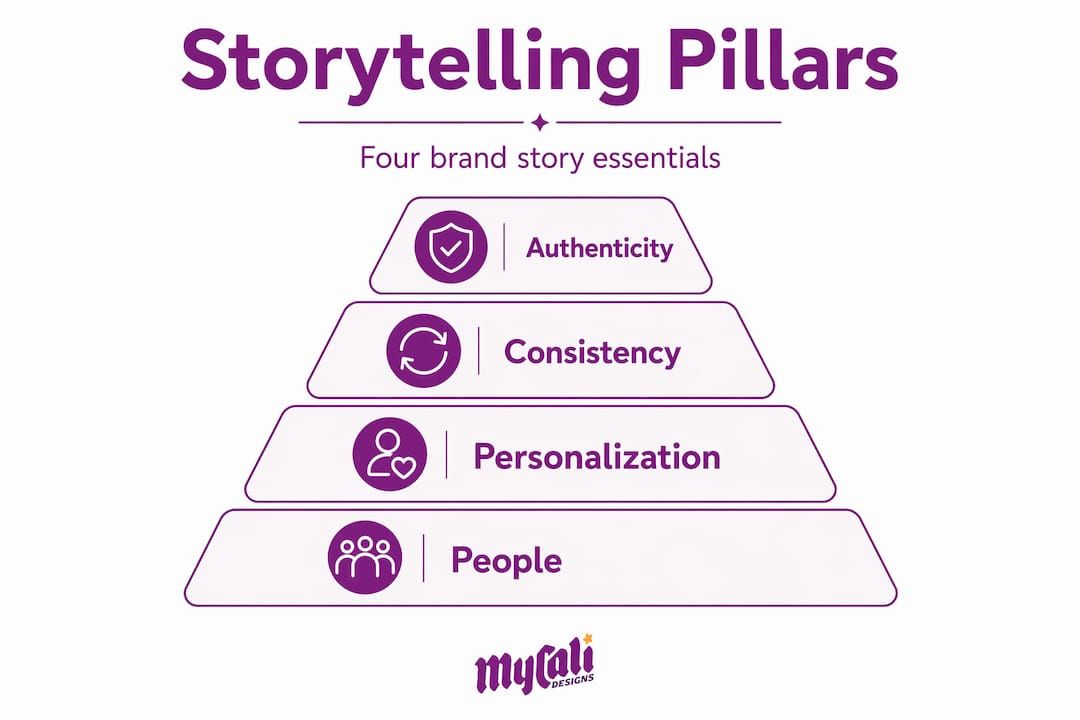
Here are the four pillars every brand story needs:
| Pillar | What it means | Why it matters |
|---|---|---|
| People | Real humans: founders, customers, team members | Humanizes the brand and creates relatability |
| Place | Where the brand comes from or operates | Grounds the story in authenticity and context |
| Purpose | The "why" behind the business | Connects with values-driven buyers and builds loyalty |
| Plot | The conflict, challenge, or tension the brand resolves | Creates narrative tension that keeps people engaged |
Authenticity ties all four together. A story that checks the structural boxes but does not reflect your actual values will read as manufactured. Research confirms that storytelling can backfire when it is misaligned with core business values, creating perceptions of manipulation rather than connection.
Consistency is the second non-negotiable. Your brand story should feel the same whether someone encounters it on your website, your Instagram, a pitch deck, or a sales call. That does not mean using identical words. It means the same values, the same tone, and the same character coming through every time. You can use a branding checklist to audit whether your story is landing consistently across touchpoints.
Pro Tip: If you have trouble writing your brand's story, start with the problem you were founded to solve. That tension is your plot. Everything else builds from there.
Personalization rounds out the picture. The role of storytelling in marketing today demands that you do not tell one generic story to everyone. Segment your narratives. The story you tell a first-time visitor is not the story you tell a repeat customer or a potential investor.
How to create your brand story, step by step
Knowing what brand storytelling is and knowing how to build it are two different things. Here is a practical framework for getting started without overthinking it.
-
Identify the tension your brand resolves. What problem or frustration existed in your customer's life before you showed up? This is your story's engine. Name it honestly.
-
Clarify your brand's belief system. What do you believe about your industry, your customer, or the world that your competitors do not? This is your point of view, and it is what makes your story distinct.
-
Document your origin. Why did this business start? A genuine origin story, even a humble one, builds credibility. Customers trust brands that have a real reason for existing.
-
Make your customer the hero. Your brand story should show the customer's transformation, not your company's achievements. Frame every narrative around their before-and-after, not your awards.
-
Choose your channels intentionally. Your story does not need to live everywhere at once. Start with one owned channel, your website, and build outward. Each platform can carry a chapter of the larger story.
-
Test and measure emotional response. Watch for signals like comment sentiment, sharing behavior, and customer language when they describe you to others. Those are your leading indicators.
One common pitfall: treating storytelling as a marketing department task. Storytelling is foundational to business success beyond marketing, shaping differentiation and investor confidence. That means founders and leadership need to own the narrative, not delegate it. When your CEO tells a different story than your website, your audience notices, even if they cannot articulate why.
Another pitfall is confusing frequency with consistency. Posting more content does not strengthen your brand story. Posting aligned content does. A clear brand strategy gives you the filter to decide what fits your narrative and what does not.
Pro Tip: Write your brand story as a one-page document before you write a single piece of content. Include: the customer's problem, your belief, your origin, your promise, and your proof. Use it as your editorial north star.
Brand storytelling in action: what the numbers show
It is worth looking at brands that have built their growth on story rather than product alone. Airbnb is the clearest example in the past decade. Rather than marketing accommodations, they built an entire identity around the idea of belonging anywhere. Every host profile, every guest review, and every campaign was a story about human connection across geography and culture. The product was a place to sleep. The story was about what travel could mean.
That strategic clarity paid off. 92% of consumers trust organic, peer-driven content and recommendations over traditional advertising. Airbnb weaponized that trust by making their customers the storytellers. User-generated stories replaced ad spend and built a community that competes on a level no hotel chain can match.
Here is a quick summary of documented storytelling outcomes:
| Outcome | Data point |
|---|---|
| Lifetime customer value | Emotionally connected customers deliver 306% higher LTV |
| Repeat purchase behavior | Emotionally connected buyers are 4x more likely to return |
| Trust in peer-driven narrative | 92% of consumers prefer organic content over ads |
| Brand perception improvement | Intentional storytelling shapes brand perception and controls the company narrative |
| SME brand management impact | Storytelling positively links identity to customer perception across brand components |
The pattern across every data point is the same. Brands that tell intentional stories do not just build awareness. They build preference, loyalty, and advocacy that compounds over time.
My honest take on where most brands get it wrong
In my experience working with business owners on brand development, the most common mistake is not a lack of creativity. It is a lack of ownership. Storytelling gets handed off to whoever manages social media or writes the newsletter, and it becomes reactive, transactional, and forgettable.
I have seen brands spend thousands on logo design and websites while their actual story, the "why" behind everything, sits undefined. The visuals look sharp, but the story underneath is hollow. That gap is where trust leaks out.
What I have learned is that the brands that get storytelling right treat it like product development. They invest time in understanding their customer's actual language, real frustrations, and genuine aspirations. They write their story before they write their tagline. And they revisit it every time the business evolves, because a story that was true at launch may not be true three years later.
The uncomfortable truth about the importance of brand storytelling is that you cannot outsource it entirely. You can get help shaping it, designing the visual language around it, and distributing it effectively. But the core belief and the authentic origin? That has to come from you. Anything else reads as fiction, and audiences in 2026 are remarkably good at detecting it.
— Cesar
How Mycalidesigns helps you build a brand story that works
If you have read this far and realized your brand does not yet have a clear story to tell, you are not behind. You are ready to start.
At Mycalidesigns, we help business owners and marketing teams build the visual and strategic foundation that gives a brand story somewhere to live. That means custom logo design, full brand identity systems, and digital design that reflects who you actually are, not just what you sell. A strong story needs a visual language that matches it. Without that alignment, even the best narrative falls flat. Our team works alongside you to capture what makes your business distinct and translate that into design that builds trust from the first impression. If you are ready to stop guessing and start building, explore our agency services or reach out directly to start the conversation.
FAQ
What is brand storytelling in simple terms?
Brand storytelling is the practice of using narrative to connect your brand's identity and values to your customer's experiences and aspirations. It goes beyond advertising by creating emotional meaning around your business.
What makes good brand storytelling?
Good brand storytelling is authentic, consistent, and customer-centered. It identifies a real tension in the customer's life, positions the brand as the guide, and delivers that message coherently across every touchpoint.
How does storytelling differ from traditional marketing?
Traditional marketing describes what you sell. Brand storytelling explains why you exist and what your customer's life looks like after choosing you. The focus shifts from features to meaning, which drives deeper loyalty.
Can small businesses benefit from brand storytelling?
Absolutely. Research shows that storytelling enhances brand management for SMEs by linking brand identity to customer perception, which means even a small business with a clear story can compete powerfully against larger competitors.
How do you measure the impact of brand storytelling?
Look beyond satisfaction scores. Measure repeat purchase rate, referral volume, time-on-site, and how customers describe your brand in their own words. These emotional connection metrics reflect true storytelling impact far better than standard surveys.
Recommended
Recent Posts