




Small business rebranding guide: refresh for growth
Small business rebranding guide: refresh for growth
TL;DR:
- Rebranding your small business requires strategic planning and clear purpose to avoid confusion and erosion of existing brand equity.
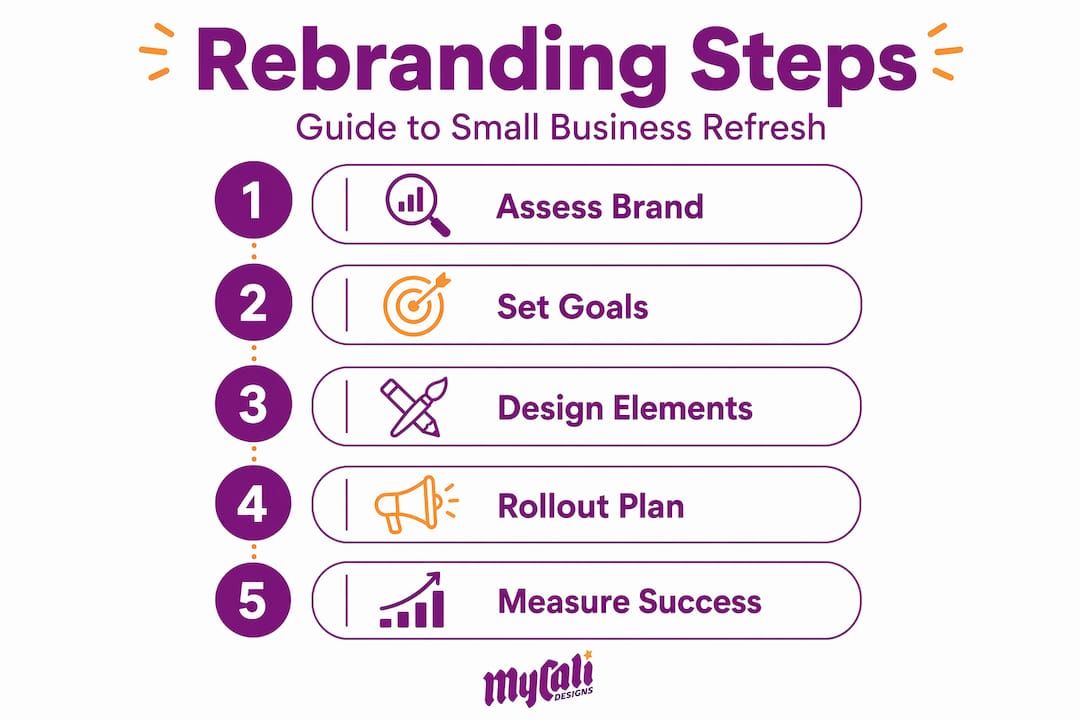
- Effective rebranding involves assessing your current brand, setting specific goals, designing resonant branding elements, and executing a phased rollout with internal alignment, ultimately measuring success over time.
Rebranding your small business is one of the most impactful decisions you can make, and also one of the easiest to get wrong. Most owners recognize something feels off about their brand, but turn it into a logo swap and call it done. This small business rebranding guide is different. We walk you through the real work: diagnosing what needs to change, building a brand that speaks directly to your ideal customer, and launching without losing the equity you have already built. Whether you are repositioning after years in business or starting fresh with a clearer vision, this guide gives you a confident, step-by-step path forward.
Key Takeaways
| Point | Details |
|---|---|
| Strategic timing | Rebrand only when your business evolution or audience shift justifies the effort for maximum impact. |
| Thorough brand assessment | Use customer feedback and competitor analysis to understand your current brand's strengths and gaps. |
| Clear objectives | Set measurable goals aligned with your audience and business vision to guide your rebranding. |
| Cohesive visual identity | Develop a simple logo and a color palette that strongly connect with customer emotions and perceptions. |
| Phased rollout | Communicate internally early and use gradual public transitions to minimize confusion and preserve loyalty. |
Understand why and when to rebrand
Not every business slump calls for a rebrand. That is the first thing we want you to internalize. A rebrand is a significant investment of time, money, and attention. Doing it for the wrong reasons, like chasing a competitor's new look or reacting to one bad quarter, can create more confusion than clarity.
The right triggers are strategic, not emotional. A rebrand makes sense when your business model evolves, your target audience shifts, or your visual identity has become outdated. You might also face a trademark dispute that forces a name change, or realize your current brand actively repels the customers you want most.
Here are the clearest signs it is time to consider rebranding:
- Your business has pivoted but your brand still reflects the old direction
- Your visual identity looks noticeably dated compared to where your market has moved
- You are attracting the wrong type of client or customer consistently
- A merger, acquisition, or new partnership demands a unified identity
- A trademark conflict puts your current name or logo at legal risk
- Your pricing and positioning have grown, but your brand still signals "budget"
Understanding your brand or brand refresh readiness before you commit saves you from investing in changes that will not move the needle. Rebranding with a clear "why" keeps every decision grounded throughout the entire process.
Prepare by assessing your current brand and defining rebranding goals
This is where most small business rebrands quietly fail. Owners skip the assessment phase and jump straight to logo design. The result is a shiny new look applied to a brand that still communicates the wrong thing. Preparation is not optional. It is the foundation everything else is built on.
Effective rebranding starts with customer feedback and competitive analysis to identify brand gaps. Here is how to structure that process:
- Collect customer feedback. Use short surveys, one-on-one interviews, or focus groups. Ask customers how they describe your business to others. Their words often reveal the brand perception you actually have versus the one you want.
- Run a competitor audit. Map out three to five direct competitors. Analyze their logos, color choices, tone of voice, and positioning. Where are you blending in? Where can you stand apart?
- Review your current brand elements. Assess every touchpoint: website, social media, packaging, signage, email templates. Are they visually consistent? Do they still reflect your current offer and values?
- Define your rebranding objectives. Be specific. "Look more professional" is not an objective. "Attract clients in the $10K+ project range by communicating premium service quality" is.
- Set your key performance indicators (KPIs). These are the measurable markers you will use to judge success. Think brand awareness, website traffic, lead quality, social engagement, and customer retention.
Pro Tip: Build your objectives directly from your customer research. If three customers described your brand as "confusing," that is a measurable problem with a measurable fix. Track whether post-rebrand surveys show improved clarity.
Our branding checklist for success covers every element worth auditing before you begin. For deeper thinking on positioning, our brand identity guide and resource on branding strategies to build identity are worth reviewing alongside this step.
Create new branding elements that resonate and stand out
With your research complete and your goals defined, you are ready to build. This is the creative phase, but it should never be purely aesthetic. Every design decision needs to connect back to your customer profile and your brand objectives.

Start with your logo. A strong small business logo redesign produces something simple, memorable, and versatile. It should work equally well on a website header, a business card, a social media avatar, and a van wrap. Complexity is the enemy of recognition.
Color is more powerful than most business owners realize. 62 to 90 percent of brand assessments rely on color alone, which makes your palette one of the most critical decisions in this entire process. Use color psychology intentionally.
| Color | Common emotion triggered | Works well for |
|---|---|---|
| Blue | Trust, reliability | Finance, healthcare, tech |
| Green | Growth, health, calm | Wellness, sustainability, food |
| Orange | Energy, warmth, creativity | Food, entertainment, startups |
| Black | Luxury, authority, sophistication | Premium services, fashion |
| Yellow | Optimism, approachability | Retail, youth brands, hospitality |
Beyond your primary palette, include one or two accent colors to add depth and flexibility across marketing materials.
Once your visuals are ready, document them in a brand style guide . This document should cover:
- Approved logo versions and minimum size requirements
- Primary and accent color codes (HEX, RGB, and CMYK)
- Typography hierarchy: headlines, body copy, and accent fonts
- Tone of voice guidelines and sample copy
- Rules for image style, iconography, and spacing
Your brand story is equally important. Customers connect with businesses they understand. Craft a short narrative (two to three sentences) that explains who you serve, what you do differently, and why it matters. This becomes the backbone of every message you put out.
Pro Tip: Check out our guide on the visual branding process for a step-by-step approach to building visual elements that hold together across every format. For inspiration on where design is heading, our piece on branding trends 2026 is a useful reference.
Communicate your rebrand internally and plan a phased rollout
Before a single customer sees your new brand, your team needs to understand and believe in it. Skipping internal communication is like renovating your storefront without telling your staff. Customers walk in and the experience does not match the new exterior.
Soft internal launches 4 to 6 weeks before the public reveal give you time to gather real feedback and catch problems early. Here is how to approach it:
- Share the brand story, the reasoning behind the change, and the new visual guidelines with your team
- Run a training session on tone of voice and messaging so everyone speaks consistently
- Designate a single point of contact (SPOC) to handle internal questions and keep the rollout organized
- Invite honest feedback from team members who interact with customers daily
For your public rollout, a phased approach protects your existing brand recognition. Dual branding, meaning presenting your new name alongside the old one ("New Brand, formerly Old Brand") reduces customer confusion significantly during the transition period. Plan this dual-brand phase to last at least 60 to 90 days.
Pro Tip: Set a rollout timeline with hard deadlines for each channel. Website goes live on day one. Social media profiles update by day three. Print materials and signage follow by week two. Without a timeline, rebrands stall mid-execution and create the worst outcome: a half-old, half-new brand visible to customers.
Our resources on brand strategy for lasting growth and rebrand readiness can help you structure your rollout plan with confidence.
Launch your rebrand and measure its success over time
A rebrand launch is not a single moment. It is a coordinated campaign. Here are the essential steps for rebranding execution at launch:
- Update all digital assets simultaneously. Website, social media profiles, email signatures, and Google Business profile should all reflect the new brand on day one.
- Issue a press release or announcement. Tell your audience the story behind the change. Make it about them, not you. Explain how the rebrand reflects your commitment to serving them better.
- Set up 301 redirects for every changed URL. If your domain is changing, 301 redirects retain 80 to 90 percent of your search traffic when implemented carefully. This is not optional. Missing redirects means losing organic traffic you spent years building.
- Contact backlink sources directly. Reach out to websites that link to your old domain and request updates. This accelerates SEO recovery.
- Monitor analytics from day one. Track website sessions, bounce rate, keyword rankings, and conversion rate weekly for the first three months.
For measuring brand perception, combine platform analytics with customer surveys. You can also measure brand awareness with AI analytics tools that surface sentiment trends and reach data across channels.
Here is a quick reference for what to track before and after launch:
| Metric | Pre-rebrand baseline | Post-rebrand target |
|---|---|---|
| Website organic traffic | Record 90-day average | Return to baseline within 90 days |
| Lead quality score | Internal rating | Increase by 20 to 30 percent |
| Brand recall (survey) | Baseline survey result | Measurable improvement at 6 months |
| Social engagement rate | Average per post | Increase within first 60 days |
Tracking KPIs for 6 to 12 months post-launch gives you enough data to understand whether the rebrand is delivering real results or needs adjustment. Do not judge too early. Brand perception changes gradually.
Pro Tip: Our guides on digital branding strategies and the website design launch guide cover the technical and strategic execution details worth reviewing before you go live.
Why clarity and customer alignment trump flashy trends in rebranding
Here is something we have seen repeatedly when working with small business owners: the rebrand that gets the most attention is rarely the one that performs best.
There is a temptation to chase whatever design trend is dominating social media right now, the gradient logo, the minimalist wordmark, the saturated color palette. These choices might earn approval from other designers. They rarely move the needle with actual customers.
Small business leaders find that rebrands attract better-fit clients when the changes clarify value rather than chase trends. That clarity is the real engine behind a successful rebrand.
The most effective rebrands we have seen start from one honest question: "Does our current brand accurately communicate what we do and who we do it for?" When the answer is no, everything else follows naturally. The right colors, the right tone, the right story. They emerge from understanding your customers deeply, not from scrolling design inspiration boards.
A rebrand also has an internal effect that is easy to underestimate. When your team sees a brand that accurately reflects the business they are proud to work for, it changes how they talk about it. That word-of-mouth shift is something no ad budget can replicate.
Our take is straightforward: before you touch a single visual element, invest the time in your branding strategies to build identity. Know who you are, who you serve, and what makes your offer worth choosing. Every design decision becomes easier when that foundation is solid.
Leverage expert branding and design services to power your rebrand
A rebrand done well builds trust, attracts better customers, and gives your business a platform for growth. A rebrand done halfway creates confusion and erodes the recognition you have already earned.
At Mycali Designs, we help small businesses get it right the first time. From custom brand identity and logo design that reflects exactly who you are, to website and SEO services that protect your search presence through the transition, we cover the full picture. Our agency branding services bring strategy, design, and execution together in one place so nothing falls through the cracks. If you are ready to rebrand with confidence, we are ready to help you build something worth being proud of.
Frequently asked questions
How long does a typical small business rebrand take?
Most small business rebrands take four to eight weeks from strategy to launch, but name and domain changes can push the timeline to three months or more.
Can I keep my existing logo when rebranding?
Yes. Many businesses rebrand by refreshing their color palette, typography, and messaging without changing the logo itself, which preserves customer familiarity while modernizing the overall identity.
How do I protect my trademark during rebranding?
Trademark experts recommend filing new trademark applications before your public launch and using both the old and new marks during the transition period to maintain continuous legal protection.
Will changing my website domain hurt my SEO?
Rankings may dip temporarily, but properly implemented 301 redirects and proactive backlink updates usually recover most organic traffic within one to three months.
What are common mistakes to avoid during a rebrand?
Common rebranding mistakes include filing trademarks too late, skipping customer research, failing to communicate changes internally, and rolling out all changes at once without a phased plan.
Recommended
Recent Posts