




Role of design in marketing: a small business guide
Role of design in marketing: a small business guide
TL;DR:
- Treating design as a strategic growth tool rather than a cosmetic afterthought significantly improves customer experience and revenue.
- Effective design encompasses visual, functional, and experiential elements that influence customer trust, behavior, and loyalty.
Most small business owners treat design as the last step before launch — the part where you "make it look good." That thinking is costing them real money. The role of design in marketing goes far beyond picking fonts and colors. It shapes how customers perceive your brand, whether they trust you enough to buy, and how easily they can find what they need on your website. When design is treated as a strategic function rather than a cosmetic one, it becomes one of the most measurable growth tools a business has.
Key Takeaways
| Point | Details |
|---|---|
| Design is strategic | Design drives measurable business growth and customer loyalty, not just aesthetics. |
| User-centered approach | Design thinking helps create marketing that addresses real customer needs. |
| Visual psychology matters | Colors and shapes subtly influence emotions and decision-making. |
| Consistency builds trust | Consistent design across touchpoints enhances recognition and scales growth. |
| Data-driven optimization | Ongoing design improvements based on user data significantly boost conversions. |
What does design mean in marketing?
Building on why design matters, let's define what design actually means in marketing terms. Most people think of design as the visual surface: logos, color palettes, and layouts. But in marketing, design is the full system of visual, functional, and experiential decisions that shape how a customer feels and acts at every touchpoint.
Think of it this way. Design is the reason a customer immediately trusts one plumber's website over another, even if both offer the same services at the same price. It's why one email gets opened and another gets deleted. Design is not decoration; it is a measurable, strategic growth engine that fuels revenue growth and strengthens customer loyalty.
In marketing, design operates on three levels:
- Visual design: Logos, color, typography, imagery, and layout that create immediate brand recognition
- Functional design: How easy it is for a customer to navigate your website, find information, and complete a purchase
- Experiential design: The overall emotional impression your brand leaves at every stage of the customer journey
Understanding design thinking in marketing means recognizing that each of these levels has a direct impact on customer behavior. And when you're building branding strategies for SMBs, all three need to work together. The importance of visual content in that system cannot be overstated, because visuals are processed faster than text and make lasting impressions before a single word is read.
How design impacts business growth and customer engagement
With a clear business impact established, let's understand the psychological and financial principles behind it. This is where the data gets hard to ignore.
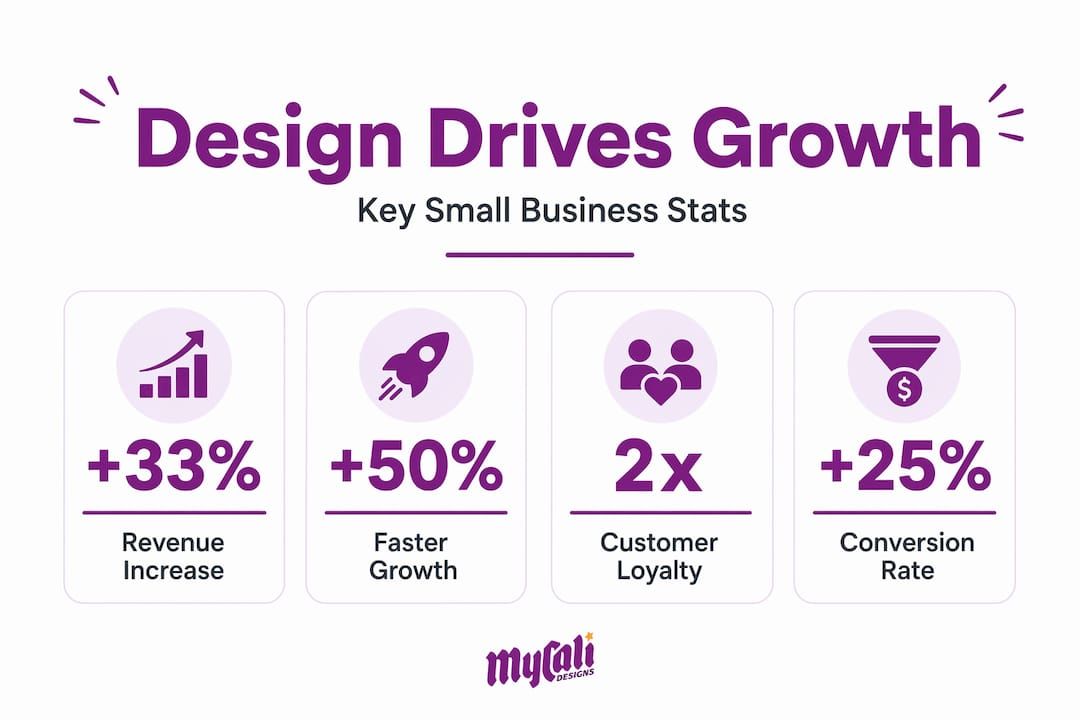
Companies that take design seriously do not just look better. They perform better. Design-mature companies outperform industry peers by 32 percentage points in revenue growth and 56 points in shareholder return over two years. That is not a minor edge. That is the difference between a business that scales and one that plateaus.

For a more grounded example: SoCal Micro Endodontics increased website conversions from 11.62% to 26.43% through design optimization alone, more than doubling above industry benchmarks without spending more on ads. Same traffic. More patients.
| Design investment area | Typical business impact |
|---|---|
| Website UX improvements | Conversion rate increases of 23–45% |
| Consistent brand identity | Up to 33% higher revenue recognition |
| Clear calls to action | Significant reduction in drop-off rates |
| Visual hierarchy in ads | Higher click-through and engagement rates |
The table above reflects patterns we see repeatedly. Businesses that invest in web design and ROI discover that improving how a page feels to use often outperforms doubling the ad budget. These are not expensive fixes. They are design decisions.
Pro Tip: Before increasing your marketing spend, audit your existing digital assets for friction. Broken forms, confusing navigation, and weak calls to action are silent conversion killers. Fixing them is faster and cheaper than finding new traffic. See more website design tips that address these exact issues. Also, call to action design is one of the highest-leverage places to start.
Design thinking and brand clarity as drivers of marketing success
Understanding the strategic mindset helps us examine specific design elements that influence customers. One framework that consistently delivers results for businesses of every size is Design Thinking, a process originally developed in product innovation that translates powerfully into marketing.
Design Thinking moves through five stages:
- Empathize: Study your customer's actual experience, fears, and goals rather than assuming you know them
- Define: Identify the specific problem your design needs to solve, such as confusion on a pricing page or distrust at checkout
- Ideate: Generate multiple creative approaches before committing to one direction
- Prototype: Build a low-cost version of your solution to test quickly
- Test: Measure real responses and refine based on what the data tells you
Design Thinking fosters innovation through empathy and rapid iteration, leading to higher engagement and brand loyalty. The key insight here is that the process begins with the customer, not the designer. That shift in starting point changes everything.
"For small businesses, strategy and brand clarity matter more than budget; defining your audience and differentiation is critical before tactics." — Liza Cirlot
This quote challenges the common assumption that strong design is a luxury for businesses with large budgets. Brand clarity means knowing exactly who you serve, what you offer, and why it matters to that specific person. Your brand strategy path should answer those questions before a single design decision is made. Without that foundation, even beautiful design fails to convert.
Start with a branding checklist to make sure your foundation is solid before you build anything on top of it.
How visual design elements influence customer behavior
With these visual insights, let's see how design applies practically in your marketing. The psychological connection between visuals and behavior is well-established. What's less understood is how specific, subtle design choices shape purchasing decisions without the customer ever noticing.
Color is a good starting point. Purple signals luxury and authority (think high-end skincare or consulting). Green suggests nature, health, or financial stability. These associations are not accidental. Brands use them deliberately to prime customers before a single word is read.
Shapes, colors, and spatial elements subtly influence emotion and decision-making, helping brands break through ad blindness and increase engagement. Here is how that plays out across common design elements:
- Circles and curves: Communicate friendliness, safety, and approachability. Common in healthcare, food, and community-based brands
- Sharp angles and triangles: Signal energy, speed, and precision. Common in tech, fitness, and performance brands
- Whitespace (negative space): Tells the brain "this is premium" and reduces cognitive overload, making decisions easier
- Asymmetry: Draws the eye and creates visual tension that guides attention toward a specific element, like a button or headline
- Processing fluency: This is the technical term for how easily the brain processes a visual. Simple, familiar layouts increase purchase likelihood because they reduce effort
Pro Tip: If your marketing materials feel "busy" or customers seem confused about what to do next, the issue is almost always visual hierarchy. Everything on the page is competing equally for attention. Give one element dominance and let the rest support it. Your digital branding strategies should prioritize this at every customer touchpoint.
Applying design strategically in your marketing efforts
Having concrete steps for application sets up a broader perspective on how SMBs can rethink design roles. Here is a practical sequence for integrating design strategies for effective marketing into your business.
- Define your audience first. Every design decision flows from knowing who you are talking to. A financial services firm targeting retirees needs a completely different visual language than a fitness brand targeting Gen Z.
- Audit your existing touchpoints. Website, social media profiles, email templates, invoices, packaging. Identify where the experience feels inconsistent, confusing, or untrustworthy.
- Prioritize friction reduction. Website redesigns that fix friction yield conversion rate lifts of 23–45% without additional traffic. Start there before expanding your reach.
- Build consistency across channels. A customer who sees your Instagram post and then visits your website should feel like they are in the same place. Disjointed branding creates subconscious doubt.
- Test and iterate. Run A/B tests on landing pages, email subject lines with different visual cues, and ad creatives. Design improvement is not a one-time event.
| Reactive design approach | Proactive design approach |
|---|---|
| Design created when something looks "outdated" | Design reviewed on a regular schedule |
| Visual decisions made by preference, not data | Decisions guided by customer behavior data |
| Each channel designed in isolation | Consistent system applied across all channels |
| Focus is on aesthetics | Focus is on conversion and customer experience |
Pair these steps with smart social media design practices, and revisit your branding checklist regularly to make sure your visual identity keeps pace with your growth.
Rethinking design's role: beyond aesthetics to growth leadership
Here is a perspective that does not get enough airtime: design is not a department. It is not a vendor you hire when something needs to look professional. Design is a language. And if your business is not fluent in it, every message you send is being misread.
We have worked with enough SMBs to notice a pattern. The businesses that struggle to scale are often not underfunding their ads or ignoring SEO. They are under-investing in design maturity. They built something that functions, but it does not signal trust at the level their target customers expect. A $10 million services firm that looks like a startup is leaving revenue on the table every single day.
Design articulates authority, provides clarity and visual logic, and enables scalable growth without losing credibility. That is not a marketing insight. That is a leadership insight. When design is treated as infrastructure, like your accounting system or your operations process, businesses allocate resources differently and collaborate more effectively.
The uncomfortable truth is that most SMBs see design as a cost. The ones who grow past the ceiling see it as a multiplier. Every dollar spent on marketing is either amplified or diluted by the quality of the design it travels through. A well-designed ad campaign converts. A poorly designed one burns budget.
Explore how digital branding insights can help you position design as a leadership priority rather than an afterthought.
How professional design services can elevate your marketing
Understanding design's strategic power is one thing. Putting it into practice with the right expertise is another. At Mycali Designs, we built our entire service model around helping SMBs use design the way growth-focused companies do — as a system, not a series of one-off projects.
Our custom logo and branding services create the brand foundation your marketing needs to actually land: clear, consistent, and built around your audience. Our custom website development goes beyond aesthetics to build sites that reduce friction, guide customers toward action, and convert. And our digital marketing services amplify your design across Google Ads and social media so every channel reinforces the same trusted brand. If you are ready to treat design as the growth tool it is, we are ready to build that with you.
Frequently asked questions
Why is design more than just decoration in marketing?
Design is not decoration; it is a measurable, strategic growth engine that drives revenue, strengthens customer loyalty, and reduces friction across every marketing touchpoint.
How can small businesses improve conversions with design?
By fixing layout issues, clarifying calls to action, and removing friction from the user journey. Website redesigns that fix friction consistently yield 23–45% conversion lifts without increasing traffic.
What role does design thinking play in marketing?
Design Thinking fosters innovation by centering the customer experience through empathy and rapid iteration, which leads to marketing strategies that genuinely resonate and build long-term loyalty.
Why is brand consistency important for growth?
Consistent design builds recognition and trust at scale. Brands with consistent presentation see up to 33% higher revenue and are 3.5 times more visible in their markets.
Can small businesses afford to invest in strategic design?
Absolutely. Strategy and brand clarity matter more than budget. Defining your audience and your differentiation clearly is the first step, and that costs time more than money.
Recommended
Recent Posts