




What Is Sustainable Branding? A 2026 Guide for Businesses
What Is Sustainable Branding? A 2026 Guide for Businesses

TL;DR:
- Sustainable branding involves embedding genuine environmental, social, economic, and governance commitments into every business layer. It requires operational transparency and internal alignment before external communication to build authentic consumer trust. Regulatory changes in 2026 demand substantiated claims and careful visual presentation, emphasizing the importance of genuine sustainability efforts over superficial marketing.
Sustainable branding is defined as the practice of embedding genuine environmental, social, economic, and governance responsibility into every layer of a brand's identity, operations, and communications. As Shopify describes it, this goes far beyond "slapping a green leaf on a logo." It means accounting for real impact across the entire value chain, from how raw materials are sourced to how products are packaged and marketed. A 2026 UN Global Compact and Kantar study of over 1,700 business leaders confirms that sustainable growth is now mandatory, requiring integration across brand building, innovation, and communications. For business owners and marketers, understanding what sustainable branding means in practice is the foundation for building a brand that earns lasting consumer trust.
What is sustainable branding and why does it matter?
Sustainable branding is the strategic alignment of a brand's identity with verifiable commitments to environmental stewardship, social equity, economic fairness, and ethical governance. It is not a marketing campaign. It is an operational and communicative posture that shapes every decision a business makes, from supplier selection to the language used in advertising.

The importance of sustainable branding has grown sharply as consumer expectations shift. Buyers increasingly scrutinize brand claims, and companies that cannot back up their messaging face real reputational risk. Brands that get this right, however, build deeper loyalty and stronger long-term positioning than competitors who treat sustainability as a seasonal campaign.
For marketers, the sustainable branding definition also carries a practical implication: your brand's credibility depends on the gap between what you say and what you actually do. The smaller that gap, the stronger your brand equity. This is why sustainable branding practices must start inside the business before they are communicated outward.
What are the core pillars of sustainable branding?
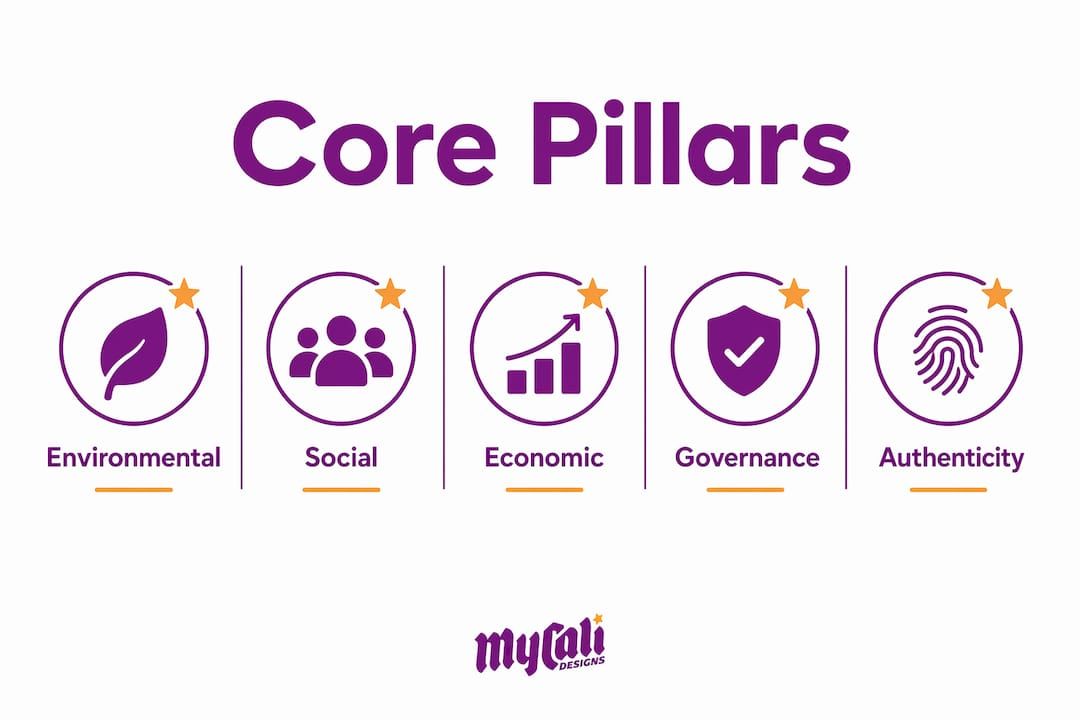
Sustainable branding rests on four interconnected pillars. Each one shapes a different dimension of how your brand operates and how consumers perceive it.
- Environmental: Reducing carbon emissions, minimizing waste, using renewable energy, and sourcing materials responsibly. This is the pillar most brands start with, but it cannot stand alone.
- Social: Fair labor practices, community investment, diversity and inclusion, and supply chain worker welfare. Shopify specifically warns that ignoring worker welfare reduces consumer credibility, even when environmental credentials are strong.
- Economic: Building a business model that is financially sustainable and distributes value fairly across stakeholders, including suppliers, employees, and communities.
- Governance: Transparent reporting, ethical leadership, and accountability structures that hold the brand to its stated commitments.
The risk of focusing on only one pillar is significant. A brand that promotes eco-friendly packaging while sourcing from suppliers with poor labor conditions will face credibility challenges the moment that inconsistency surfaces. Consumers and journalists are skilled at finding these gaps.
Frameworks like the MCM Sustainability Compass use 19 evidence-based questions across brand, offer, pricing, channels, and conversation strategy to diagnose how deeply sustainability is embedded in a business. This kind of structured assessment helps you identify which pillars are genuinely integrated and which are still aspirational.
Pro Tip: Before communicating any sustainability claim externally, map your four pillars internally. Identify where your operations are strong and where gaps exist. Messaging built on honest self-assessment is far more defensible than messaging built on aspiration.
How does authenticity build trust in sustainable branding?
Authenticity in sustainable branding is not a tone of voice. It is a structural quality, meaning your claims are backed by verifiable data, operational changes, and transparent reporting. Research shows that perceived authenticity drives trust with a correlation of r = 0.55, making it one of the strongest predictors of positive consumer attitudes toward a brand. That is a meaningful number, and it tells you that trust is earned through evidence, not enthusiasm.
The challenge is what researchers call the attitude-behavior gap. Consumers may evaluate your brand positively and still not change their purchasing behavior. This gap exists because positive attitudes do not automatically overcome friction in the buying process. Bridging it requires digital experience design that makes sustainable choices easier and more accessible, not just more visible.
Here is how to build authenticity into your sustainable branding from the ground up:
- Assess before you claim. Use a framework like the MCM Sustainability Compass to evaluate your actual sustainability integration before writing a single piece of marketing copy.
- Use specific, verifiable language. Replace "eco-friendly" with "made from 80% recycled materials, certified by the Global Recycled Standard."
- Report transparently. Publish annual sustainability reports, even if they include areas where you are still improving. Honesty about progress builds more trust than perfection claims.
- Align your operations first. Authenticity in branding is a byproduct of operational reality. If your supply chain, packaging, and energy use do not reflect your claims, no amount of messaging will protect you.
Pro Tip: Authenticity in branding builds trust and growth when it is grounded in real operational decisions. Partner with your operations and legal teams before finalizing any sustainability messaging.
What are the 2026 regulatory requirements for sustainable branding?
The legal environment for sustainable branding changed significantly in 2026. Directive (EU) 2024/825, effective September 27, 2026, imposes strict new requirements on how businesses communicate environmental credentials to consumers. The directive is designed to eliminate greenwashing, and its scope is broader than most marketers expect.
Key requirements and risks under the directive include:
- Generic claims are prohibited. Terms like "green," "eco-friendly," "natural," and "sustainable" cannot be used without specific, substantiated evidence tied to the product or service.
- Carbon offset labels face restrictions. Claims based solely on carbon offsetting schemes are now heavily scrutinized and, in many cases, disallowed.
- Visuals and design elements count. EU green claim scrutiny considers the entire external presentation of a brand, including imagery, color choices, and naming conventions. A green color palette or a leaf icon can trigger an environmental claim interpretation even without explicit text.
- Supply chain data must support claims. Marketing claims must align with verifiable product and supply chain data, not just brand intent.
| Claim type | Status under Directive (EU) 2024/825 |
|---|---|
| "Eco-friendly" (unsubstantiated) | Prohibited |
| Certified carbon-neutral with verified data | Permitted with documentation |
| Green imagery without substantiation | Triggers environmental claim review |
| Specific recycled content percentage | Permitted if third-party verified |
The directive applies directly to EU markets, but its influence extends globally as multinational brands align their communications to a single, higher standard. For US-based businesses with any EU exposure, this is a compliance priority, not a future consideration.
Cross-functional collaboration between marketing, legal, and sustainability teams is now a compliance requirement, not just good practice. Brands that build this internal alignment gain a competitive advantage: their claims are defensible, their messaging is consistent, and their risk exposure is lower.
How can businesses implement sustainable brand strategies effectively?
Implementing sustainable branding requires separating two distinct activities: sustainability integration and sustainability communication. Integration means changing how your business actually operates. Communication means telling your audience about those changes. Most brands get into trouble by reversing the order.
Here is a practical comparison of where businesses typically start versus where they should start:
| Common starting point | Better starting point |
|---|---|
| Redesigning packaging with green colors | Auditing supply chain for environmental impact |
| Publishing a sustainability mission statement | Measuring and reporting actual emissions data |
| Launching a "green" product line | Embedding sustainability criteria into all sourcing decisions |
| Hiring a sustainability communications agency | Forming a cross-functional sustainability task force |
Once your operations reflect genuine commitment, communication becomes straightforward. The steps below provide a practical sequence for implementation:
- Conduct a sustainability audit. Map your value chain from sourcing to delivery and identify your highest-impact areas.
- Set specific, measurable goals. Commit to targets like reducing packaging waste by 30% within two years or sourcing 100% renewable energy by a specific date.
- Build partnerships that reinforce your values. Supplier relationships, certifications like B Corp or Fair Trade, and industry coalitions add credibility that self-reporting alone cannot provide.
- Design frictionless consumer experiences. Reducing the effort required to choose your sustainable option directly addresses the attitude-behavior gap. This means clear labeling, accessible pricing, and transparent product information.
- Measure and benchmark regularly. Use tools like the MCM Sustainability Compass or third-party audits to track progress and identify where your brand strategy needs adjustment.
Authentic storytelling plays a real role here, but only after the operational foundation is in place. Sharing your sustainability journey, including setbacks, builds the kind of credibility that polished campaigns cannot manufacture.
How do sustainable brand strategies create competitive advantage?
The business case for sustainable branding is grounded in consumer behavior data. 57% of UK shoppers say they would pay more for sustainable products, and that figure rises to 69% among Gen Z adults. This means sustainable branding is not just an ethical position. It is a pricing and loyalty strategy.
Brands that integrate sustainability deeply also gain advantages in three areas that go beyond consumer preference:
- Innovation: Sustainability constraints push product and process innovation. Companies that commit to reducing waste or eliminating harmful materials often discover more efficient production methods as a result.
- Regulatory resilience: Brands with genuine sustainability integration are better positioned to adapt as regulations tighten. The EU directive is one example, but similar frameworks are developing in the US, UK, and Asia-Pacific markets.
- Talent and partnership attraction: Employees and business partners increasingly choose to work with brands whose values align with their own. Sustainability credentials strengthen your ability to recruit and retain top talent.
"Sustainable growth is now a mandate, not a differentiator. Brands that integrate sustainability across growth strategy, brand building, innovation, and communications will outperform those that treat it as a campaign." — UN Global Compact and Kantar, 2026
The brands succeeding with sustainable branding, from Patagonia's supply chain transparency to Unilever's Sustainable Living brands, share one characteristic: their sustainability commitments are integrated into brand building at the strategic level, not bolted on as a communications layer.
Key takeaways
Sustainable branding succeeds only when genuine operational commitment precedes public claims, making internal alignment the single most important factor in building a credible and durable sustainable brand.
| Point | Details |
|---|---|
| Definition is operational, not cosmetic | Sustainable branding covers the full value chain, not just logos or packaging colors. |
| Four pillars must work together | Environmental, social, economic, and governance dimensions each affect brand credibility. |
| Authenticity drives measurable trust | Perceived authenticity correlates with consumer trust at r = 0.55, making evidence the foundation of messaging. |
| Regulation is now a branding factor | Directive (EU) 2024/825 means unsubstantiated green claims carry legal risk, not just reputational risk. |
| Integration before communication | Operational changes must precede sustainability messaging to avoid greenwashing exposure. |
Why sustainable branding is harder than it looks
I have worked with enough businesses to know that sustainable branding is one of those areas where good intentions create the most risk. A founder genuinely committed to doing the right thing will often move faster on messaging than on operations, not because they are being dishonest, but because communications feel tangible and supply chain audits feel overwhelming.
The problem is that consumers and regulators are now sophisticated enough to close that gap for you, and not in a way you want. The brands I have seen navigate this well share a common habit: they treat sustainability as a cross-departmental discipline, not a marketing brief. Their legal team reviews claims. Their operations team owns the data. Their marketing team tells the story only after the other two have signed off.
The other thing I would push back on is the idea that you need to be perfect before you communicate. Transparency about where you are in your sustainability journey, including what you have not yet solved, builds more trust than a polished claim that falls apart under scrutiny. Consumers respect progress. They do not forgive deception.
If you are just starting out, pick one pillar and go deep rather than spreading thin claims across all four. A digital branding strategy built on one genuine, verifiable commitment is worth more than a broad sustainability narrative with nothing behind it.
— Cesar
Build a brand identity that reflects your values
Your sustainability commitments deserve a brand identity that communicates them clearly and credibly. At Mycalidesigns, we help businesses translate their values into visual systems and messaging frameworks that hold up under scrutiny. From logo design to full branding systems, we build identities that are not just attractive but strategically aligned with what your business actually stands for. If you are ready to create a brand that earns trust at every touchpoint, explore our brand identity services and see how we can help you build something that lasts.
FAQ
What is the sustainable branding definition in simple terms?
Sustainable branding is the practice of building a brand identity around genuine environmental, social, economic, and governance commitments, verified through operations and transparent reporting, not just marketing language.
What makes a brand truly sustainable?
A brand is truly sustainable when its claims are backed by verifiable data across its full value chain, including sourcing, manufacturing, labor practices, and governance, rather than surface-level messaging alone.
What are the biggest risks of greenwashing in 2026?
Under Directive (EU) 2024/825, effective September 2026, unsubstantiated environmental claims, including generic terms like "eco-friendly" and even green visual design elements, can trigger legal liability in EU markets.
How do you implement sustainable branding without greenwashing?
Start with a sustainability audit of your operations, set specific and measurable goals, and only communicate claims that are supported by third-party verification or documented internal data.
Why is the attitude-behavior gap important for sustainable marketers?
The attitude-behavior gap means consumers who evaluate your brand positively may still not purchase sustainably. Reducing friction in the buying experience, through clear labeling, accessible pricing, and simple choices, is what converts positive attitudes into actual sales.
Recommended
Recent Posts