




What Is Brand Positioning? A Strategy Guide for SMBs
What Is Brand Positioning? A Strategy Guide for SMBs

TL;DR:
- Brand positioning involves deliberately shaping how a brand occupies a distinct place in customers' minds relative to competitors, guiding all marketing efforts. It answers who the target audience is, what category the brand competes in, and why the brand wins, ensuring consistency and customer understanding. Small and medium businesses should focus on clear, customer-centered positioning using tools like perceptual mapping and customer feedback to build stronger, more memorable brands.
Brand positioning is defined as the deliberate strategic choice of how a brand occupies a distinct place in the minds of target customers relative to competitors. It is not a tagline, a logo, or a mission statement. It is the upstream decision that shapes every downstream branding and marketing effort your business makes. Frameworks from Al Ries and Jack Trout to April Dunford confirm that brands like Patagonia and Nike built lasting customer loyalty not through creative luck, but through disciplined positioning that answered three questions clearly: who we serve, what category we compete in, and why we win.
What is brand positioning and why does it matter?
Brand positioning is the upstream strategic decision that guides all downstream branding efforts, ensuring your marketing budget builds consistent preference rather than scattered awareness. Think of it as the filter every business decision passes through before it reaches your customer. If your positioning is unclear, your marketing will feel inconsistent, your creative will feel generic, and your sales team will struggle to explain why you are the right choice.
Positioning answers three questions simultaneously: who is served, in what category, and why your brand wins over competitors. Clear answers to these questions give customers a mental shortcut for choosing you. Without them, you are asking customers to do the hard work of figuring out your value on their own, and most will not bother.
Patagonia is the clearest modern example. Its disciplined positioning around environmental responsibility drives decisions that would seem counterintuitive at any other company, including campaigns that actively encourage customers to buy less. That consistency is not accidental. It is the direct result of a positioning strategy applied without compromise across every business function.
What are the core components of a positioning framework?
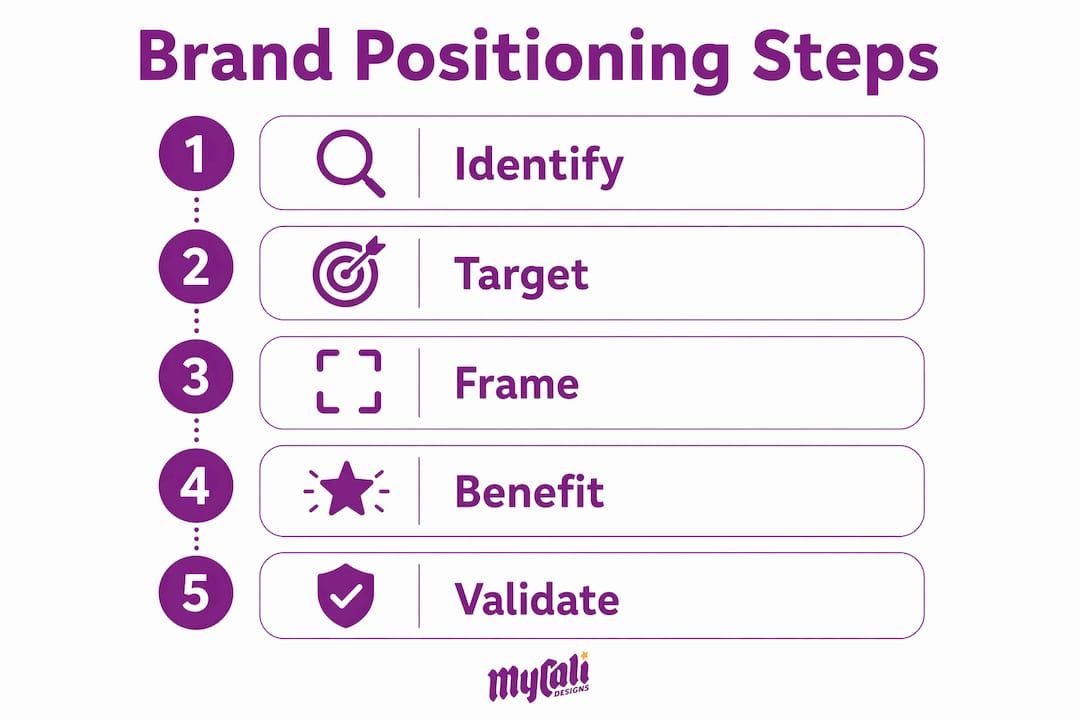
Every effective brand positioning strategy contains four building blocks: a defined target customer, a competitive frame of reference (the category), a primary benefit or point of differentiation, and a reason to believe that benefit is real. Miss any one of these, and your positioning will feel incomplete to the people you are trying to reach.

April Dunford's approach adds a critical starting point that most frameworks skip. Her method begins with competitive alternatives, meaning the tools, solutions, or behaviors customers use today instead of your product. From there, you identify your unique attributes, translate those into customer value, define your best-fit audience, and only then name the category you compete in. This sequence matters because it forces you to think from the customer's perspective rather than your own preferences.
The four components work together like this:
- Target customer: Not "everyone who needs X," but the specific segment most likely to value what makes you different
- Competitive frame: The category or context that helps customers understand what you are and who you compete against
- Primary benefit: The single most compelling reason your target customer should choose you over alternatives
- Reason to believe: The proof point, credential, or mechanism that makes your benefit claim credible
Narrowing your audience deliberately is one of the most counterintuitive but powerful moves in positioning. Trying to appeal to everyone causes a brand to be memorable to no one. The brands that dominate a category almost always started by owning a narrow segment first.
Pro Tip: A positioning statement is an internal strategy document, not marketing copy. The classic template reads: "For [target customer], [brand] is the [category] that [primary benefit] because [reason to believe]." Write it for your team, not your ads.
How does brand positioning differ from branding and related concepts?
This is where most small business owners get stuck. Positioning and branding are not the same thing, and confusing them leads to expensive mistakes.
Positioning is not branding. Branding is the visible expression of the underlying positioning strategy. Your logo, color palette, typography, and tone of voice are all branding elements. They communicate your positioning, but they do not create it. Many businesses invest in logos and visual systems before clarifying their positioning, which produces a polished but strategically hollow brand. The design looks professional, but it says nothing specific about why customers should choose you.
Here is how positioning relates to four commonly confused concepts:
- Brand identity refers to the visual and verbal system that expresses your brand, including logos, colors, and messaging. It is the output of positioning, not the source of it. Learn more about building brand identity before investing in design.
- Slogans and taglines are external-facing creative expressions. They may reflect positioning, but they are not positioning itself. Nike's "Just Do It" communicates a positioned idea, but the positioning existed before the slogan did.
- Mission statements describe organizational purpose and values. They inform positioning but operate at a different level of abstraction. A mission statement answers "why we exist." Positioning answers "why customers should choose us."
- Brand repositioning is the deliberate process of shifting how a target market perceives your brand, usually in response to competitive pressure, audience shifts, or business model changes. Old Spice repositioned from a legacy men's brand to a culturally relevant one through a single campaign that redefined its competitive frame.
Weak or unclear positioning creates a compounding problem. Without it, your marketing team writes copy without direction, your design team creates visuals without strategic intent, and your sales team improvises messaging in every conversation. The result is inconsistency that erodes trust over time.
What tools help you develop and validate your positioning?
Developing positioning is not a one-time brainstorm. It requires structured tools that connect internal strategy to external customer perception.
| Tool | Purpose | Key Benefit |
|---|---|---|
| Perceptual mapping | Visualize brand vs. competitors on two key attributes | Reveals gaps and differentiation opportunities |
| Competitive alternatives analysis | Identify what customers use instead of your product | Forces customer-centered differentiation |
| Customer feedback surveys | Collect direct perception data from real buyers | Aligns internal strategy with market reality |
| Positioning statement template | Formalize the strategic choice in one sentence | Creates internal alignment across teams |
| Category audit | Review how competitors describe themselves | Identifies overcrowded language to avoid |
Perceptual mapping is a particularly powerful starting point. It plots your brand against competitors using two attributes that matter most to your customers, such as price versus quality or innovation versus reliability. The visual output reveals where the market is crowded and where gaps exist. Those gaps are your positioning opportunities. Perceptual maps translate complex market data into visual formats that help teams make strategic differentiation decisions and strengthen brand equity.
Competitive alternatives analysis, the first step in April Dunford's framework, is equally important. Starting from competitive alternatives forces a customer-centered differentiation, focusing on what influences buyer outcomes rather than internal feature preferences. Ask your best customers what they were using or doing before they found you. Their answers reveal the real competitive frame, which is often different from the one you assumed.
Customer feedback surveys close the loop between what you intend to communicate and what customers actually perceive. Run short surveys with open-ended questions like "How would you describe us to a colleague?" and "What made you choose us over other options?" The language customers use is often more precise and persuasive than anything your internal team will generate.
Pro Tip: When building your perceptual map, choose attributes that your best customers actually use to make purchase decisions, not attributes you wish they cared about. The map is only as useful as the axes you choose.
What are the most common brand positioning mistakes?
Most positioning failures come from a small set of repeatable errors. Recognizing them early saves significant time and budget.
- Starting with the category you prefer. Many teams reverse the proper logic by choosing a favored category first and then seeking customers to fit it. This produces positioning that is internally comfortable but externally confusing.
- Trying to serve everyone. Broad positioning feels safe but performs poorly. The more specific your target customer definition, the more powerfully your messaging resonates with the people most likely to buy.
- Confusing positioning with creative output. A new logo, a refreshed website, or a clever tagline does not fix a positioning problem. These are expressions of positioning, not substitutes for it.
- Ignoring customer perception. Your positioning is not what you say it is. It is what customers believe it is. Skipping customer research means you are positioning for yourself, not for the market.
- Hedging to avoid commitment. Vague positioning that tries to be "premium but accessible" or "innovative yet traditional" satisfies no one. Conventional language in category description risks blending a brand into the crowd. Identifying overlooked perceptual gaps is what creates real differentiation.
The common thread across all these mistakes is a reluctance to make a clear, committed choice. Positioning requires you to say yes to one thing and no to many others. That decisiveness is exactly what makes it work.
How can SMBs apply brand positioning strategies to grow?
For small to medium-sized businesses, brand positioning is not a luxury reserved for companies with large marketing budgets. It is the most cost-effective growth tool available because it makes every other marketing investment more efficient.
Here is a practical sequence to build and activate your positioning:
- Run a competitive alternatives audit. List every option your target customer considers before choosing you, including doing nothing. This defines your real competitive frame.
- Interview your best customers. Ask them why they chose you, what they were using before, and how they would describe you to a peer. Their language is your positioning raw material.
- Draft a positioning statement. Use the classic template: "For [target customer], [brand] is the [category] that [primary benefit] because [reason to believe]." Keep it internal and strategic, not polished for public use.
- Validate with a perceptual map. Plot your draft positioning against two to three key competitors using attributes your customers care about. Confirm you occupy a distinct space.
- Align your brand identity with your positioning. Once positioning is clear, brief your design and messaging work from it. Your visual branding process should express the strategic choice you have already made, not invent one from scratch.
- Review positioning annually. Markets shift, competitors move, and customer needs evolve. Treat positioning as a living strategy, not a one-time exercise. Check your brand refresh readiness before making major changes.
Tools like competitive alternatives analysis and customer feedback surveys are vital to continuously refine and validate positioning. They help brands align internal strategy with external customer perception, reducing the gap between what you intend and what the market hears. For SMBs, this ongoing alignment is what separates brands that grow from brands that plateau.
Key takeaways
Effective brand positioning is the single strategic decision that determines whether all other marketing investments work or waste budget.
| Point | Details |
|---|---|
| Positioning precedes branding | Define your strategic position before investing in logos, visuals, or messaging. |
| Four core components | Every positioning strategy needs a target customer, competitive frame, primary benefit, and reason to believe. |
| Start with alternatives | Begin with what customers use today, not the category you prefer, to build customer-centered differentiation. |
| Validate with real tools | Use perceptual mapping and customer interviews to confirm your position reflects market reality. |
| Narrow to grow | Specific audience targeting builds stronger preference and memorability than broad appeals. |
Why I think most SMBs get positioning backwards
From working with small and medium-sized businesses at Mycalidesigns, I have seen the same pattern repeat itself more times than I can count. A business owner comes to us wanting a new logo or a website redesign. When we ask what makes their brand different from competitors, the answer is usually something like "great service" or "quality products." Those are not positioning statements. They are table stakes.
The uncomfortable truth is that most SMBs start with the creative and work backwards, hoping the design will generate strategic clarity. It never does. A logo cannot tell you who your best customer is. A color palette cannot explain why you win against a specific competitor. That work has to happen first, and it has to happen internally before a single pixel is placed.
What I have found actually works is starting with your best existing customers, not your ideal imagined ones. Ask them why they chose you. Ask them what they were doing before. The answers are almost always more specific and more useful than anything a brainstorming session produces. One client discovered their real competitive alternative was not another agency. It was their customer doing the work in-house. That single insight completely changed how they positioned their services and who they targeted.
Positioning is not a creative exercise. It is a strategic one. Get that right first, and the creative work becomes faster, cheaper, and far more effective.
— Cesar
How Mycalidesigns helps you build a brand that stands out
At Mycalidesigns, we work with SMBs that are ready to move beyond generic visuals and build a brand that actually reflects their strategic position in the market. Once your positioning is clear, the design work becomes purposeful. Every logo, color choice, and brand element communicates something specific about who you serve and why you win.
Our brand identity and logo design services are built to express the positioning you have worked to define, not invent a strategy from scratch through design. Whether you are launching a new brand or refreshing an existing one, we bring the strategic and creative expertise to make your market position visible. If you are in the Davis, CA area, our local branding services are ready to support your next growth phase. Reach out to start the conversation.
FAQ
What is brand positioning in simple terms?
Brand positioning is the strategic decision about how your brand is perceived by target customers compared to competitors. It defines who you serve, what category you compete in, and why customers should choose you.
How is brand positioning different from brand identity?
Brand positioning is the internal strategy that defines your competitive place in the market. Brand identity is the visual and verbal expression of that strategy, including your logo, colors, and tone of voice.
What is brand repositioning and when is it needed?
Brand repositioning is the deliberate process of shifting how your target market perceives your brand. It is typically needed when competitive pressure increases, your audience shifts, or your original positioning no longer reflects your actual value.
How do you write a brand positioning statement?
Use this template: "For [target customer], [brand] is the [category] that [primary benefit] because [reason to believe]." This statement is an internal strategy tool, not a public-facing tagline.
Why does brand positioning matter for small businesses?
Clear positioning makes every marketing investment more efficient by giving your team a consistent filter for decisions. Without it, messaging becomes inconsistent and marketing budgets produce scattered results instead of compounding brand preference.
Recommended
Recent Posts