




What Is Brand Consistency and Why It Matters
What Is Brand Consistency and Why It Matters

TL;DR:
- Many small businesses wrongly believe brand consistency only involves logos, but it actually encompasses tone, messaging, and customer experience. Maintaining a unified brand system across all touchpoints builds trust, recognition, and can increase revenue by 10% or more. Implementing clear guidelines, centralized assets, regular audits, and governance processes ensures long-term consistency and stronger brand recognition.
Most business owners think brand consistency means using the same logo everywhere. That assumption is costing them customers. What is brand consistency, really? It's the practice of delivering a uniform brand experience across every touchpoint your customers encounter, from your website and social media to your packaging and customer support. More than visuals, it covers your tone of voice, messaging, and the feeling people get every time they interact with your business. Get it right, and you build the kind of trust that turns first-time buyers into loyal fans.
Key takeaways
| Point | Details |
|---|---|
| Beyond visuals | Brand consistency covers voice, messaging, and customer experience, not just logos and colors. |
| Trust and recognition | Consistent brands build faster recognition and stronger customer loyalty across all touchpoints. |
| Revenue impact | Consistent branding drives revenue growth of 10% or more through increased trust and recall. |
| Common failure point | Brand drift usually starts with new content, freelancers, or one-off campaigns without proper guidelines. |
| Practical fix | Brand guidelines, governance systems, and regular audits keep your brand aligned as your business grows. |
What is brand consistency?
At its core, brand consistency means delivering a coherent, uniform experience across every channel and customer interaction your business touches. Think of it as the difference between a restaurant that tastes exactly the same whether you visit the downtown location or order delivery online, versus one where the food, service, and presentation feel like three different businesses.
The industry term most designers and brand strategists use is brand identity , which refers to the complete system of elements that express who you are. Brand consistency is how reliably you apply that identity. The two concepts work together: your brand identity defines the standard, and consistency is how well you uphold it.
What does that standard actually include? Here are the core elements every business needs to manage:
- Logo and visual marks: Your logo should appear in approved formats, with correct spacing, on every platform and piece of collateral.
- Color palette: A defined set of primary and secondary colors used consistently across digital and print materials.
- Typography: Specific font families and sizes that signal your brand's personality without variation.
- Tone of voice: The way your brand speaks. Are you formal and authoritative, or casual and friendly? That personality should be consistent in every email, caption, and customer reply.
- Messaging and value proposition: The core promises you make to customers should be worded consistently so they reinforce each other over time.
- Customer experience: How your team greets customers, handles complaints, and delivers service is part of your brand. Experiential consistency drives emotional trust more reliably than visuals alone.
The distinction between visual and experiential consistency is where most small businesses fall short. You can have a perfect logo system and still erode trust if your Instagram captions sound nothing like your website copy, or if your in-store staff behaves completely differently from what your marketing promises.
Why brand consistency matters
When a customer encounters your brand repeatedly in a consistent way, something specific happens in their memory. Consistent marketing exposure strengthens memory encoding, which means your brand becomes easier to recall and recognize with less effort on their part. That's not a small advantage. In a crowded market, being the name a customer thinks of first is worth real money.
"A brand that shows up the same way, every time, stops being just a name. It becomes a reliable signal customers trust before they even make a decision."
The business case is hard to ignore. Brands that maintain high consistency see revenue growth of 10% or more compared to those with fragmented brand presentations. Go further and align your brand experience with your customer experience, and the revenue impact can multiply up to 3.5x, according to Forrester research on total experience strategies.
The flip side matters just as much. Inconsistent branding can cost companies billions in lost revenue, not because customers consciously notice the inconsistency, but because mixed signals create doubt. When your website feels polished but your follow-up email looks like it came from a different company, customers subconsciously wonder which version represents the real you. That doubt is the enemy of conversion.

For restaurants, retailers, service providers, and any business with multiple locations or channels, the stakes are even higher. What is brand consistency for restaurants, for example? It means a customer who visits your second location, orders from your app, or sees your ad on Instagram should feel the same emotional connection they felt the first time they walked through your door. That continuity is what builds loyalty, not any single great experience in isolation.
Common mistakes that break brand consistency
The most frequent mistake we see is treating brand consistency as a visual exercise only. Business owners invest in a great logo, then assume the work is done. But brand consistency failures most often happen at the "last mile," when new content gets created under pressure. A freelancer writes a social caption in the wrong tone. A team member creates a promo flyer using a slightly off-brand font. A seasonal sale ad uses colors that clash with your palette. None of these feel like a big deal in the moment. Accumulated over months, they add up to a brand that feels scattered.
Here are the pitfalls that undermine consistency most often:
- No written brand guidelines: Relying on institutional memory means every new hire or contractor brings their own interpretation.
- Multiple asset sources: When your team pulls logos and templates from different folders, versions, or drives, inconsistency is almost guaranteed.
- Inconsistent tone across channels: Your LinkedIn posts sound like a corporation while your Instagram reads like a completely different personality.
- Seasonal campaign drift: Promotional periods often introduce temporary colors or fonts that never fully go away.
- Customer experience gaps: Your marketing promises warmth and responsiveness, but your support tickets take three days. That's a consistency failure too.
Pro Tip: Before creating any new brand asset, ask yourself one question: "If a customer sees only this piece, does it feel like the same brand they encountered last time?" If you hesitate, it's a sign to revisit your guidelines first.
How to build and maintain brand consistency
Building lasting consistency requires more than a mood board. It requires a system. Here is a practical sequence that works for businesses of any size.
1. Create documented brand guidelines. Your guidelines should cover your logo usage rules, color codes (hex, RGB, and CMYK), approved fonts, tone of voice examples, and core messaging statements. Think of it as the single source of truth every team member and contractor references. A branding checklist built around these guidelines makes onboarding new collaborators much faster.
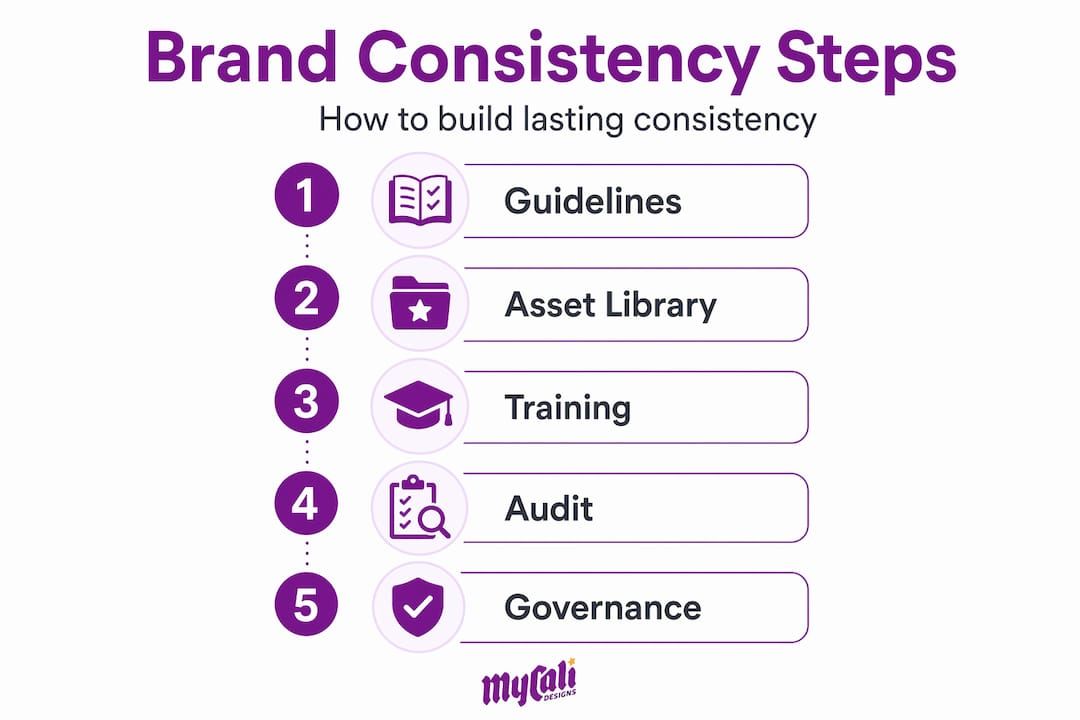
2. Build a centralized asset library. Store every approved logo file, template, and brand element in one place. When people can find the right asset easily, they stop improvising.
3. Train everyone who touches your brand. That includes your front-line staff, your social media manager, your email writers, and any outside agencies. Consistency is a team behavior, not just a design rule.
4. Audit your brand regularly. Walk through every customer touchpoint at least twice a year. Look at your website, social profiles, email signatures, printed materials, packaging, and any physical signage. Note anything that feels off and correct it.
5. Govern new content creation. Any new campaign, promotional piece, or platform expansion should go through a quick brand check before it goes live. This is where many businesses fail: they build great guidelines but have no enforcement step. Think of it like "too many cooks in the kitchen." Without a clear approval process, everyone adds their own flavor.
Here is a quick comparison of what a governed brand system looks like versus an ungoverned one:
| Factor | With governance | Without governance |
|---|---|---|
| Logo usage | Consistent across all touchpoints | Multiple versions in circulation |
| Tone of voice | Uniform across channels | Varies by writer or platform |
| New content | Reviewed against guidelines | Created ad hoc |
| Brand drift | Caught early through audits | Grows unnoticed for months |
| Customer experience | Feels cohesive and intentional | Feels fragmented and uncertain |
Pro Tip: Use digital branding strategies to set up a simple internal review step for any new piece of content before it publishes. Even a 60-second brand check prevents months of cleanup.
Measuring brand consistency over time
Most businesses measure their marketing by campaign performance: clicks, conversions, and reach. Those numbers tell you what's happening right now, but they miss something important. Measuring consistency over multiple years using tools like System1's Creative Consistency Score shows compounding gains that short-term snapshots simply cannot capture. A brand that scores high on consistency over a three-year period builds recognition advantages that take competitors years to close.
Here are the practical metrics worth tracking:
- Brand recall surveys: Ask customers (or a sample audience) to name brands in your category unprompted. How often does your brand appear?
- Recognition rate: When shown your logo or colors without your name, do people identify you correctly?
- Tone consistency score: Have someone outside your team read across three channels (website, email, social) and rate how cohesive the voice feels on a scale of one to ten.
- Customer experience ratings: Review your support and service ratings alongside your brand touchpoints. Gaps between the two signal experiential inconsistency.
- Creative Consistency Score: For businesses running advertising, tracking how consistently your creative assets signal your brand identity over time connects directly to stronger business results.
The goal is not perfection on any single measurement. It's a steady upward trend that tells you your brand is becoming more recognizable, more trusted, and more valuable with every interaction.
My take on where brand consistency really breaks down
I've worked with a lot of small business owners who have genuinely good instincts about their brand. They can describe their tone perfectly in a conversation. They know exactly what their business stands for. But the moment you look at their assets across channels, the brand starts to feel like it was built by five different people in five different years. That's the gap I see most often: the vision is clear internally, but it doesn't survive the execution.
What surprises most people is that the problem rarely starts with the logo or color palette. It starts with the first time someone creates a new piece of content without checking the guidelines. That one off-brand flyer, that Instagram caption in the wrong voice, that email template built by a contractor who never saw your brand standards. Each one feels minor. Together, they create a version of your brand that nobody chose on purpose.
The businesses I've seen do this well share one habit: they treat brand consistency as an operational process, not a creative project. The brand messaging updates that actually stick are the ones tied to a review process, not just a redesign. Creativity lives in the expression. Consistency lives in the system around it.
Long-term measurement matters more than most people realize too. A single campaign can look great or terrible for reasons that have nothing to do with your brand. But a brand that compounds its consistency over two or three years builds something no ad spend can manufacture: recognition that feels automatic to customers.
— Cesar
Build a brand that customers always recognize
Ready to stop guessing and start building a brand that actually holds together across every channel? At Mycalidesigns, we've helped businesses from local service providers to growing e-commerce brands develop identities that look professional, communicate clearly, and stay consistent as they scale.
Whether you're starting from scratch or tightening up an existing brand, we offer full brand identity services designed to give you a cohesive visual system and the guidelines to maintain it. From logo design to messaging frameworks, everything we build is made to work together. Take a look at our logo design services to see how we approach the foundation of a consistent brand, and reach out when you're ready to build something that lasts.
FAQ
What is brand consistency in simple terms?
Brand consistency means your business looks, sounds, and feels the same every time a customer encounters it, whether on your website, social media, packaging, or in person.
What is brand consistency for restaurants?
For restaurants, brand consistency means every location, delivery experience, and marketing asset delivers the same visual identity, tone, and customer experience so guests feel the same connection regardless of how they interact with the brand.
Why does brand consistency matter for small businesses?
Consistent brands build recognition faster, reduce customer confusion, and earn more trust. Research shows consistent branding supports revenue growth of 10% or more because customers are more likely to choose and recommend a brand they recognize and trust.
How do I achieve brand consistency as a small business?
Start with documented brand guidelines covering your visuals, tone, and messaging. Centralize your assets, train everyone who creates content, and audit your touchpoints regularly to catch and correct drift before it compounds.
How do you measure brand consistency?
Track brand recall, recognition rates, tone consistency across channels, and customer experience scores over time. Tools like System1's Creative Consistency Score help connect your long-term brand tracking to measurable business outcomes.
Recommended
Recent Posts