



Content Marketing Process for Agencies in 2026
Content Marketing Process for Agencies in 2026
TL;DR:
- Effective agency content workflows begin with structured onboarding, clear briefs, and defined approval SLAs to prevent delays. Standardizing processes first ensures that tools enhance efficiency rather than amplify chaos or confusion. Continuous process review and solid brand foundations enable scalable, high-quality content production across multiple clients.
Running content for multiple clients simultaneously is one of the messiest operational challenges in agency life. Missed deadlines, conflicting feedback, and briefs that somehow lose all strategic context between strategy and writer. The content marketing process for agencies, properly understood as a structured Standard Operating Procedure (SOP), is what separates shops that scale from shops that scramble. This article walks you through every stage: preparation, execution, and approval workflows, with practical guidance on tools and automation that actually reduce friction rather than just adding another platform to manage.
Key takeaways
| Point | Details |
|---|---|
| Preparation prevents rework | A 30-day onboarding framework with a 90-day roadmap and brand voice baseline reduces strategic drift before a single word is written. |
| Briefs are the highest-leverage step | Unclear briefs force writers to guess strategy, creating costly revision cycles that could have been avoided entirely. |
| SLAs convert approvals into contracts | Written "deemed approved" clauses with escalation triggers stop approval delays from derailing entire production schedules. |
| Standardize before adding tools | Centralized workspaces reduce context loss and errors; adding technology to a broken process only accelerates chaos. |
| Measure to feed the next cycle | Performance data from published content should loop directly back into planning to improve future briefs and editorial decisions. |
The content marketing process for agencies starts at intake
Most production problems you encounter in month three started in week one. Specifically, they started because onboarding was rushed, informal, or inconsistent across account managers.
A structured 30-day onboarding framework creates the foundation every other stage depends on. The cadence looks like this:
- Day 5: Kickoff call completed, goals documented, Single Point of Contact (SPOC) identified on both sides
- Day 10: Intake bundle collected (brand assets, tone references, audience personas, past performance data)
- Day 14: Platform and tool access confirmed
- Day 21: Brand and content audit completed
- Day 28: 90-day content roadmap and brand voice baseline approved by client stakeholders
- Day 30: Reporting cadence active, first content brief in queue
This sequence is not bureaucratic overhead. It is your insurance policy against strategic drift. Onboarding artifacts compound over time, turning future decisions into referencing problems rather than reinvention problems. When a writer asks "What tone does this client use?" the answer should be in a document, not in someone's memory.
Identifying roles early matters too. "Too many cooks in the kitchen" is not just an expression in agency work. It describes what happens when four stakeholders give conflicting feedback because no one established who has final approval authority on day one. A clear SPOC arrangement, documented in the intake bundle, prevents this.
Pro Tip: Treat your intake artifacts as living references. Pin your brand voice doc, the 90-day roadmap, and the kickoff notes in your project management workspace so every team member can find them in under 30 seconds.
Building the execution phase: briefs, drafts, and design
Once preparation is solid, execution becomes a matter of following a defined sequence rather than reacting to whoever is loudest.

Write the brief before anything else
The content brief is the single most important document in your agency marketing workflow. Think of it as a contract between strategy and production. Without a clear brief, writers fill in the strategic gaps themselves, which creates predictable review cycles. A strong brief includes the intent (what this piece is meant to accomplish), the evidence (data, examples, or sources to draw from), the success criteria (how you will know the piece worked), target keyword, format, word count, and tone reference. That is not a long list. It is a focused one.
Draft fast, then edit in stages
A common mistake is editing while writing. The first draft should be produced quickly, with the writer focused entirely on getting ideas down. Quality comes in the editing phase, which should be divided into two distinct passes:
| Edit Type | Focus | Who Does It |
|---|---|---|
| Structural edit | Flow, organization, argument strength, section gaps | Senior editor or strategist |
| Copyedit | Grammar, style, brand voice, formatting | Editor or account manager |
Separating structural from copyediting improves final output quality significantly. Running both in one pass leads to missed structural problems because the editor gets distracted by surface-level corrections.
Handing off to design
Design handoffs are where production workflows often break down. A well-structured design brief should include final approved copy, visual direction notes, brand asset references, dimensions, and a hard deadline. Style guides and reusable templates reduce back-and-forth here. The goal is to give your designer everything they need to execute without a clarification call.
- Write design briefs with final approved copy only (never route to design before copy approval)
- Include visual tone references, not just written descriptions
- Set a specific due date, not "as soon as possible"
- Reference your brand style guide version so there is no ambiguity on colors, typography, or logo usage
Pro Tip: Keep your content brief attached or linked to the active draft document. This way, editors can reference strategic intent without tracking down a separate file, which cuts edit time considerably.
Approval workflows, SLAs, and managing revisions
Approval is where most agency content pipelines quietly collapse. A brief is approved, a draft is written, edits are made, and then the piece sits in a client inbox for two weeks with no response. Without structure, this is a negotiation. With structure, it is a contract.
Setting up written SLAs
A Service Level Agreement (SLA) for content approvals should specify four things: the named approver on the client side, the response window (typically three business days), what counts as a valid response, and what happens if no response arrives.
SLA escalation language works in a tiered sequence. If a draft is not approved or revised within three business days, it is deemed approved. If the client needs more time, day four triggers a written reminder. Day seven triggers an escalation to the account director. Day ten triggers a formal project delay notice. This transforms approval from an open-ended wait into a defined process with consequences.
Approval models worth knowing
- Single-approver model: One designated client contact has final sign-off. Clean, fast, and the recommended default for most accounts.
- Multi-role gated model: Different content types require different approvers (legal reviews one format, brand reviews another). This model works well for regulated industries but requires clear role documentation to avoid logjams.
- Auto-approve exception model: Routine content types (social captions, templated newsletters) are deemed approved after a window unless flagged. Saves significant time on high-volume accounts.
Managing revision rounds without scope creep
Limiting revision rounds is one of the most effective ways to protect your team's capacity. Define in the project scope how many revision rounds are included (two is standard) and what counts as a revision versus a scope change. Centralize all feedback in one location. Scattered feedback across email threads, Slack messages, and comment documents creates version chaos that costs more time to untangle than the revisions themselves.
Pro Tip: For accounts managing six or more active clients, build a weekly review dashboard showing approval status, days pending, and next escalation trigger for each piece. It takes 20 minutes to set up and eliminates the daily "checking in" emails that consume account managers.
Tools, templates, and the automation question
The biggest operational problems in agency workflows, including planning disconnect, production fragmentation, and feedback chaos, are not solved by adding more tools. They are solved by standardizing the process first, then selecting technology that supports it.
The core pain points in most agency content operations come down to three failures: strategy and production teams working in disconnected systems, feedback arriving in inconsistent formats with no version control, and publishing decisions made without performance data from previous cycles.
A centralized workspace addresses all three. Keeping strategy, briefs, drafts, feedback, and publishing in one platform reduces context loss, cuts rewrites, and speeds approval cycles. Whether you use a project management platform, a dedicated content operations tool, or an AI-assisted system like the content marketing automation approach, the architecture matters more than the brand name on the software.
What good tooling looks like in practice:
- A content calendar with role assignments and status tracking visible to all team members
- Brief templates that auto-populate standard fields and link to brand voice docs
- A single feedback thread per piece of content (not email plus comments plus chat)
- Approval status tracking with timestamps
- A publishing queue that connects to performance reporting
Templates and style guides are underrated leverage points here. A reusable brief template alone can cut brief creation time by 40 to 60 percent per piece. That adds up fast across a full client roster. For agencies scaling to multiple clients, governance factors like revision load, client review latency, and refresh backlogs become as critical as writer throughput. Agencies that treat content operations as a discipline, not just a delivery function, are the ones that scale without burning out their teams. You can also read more about optimizing your social media workflow to extend these practices into your social content production.
Pro Tip: Before evaluating any new content marketing tool, document your current workflow in writing. If you cannot describe the process clearly on paper, the tool will not fix it. Standardize first, then automate.
What I have learned about process discipline in agency work
I have worked with enough agencies to notice a pattern. The ones struggling with missed deadlines and unhappy clients are rarely short on talent. They are short on process discipline.
The instinct when things break down is to add a new tool or hire another person. What I have found actually works is going back to the brief. Nine times out of ten, a piece that required three revision rounds had a weak brief behind it. The writer was not guessing because they lacked skill. They were guessing because the brief did not give them a clear enough target.
Client onboarding is the other hidden variable most agencies underinvest in. I have seen accounts lose months of productive momentum because the brand voice was never formally documented, or because three people on the client side all believed they had final approval authority. Fixing this at the start costs a few hours. Fixing it after the fact costs weeks.
My honest take on approvals: most agencies are too polite about timelines. Framing SLAs as a service to the client, not a constraint on them, changes the conversation. Clients generally respect deadlines when they understand that the alternative is a delayed campaign.
Treat your SOP as a living document. What works for a five-person team with three clients needs to evolve when you reach 20 clients and a distributed team. Review your workflow quarterly. Ask your team where the friction is. The agencies that get this right do not have a perfect process. They have a process they actually update.
— Cesar
How Mycalidesigns supports your agency's content workflow
If you are building out or refining your agency's content process, the underlying brand system your clients bring to you matters more than most people realize.
At Mycalidesigns, we have seen firsthand how a disorganized brand identity creates downstream confusion in content production: inconsistent tone, mismatched visuals, and briefs that are impossible to write because there is no clear brand voice to anchor them. We help agencies and their clients build the brand foundation that makes everything downstream easier, from logo and brand identity design to full agency service packages covering digital marketing and strategy. When the brand is solid, content briefs write themselves faster and client approvals go more smoothly. Explore what we offer and see how we support agencies at every stage of the production process.
FAQ
What are the core steps in the agency content marketing process?
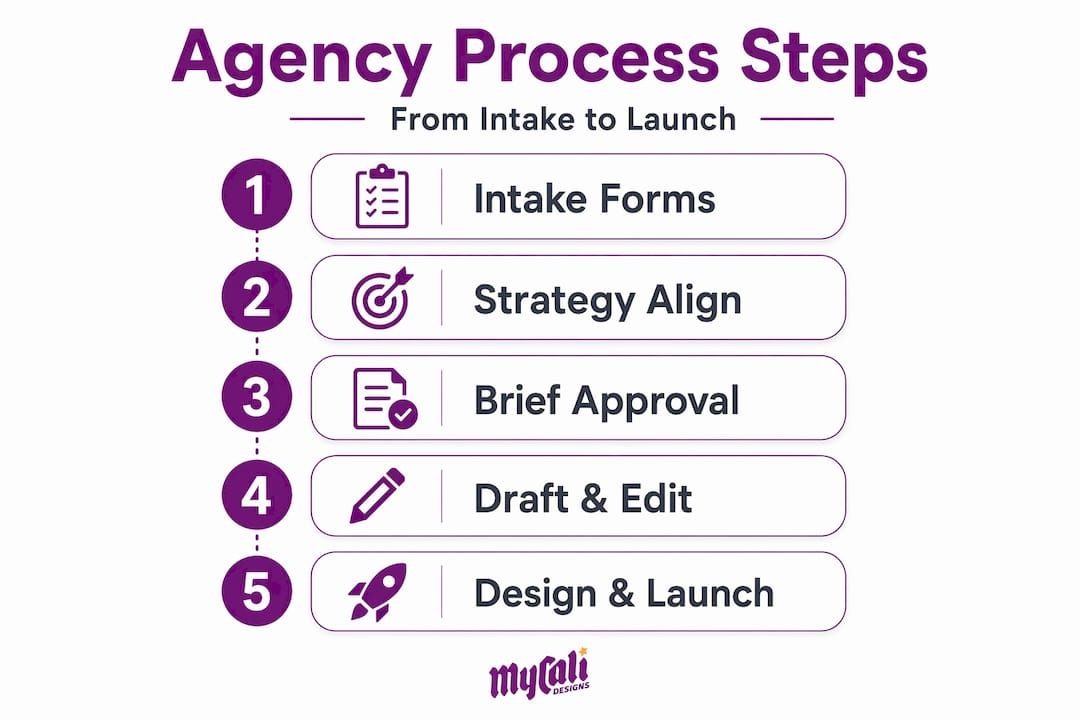
A repeatable agency content workflow includes client intake, strategy alignment, brief approval, drafting, structural and copy editing, client approval, and performance measurement. Each stage feeds the next in sequence.
How long should client onboarding take for content marketing?
A 30-day onboarding cadence is the standard, covering kickoff, intake, access, audit, strategy approval, and reporting setup. Shorter onboarding tends to produce strategic drift and rework later.
What is a "deemed approved" clause and why does it matter?
A deemed approved clause states that content not reviewed within a set window (typically three business days) is considered approved and moves to publishing. This SLA structure converts open-ended approval delays into a defined, contractual process.
How many revision rounds should agencies include in a content scope?
Two revision rounds is the agency standard. Defining this in writing at the scoping stage, along with what counts as a revision versus a scope change, protects team capacity and prevents unbounded feedback cycles.
Should agencies standardize processes before choosing content marketing tools?
Yes. The most common workflow failures in agencies come from planning disconnect and feedback chaos, both of which tools amplify if the underlying process is undefined. Standardize the workflow on paper first, then select tools that match it.
Recommended
Recent Posts