




Why Hire a Marketing Agency for Your Business Growth
Why Hire a Marketing Agency for Your Business Growth

TL;DR:
- Hiring a marketing agency yields 43% higher ROI than managing marketing in-house due to expertise, speed, and cost savings. Agencies provide specialized services, faster campaign launches, and scalable solutions, making them more effective than internal teams. A hybrid model with internal strategy and external execution often maximizes growth and efficiency.
Most business owners searching for why hire a marketing agency already sense something is missing. Their marketing feels scattered, inconsistent, or simply not producing results. Here is a number worth stopping on: businesses that outsource marketing see 43% higher ROI on average than those managing it internally. That is not a marginal difference. It reflects a structural advantage that agencies hold over even well-resourced in-house teams. This article breaks down what that advantage actually looks like in practice, what it costs, and how to decide whether an agency partnership is the right move for your business right now.
Key takeaways
| Point | Details |
|---|---|
| Significant cost savings | Agencies typically cost 60–70% less than building an equivalent in-house team. |
| Faster campaign execution | Agencies can launch optimized campaigns within 30 days versus months for in-house onboarding. |
| Specialized expertise on demand | You get SEO, paid media, content, and design specialists without hiring each role separately. |
| Built-in flexibility | Agency engagements scale up or down based on your business cycle without layoffs or rehiring. |
| Relationship management matters | Clear goals and internal accountability are what separate productive agency partnerships from wasted spend. |
Why hire a marketing agency instead of building in-house
The math on in-house marketing teams surprises most business owners when they see it laid out plainly. A mid-level in-house marketing team with a manager, SEO specialist, content writer, and paid media buyer can easily run $450,000 to $670,000 annually once you factor in salaries, benefits, software subscriptions, office overhead, and recruiting fees. Agency retainers for comparable coverage typically range from $36,000 to $180,000 per year. That is a 60–70% cost reduction for the same functional output.

Beyond salary, consider what gets missed in most comparisons.
Recruitment carries hidden costs. Replacing a single marketing hire can cost 15–30% of that person's salary in recruiting fees alone, before accounting for ramp-up time and lost campaign continuity. An agency absorbs that risk. If a team member leaves their side, your campaigns keep running.
Software access is often underestimated. Enterprise-grade marketing platforms covering SEO audits, paid media automation, analytics dashboards, and heat mapping can cost $1,000 to $5,000 per month when purchased independently. Agencies spread tool costs across clients, so you get full access to that stack without paying for the entire license yourself.
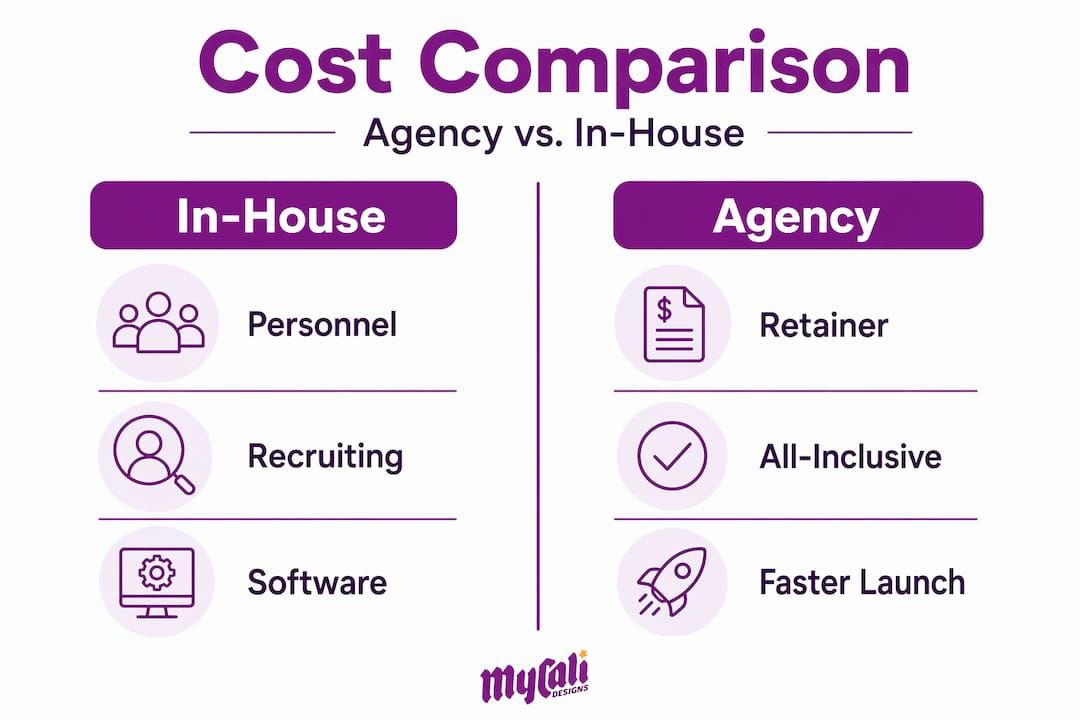
Here is a quick cost comparison across key categories:
| Cost category | In-house team | Agency retainer |
|---|---|---|
| Annual personnel cost | $450,000–$670,000 | Included in retainer |
| Marketing software stack | $12,000–$60,000/year | Included in retainer |
| Recruiting and onboarding | $10,000–$50,000 per hire | No cost to client |
| Campaign launch timeline | 3–6 months | 30 days or less |
| Total estimated annual cost | $500,000+ | $36,000–$180,000 |
Speed is another factor that rarely gets proper attention. Agencies launch optimized campaigns within 30 days because the systems, tools, and people are already in place. An in-house hire, by contrast, spends the first 60 to 90 days learning your business, building access, and getting approvals. In a competitive market, that timeline gap has real commercial consequences.
Pro Tip: When evaluating agency costs, always calculate the fully loaded in-house equivalent, including benefits, software, training, and management time. The gap between the two numbers is almost always larger than you expect.
The expertise advantage agencies bring
There is a ceiling on how much any single in-house marketer can specialize. A great content writer is not also a technical SEO specialist. A paid media buyer who manages Google Ads every day is not equally skilled at organic social strategy. When you hire one or two generalists in-house, you get decent coverage across the board and deep expertise in none of it.
Agencies are structured differently. A well-run agency gives you access to specialists across every channel without you needing to recruit, manage, or retain each one as a separate employee. The channels that typically require distinct expertise include:
- SEO and technical optimization: Structured data, site architecture, and content strategy working together
- Paid media (PPC): Google Ads, Meta Ads, and programmatic buying with budget efficiency as the core discipline
- Content marketing: Editorial planning, writing, and distribution calibrated to your audience
- Social media management: Platform-specific strategy, not generic posting
- Analytics and reporting: Turning raw data into decisions, not just dashboards
- Brand design: Visual systems that build recognition and trust over time
Beyond depth of specialization, agencies bring something equally valuable: cross-industry pattern recognition. A tactic that generated strong lead volume for an e-commerce client can often be adapted for a B2B service provider with the right adjustments. Your in-house team will never see patterns across industries because they only see your industry. An agency working across multiple sectors sees what is working right now, in adjacent markets, and can apply those lessons to your campaigns faster.
"The best agency partnerships feel less like vendor relationships and more like having a well-connected growth team that happens to sit outside your building."
This cross-industry exposure also helps with problem-solving. When your campaigns hit a plateau, an agency draws on a wider set of case studies and test results than an internal team ever could. That breadth of reference is one of the most undervalued reasons to hire marketing experts rather than building an isolated in-house function.
Flexibility and scalability that in-house teams cannot match
One of the structural limitations of in-house marketing is fixed headcount. You hire for your current level of need, which means you are overstaffed during quiet periods and understaffed during product launches or seasonal peaks. Agencies solve this problem directly.
Here is how flexible agency engagements typically work in practice:
-
Launch or peak season scaling. When you are preparing for a product launch, a new market entry, or a seasonal campaign push, you can add channels, increase ad spend, and expand content output without hiring additional staff. The agency absorbs that capacity demand.
-
Scaling back without disruption. If business slows or priorities shift, you adjust the retainer scope. There are no layoffs, no severance conversations, and no loss of institutional knowledge. You simply recalibrate the engagement.
-
Pivoting on underperforming campaigns. When a campaign is not delivering, an agency can redirect budget and strategy quickly. In-house teams often face internal politics and approval layers that slow down the same decision. Agencies are built to move.
-
Predictable budget management. Agency retainers give you a fixed monthly cost that is easy to plan around. Contrast that with in-house payroll, which carries fixed costs regardless of whether your marketing is active or paused.
The hybrid marketing model has become a practical middle path for many growing businesses. You maintain one or two in-house people who hold your brand knowledge, manage the relationship, and define strategy. The agency handles execution across specialist channels. This keeps your brand voice consistent while giving you the execution firepower of a full team.
Pro Tip: Before signing an agency retainer, map out your marketing calendar for the next 12 months. Identify your two or three highest-intensity periods. Make sure your agency agreement has defined provisions for scaling scope during those windows.
Making an agency relationship actually work
Knowing the benefits of hiring a marketing agency is one thing. Getting those benefits reliably requires work on your side of the relationship. Poorly managed agency relationships waste budget and produce little commercial value, and the failure almost always traces back to unclear goals or absent internal leadership.
Here is what separates productive agency partnerships from expensive disappointments:
- Define outcomes before deliverables. Tell your agency what business result you need, not just what content you want produced. "Increase qualified leads from organic search by 30% in six months" is a workable goal. "Post three times a week on Instagram" is an activity, not an objective.
- Choose agencies with relevant sector experience. A firm that has served businesses like yours understands your buyer's behavior, your competitive context, and the content formats that resonate in your market. General experience matters, but specific pattern recognition matters more.
- Require reporting tied to business outcomes. Monthly reports should show you leads, conversions, cost per acquisition, and revenue attribution, not just impressions and follower counts. Vanity metrics are easy to generate and difficult to act on.
- Commit internal resources to the relationship. Someone in your company needs to own the agency relationship. That means attending briefings, reviewing work promptly, providing feedback, and making decisions. Agencies amplify your direction. They cannot replace it.
- Start with a foundation before scaling. Hiring an agency before you have consistent content, a functioning website, and basic email communication in place sets the engagement up to underdeliver. Agencies amplify what exists; they do not create foundational processes from scratch.
The question of whether you need a marketing agency comes down to a simple diagnostic: Are you consistently producing marketing output that moves your business metrics, or are you churning activity without measurable progress? If it is the latter, an agency partnership is worth serious evaluation.
My perspective on the agency vs. in-house question
I have watched a lot of businesses make this decision, and I will tell you where I see people go wrong most often. They treat the marketing agency vs. in-house question as a permanent binary. In my experience, it is not. The most effective model I have seen is what I think of as a hub-and-spoke arrangement: a lean internal hub that owns strategy and brand direction, with agency specialists plugged in as spokes for execution.
What I have learned is that agencies excel when you give them something to work with. The businesses that get the most from an agency partnership are ones where someone internally has done the hard thinking: who is our customer, what makes us different, and what does growth actually look like for us? When that foundation exists, a good agency multiplies it. When it does not, even the best agency will spin its wheels.
I also think people underestimate how much modern agencies have evolved in the last few years. The old model of an agency as a production shop you hand briefs to is mostly gone. The agencies worth working with today are tracking your revenue numbers, adjusting campaigns based on conversion data, and flagging strategy gaps you have not noticed yet. That is a fundamentally different relationship, and it is worth paying for.
My honest take: if you are a small or medium business owner spending more than 10 hours a week managing scattered marketing tasks without clear ROI, you do not have a budget problem. You have a structure problem. An agency does not just save you money. It gives your marketing a professional backbone it probably does not have yet.
— Cesar
How Mycalidesigns can support your growth
At Mycalidesigns, we built our services around exactly the kind of businesses this article is written for. Small and medium businesses that need professional marketing execution without the overhead of a full in-house team. What started as design work grew into branding systems, websites, SEO, and digital marketing because our clients kept asking for more, and we kept delivering results.
Whether you are looking to build a recognizable brand, drive more traffic through SEO and website strategy, or run paid social and Google Ads campaigns that actually convert, we offer a full range of services designed for your stage of growth. Our model is transparent: clear reporting, defined goals, and a single point of contact so you always know what is happening and why. If you are ready to stop guessing and start growing, we would like to hear about your business. Explore our digital marketing services or reach out to start a conversation.
FAQ
Why hire a marketing agency instead of a full-time employee?
An agency gives you access to multiple specialists across SEO, paid media, design, and content for roughly the same cost as one mid-level hire. You also avoid recruiting risk, onboarding delays, and the disruption of employee turnover.
How much does a marketing agency typically cost?
Agency retainers generally range from $3,000 to $15,000 per month depending on scope and channel mix. That compares to $450,000 or more annually for a comparable in-house team when you include salaries, benefits, and software.
How quickly can an agency launch marketing campaigns?
Most agencies can launch optimized campaigns within 30 days. In-house teams typically require three to six months of onboarding before they are fully operational and producing consistent output.
What are the main benefits of hiring a marketing agency?
The primary benefits include significant cost savings, faster execution, access to specialist expertise across multiple channels, enterprise-grade tools included in the retainer, and the flexibility to scale your marketing up or down without changing headcount.
Do I need a marketing agency if I already have someone handling marketing in-house?
A hybrid approach often delivers the best results. Your in-house person manages strategy and brand oversight while the agency handles specialist execution in channels like SEO, paid media, or content. This model captures the advantages of both without the cost of a full in-house team.
Recommended
Recent Posts