



What Is a Design Audit? A Guide for Marketers
What Is a Design Audit? A Guide for Marketers

TL;DR:
- A design audit is an evidence-based review of a digital product that identifies usability, accessibility, and visual issues. It helps prioritize fixes to improve trust, user experience, and conversions, focusing on key evaluation areas like usability, accessibility, visual consistency, information architecture, and conversion friction. Regular audits ensure ongoing consistency, enhance brand integrity, and support continuous marketing performance improvement.
A design audit is a structured, evidence-based review of a digital product against usability, accessibility, and visual consistency standards that identifies issues and prioritizes improvements. Think of it as a diagnostic checkup for your brand's digital presence. Experts conduct the review without user involvement, measuring your website or app against recognized standards like WCAG accessibility guidelines and Nielsen's 10 usability heuristics. The output is a prioritized list of fixes that directly affect brand trust, user experience, and conversion performance. For marketing professionals and business owners, a design audit is one of the fastest ways to find out why your digital presence is underperforming and what to do about it.
What is a design audit and what does it evaluate?
A design audit covers five core evaluation areas, each tied directly to marketing outcomes. Understanding these areas helps you ask the right questions before commissioning an audit or reviewing its findings.
- Usability: Reviewers examine navigation structures, user flows, and task completion paths. Broken flows in checkout or signup are common culprits behind high drop-off rates.
- Accessibility: Auditors check measurable criteria including text contrast ratios such as a minimum 4.5:1 for body text, visible focus states, keyboard navigation, and touch targets of at least 44x44px. Accessibility failures also create legal exposure under the Americans with Disabilities Act.
- Visual consistency: Typography, color usage, spacing, and UI components are compared against your brand's design system or style guide. Inconsistencies here erode user confidence faster than most marketers realize.
- Information architecture: Labels, content hierarchy, and page structure are reviewed for clarity. Confusing labels increase cognitive load and reduce time on site.
- Conversion friction: Auditors identify specific points in onboarding, signup, or checkout flows where users are likely to abandon. These findings connect directly to revenue.
Each of these areas feeds into a single outcome: a digital experience that builds trust and converts visitors into customers. A visual design audit specifically reviews logos, typography, UI components, imagery, and spacing to identify inconsistencies that weaken brand identity and usability.
Pro Tip: Before scheduling an audit, pull your Google Analytics or Hotjar data and identify your three highest-exit pages. Share that data with your auditor so the review starts where your business is already losing.
How to conduct a design audit effectively
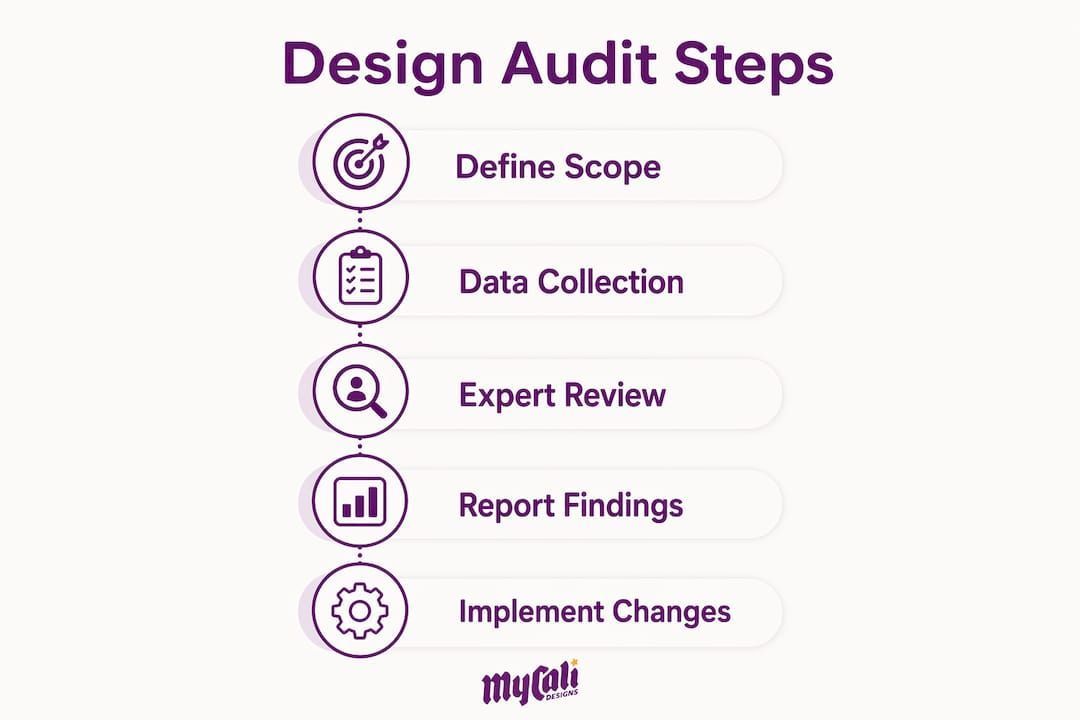
The design audit process works best when it follows a clear sequence. Skipping steps, especially scoping, is the most common reason audits produce reports that no one acts on.
-
Define the scope. Scoping by user journey or asset type keeps the review focused and produces results you can act on. Auditing your entire website at once often leads to a 40-page deck that overwhelms stakeholders. Instead, focus on one critical flow, such as onboarding or checkout, or one component family, such as forms or navigation.
-
Define evaluation criteria upfront. Choose your standards before reviewing a single screen. Common frameworks include Nielsen's 10 heuristics for usability, WCAG 2.1 for accessibility, and your own brand style guide for visual consistency. Pre-defining criteria prevents the audit from becoming a collection of personal opinions.
-
Conduct the expert review. One or two experienced reviewers work through the scoped area systematically, documenting every issue they find. Screenshots, annotated mockups, and screen recordings all serve as useful evidence.
-
Rate findings by severity. A design audit report should include each finding with a severity rating, a clear owner, and specific next actions. Without this structure, findings get ignored. Use a simple scale: critical, major, minor.
-
Integrate findings into your backlog. Audit outputs belong in your project management tool, whether that is Jira, Asana, or Linear. Each finding becomes a ticket with an owner and a deadline. This step is what separates audits that change things from audits that collect dust.
Pro Tip: Run a focused audit on a single high-traffic landing page before committing to a full site review. You will surface enough issues to build a compelling internal case for broader investment.
Design audit vs. usability testing: what marketers need to know
These three methods are often confused, and using the wrong one at the wrong time wastes budget. Here is how they differ and when to use each.
| Method | Who is involved | What it finds | Speed and cost |
|---|---|---|---|
| Design audit | Expert reviewers only | Known usability, accessibility, and visual issues | Fast and low cost |
| Usability testing | Real users observed | Unexpected behavior and emotional friction | Moderate time and cost |
| UX audit | Experts plus analytics data | Combines qualitative and quantitative findings | Moderate time and cost |
Design audits are expert reviews conducted without users present. This makes them faster and cheaper than usability testing, which observes real users interacting with a product. The trade-off is that audits catch known issues while usability testing uncovers unexpected problems that even experienced reviewers miss.
UX audits blend qualitative expert evaluation with quantitative data such as web analytics and conversion metrics. This combined approach prevents findings from being purely subjective and helps teams prioritize fixes based on real user behavior. VWO, Hotjar, and Google Analytics are common data sources for this layer.
Heuristic evaluation is a specific auditing method that scores design issues against Nielsen's 10 recognized usability principles. It provides a structured snapshot but differs from a full UX audit that integrates analytics and user research.
The practical recommendation for most marketing teams: run a design audit first to fix known issues quickly and cheaply, then follow up with usability testing to catch what the audit missed.
Why visual consistency matters more than you think
Visual inconsistency is the silent conversion killer most business owners overlook. When your homepage uses one font family, your landing pages use another, and your email templates use a third, users sense the disconnect even if they cannot name it. That sense of disorder reduces trust.
Inconsistent colors, fonts, or imagery confuse users and harm brand trust. A visual audit realigns your visual language across all touchpoints. The common issues a visual audit surfaces include:
- Logo variations used inconsistently across pages and platforms
- Typography that drifts from the brand's defined type scale
- Button styles and colors that vary without a logical system
- Image styles that mix stock photography with illustrations without a clear rationale
- Spacing and padding that is applied inconsistently across components
Fixing these issues does more than improve aesthetics. It makes your marketing more efficient. When your design system is consistent, your team produces new assets faster, with fewer revision cycles. Think of it as removing "too many cooks in the kitchen" from your production process.
Treating a design audit as a one-time fix rather than an ongoing process leads to recurring inconsistencies and erodes brand integrity over time. The brands that maintain the strongest visual identities schedule quarterly or semi-annual visual reviews as part of their standard marketing operations. You can use a visual identity checklist to keep those reviews structured and repeatable.
Pro Tip: Build a one-page brand reference card with your exact hex codes, font names, and approved logo files. Share it with every vendor, contractor, and internal team member who touches your brand. This single document prevents most visual inconsistencies before they start.
Applying audit results to improve marketing performance
Finding issues is only half the work. The other half is turning findings into decisions that move your marketing metrics.
-
Sort findings by severity and business impact. Critical issues that block task completion or violate accessibility standards get fixed first. Marketers should prioritize findings that produce measurable improvements in conversion and engagement rather than aesthetic preferences. A broken form field outranks a misaligned logo in every sprint.
-
Assign clear ownership. Every finding needs one owner, not a committee. Assign each ticket to a specific designer, developer, or marketing manager with a due date. Shared ownership is no ownership.
-
Separate quick wins from strategic improvements. Quick wins are fixes that take less than a day and deliver immediate impact, such as correcting a broken CTA button color or fixing a missing alt text on a hero image. Strategic improvements require design system updates or development work and belong in a longer planning cycle.
-
Connect fixes to KPIs. Before closing a ticket, define how you will measure success. A checkout flow fix should be measured against cart abandonment rate. An accessibility fix should be tracked against web accessibility compliance metrics and bounce rate. This discipline keeps your audit from becoming a one-time cleanup exercise.
-
Schedule the next audit. Ongoing backlog updates and design system maintenance are what sustain brand consistency after the initial audit is complete. Build the next review into your marketing calendar before you close out the current one.
Key takeaways
A design audit is the most cost-effective method for identifying usability, accessibility, and visual consistency issues before they damage brand trust or block conversions.
| Point | Details |
|---|---|
| Start with scope | Focus on one user journey or component family to produce findings you can actually act on. |
| Rate every finding | Assign severity, an owner, and a next action to every issue so nothing gets ignored. |
| Audits complement testing | Use design audits for fast, expert diagnosis and usability testing to catch unexpected user behavior. |
| Visual consistency drives trust | Inconsistent fonts, colors, and components reduce user confidence and slow down your marketing team. |
| Make audits ongoing | Schedule regular reviews to prevent inconsistencies from rebuilding after the initial audit is complete. |
What I have learned running design audits for growing businesses
Most business owners come to us expecting a design audit to be a one-time project with a clear finish line. That expectation sets them up for disappointment. The audit itself is straightforward. The hard part is what happens after the report lands.
The teams that get real value from audits are the ones that treat findings as a backlog, not a to-do list. There is a meaningful difference. A backlog is prioritized, owned, and revisited every sprint. A to-do list gets buried under the next campaign deadline.
I have also seen a pattern where audit reports become too long to be useful. A 60-slide deck with 80 findings does not help a marketing director decide what to fix this week. Strong audit frameworks pre-define evaluation criteria and classify findings by severity to keep reports concise and actionable. The best audit reports I have seen fit on two pages and answer one question clearly: what are the top five things we fix right now?
My honest advice is to resist the urge to audit everything at once. Pick your highest-traffic conversion path, run a focused review, fix what you find, and measure the result. That cycle builds internal confidence and creates a repeatable process. Over time, that process becomes your competitive advantage.
— Cesar
How Mycalidesigns can help you act on your audit findings
If your design audit has surfaced brand inconsistencies, outdated visual assets, or a logo that no longer reflects where your business is headed, Mycalidesigns is built for exactly that moment.
We help businesses translate audit findings into a cohesive brand identity system that holds up across every digital touchpoint. From custom logo design to full branding packages, our team works with you to build the visual foundation your marketing needs to perform. We also offer website and SEO services to implement the technical and design improvements your audit recommends. Whether you need a brand refresh or a complete design system built from scratch, we are ready to help you move from findings to finished.
FAQ
What is a design audit in simple terms?
A design audit is an expert review of a website or digital product that checks for usability problems, accessibility issues, and visual inconsistencies. It produces a prioritized list of fixes without requiring any user testing.
How long does a design audit take?
A focused audit scoped to a single user journey or component family can be completed in a few hours to two days. A full-site audit typically takes one to two weeks depending on the size and complexity of the product.
What is the difference between a design audit and a UX audit?
A design audit focuses on visual consistency, usability standards, and accessibility criteria reviewed by experts. A UX audit combines that expert review with quantitative data from analytics and conversion metrics for a broader diagnosis.
What does a design audit checklist include?
A standard design audit checklist covers navigation and user flows, color contrast ratios, typography consistency, button and component styles, accessibility compliance against WCAG standards, and conversion friction points in key user journeys.
How often should a business run a design audit?
Most businesses benefit from a design audit every six to twelve months, or after any major website update or brand refresh. Treating audits as ongoing reviews rather than one-time events prevents inconsistencies from rebuilding over time.
Recommended
Recent Posts