




SMB website design guide: launch with confidence in 7 steps
SMB website design guide: launch with confidence in 7 steps

A poorly designed website does not just look bad. It actively costs you business. 83% of SMBs now have websites, yet many of those sites fail to convert visitors into real leads because they were built without a clear strategy. If your site is slow, confusing, or missing key information, potential customers are quietly clicking away to a competitor. This guide walks manufacturing and service business owners through every stage of the web design process, from laying the groundwork to measuring results after launch, so your site works as hard as you do.
Table of Contents
- What you need before designing a website
- Step-by-step website design: from planning to publish
- Common mistakes and how to avoid them
- Verifying launch success and ongoing improvement
- Why most website guides fail and what really works for SMBs
- Take the next step with professional help
- Frequently asked questions
Key Takeaways
| Point | Details |
|---|---|
| Plan first | A well-defined goal and clear content lay the foundation for a successful small business website. |
| Execute with focus | Follow a step-by-step approach emphasizing speed, mobile usability, and clear calls to action. |
| Measure what matters | Judge your site by qualified leads and customer actions, not just pageview numbers. |
| Ongoing improvements | Regularly update and test your website to maintain speed, security, and relevance. |
What you need before designing a website
Before you dive into actual design, it is essential to lay the groundwork for a site that delivers. Skipping this stage is one of the most common reasons business owners end up with a site they are not happy with six months later. Think of it like building a production floor: you plan the layout before you move the equipment.
Start by defining what you actually want the website to do. The three most common goals for SMBs are generating leads, building credibility, and supporting sales. Be specific. "Get more customers" is not a goal. "Capture 10 qualified service inquiries per month through a contact form" is.

Next, identify your core audience and your key message. Who are they, and what problem do you solve for them? Your homepage headline should answer both questions in one sentence.
Here is what to gather before any design work begins:
- Business goals (lead gen, credibility, e-commerce)
- Target audience profile (industry, location, pain points)
- Core services or products with clear descriptions
- Contact details , hours, and location information
- Brand assets (logo, brand colors, existing photography)
- Testimonials and differentiators that set you apart
Choosing the right platform matters too. Here is a quick comparison to help you decide:
| Platform | Best For | Ease of use | Cost range |
|---|---|---|---|
| Wordpress | Custom, scalable sites | Moderate | $500+ |
| Squarespace | Simple, polished sites | Easy | $16-$49/mo |
| Wix | Quick DIY setup | Very easy | FREE-$45/mo |
| Custom build | Complex functionality | Requires a pro | $3,000+ |
Your website SEO essentials should also be considered at this stage, not as an afterthought. According to research, 60-70% of leads come directly from clear, well-structured service pages. If you have questions about what your site needs, our website design FAQs are a helpful starting point.
Pro Tip: Collect three to five strong customer testimonials now. They are among the most persuasive elements on any service business website and are easy to overlook until the last minute.
Step-by-step website design: from planning to publish
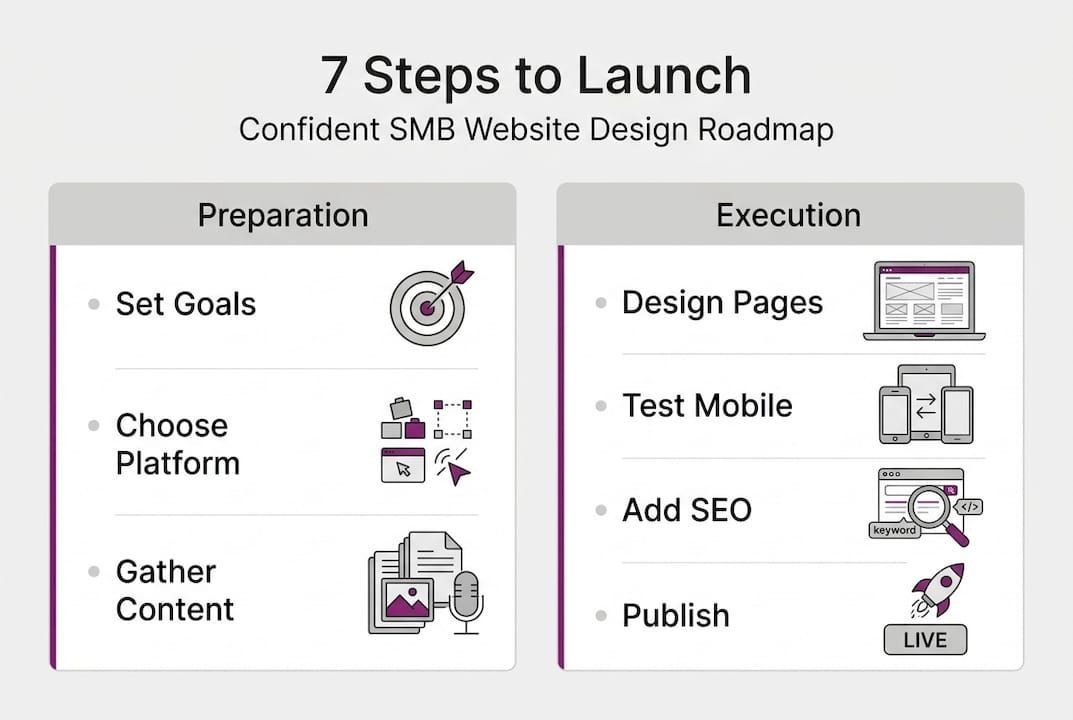
With preparation complete, it is time to transform ideas and goals into an effective web presence. Follow these steps in order and you will avoid the most common launch delays.
-
Map your site structure. Start with the core pages every SMB needs: Home, About, Services, Contact. Add industry-specific pages as needed, such as a Project Gallery for manufacturers or a Booking page for service businesses.
-
Choose your design approach. Decide early whether you are building it yourself or working with professionals. Here is a side-by-side comparison:
| Approach | Time Investment | Cost | Best result |
|---|---|---|---|
| DIY builder | High (owner's time) | Low ($0-50/mo) | Basic presence |
| Freelancer | Medium | Moderate ($1,000-$3,000) | Custom look |
| Full-service agency | Low (owner's time) | Higher ($3,000-$10,000+) | Strategy-driven site |
If your website needs to generate real revenue, finding the right web agency is worth the investment. A good agency brings strategy, not just design skills.
-
Write and organize your content. Every page needs a clear headline, a short description of the value you offer, and a call to action (CTA). CTAs should be specific: "Request a free quote" converts better than "Contact us."
-
Build and preview on mobile first. Over half of all web traffic comes from mobile devices. Design for a small screen first, then scale up. Check that buttons are tappable, text is readable, and images load cleanly.
-
Test before you launch. Run your site through a speed checker. Review all forms, links, and CTAs. Ask someone unfamiliar with your business to navigate the site and tell you what they think you do.
Research shows that a mobile load under 2.5 seconds is the standard to aim for, and hitting that target can increase leads by 25-60% post-launch. Your website and SEO best practices guide covers the technical side in detail.
Pro Tip: Never launch without a clear CTA on every single page. Even your About page should invite visitors to take a next step.
Common mistakes and how to avoid them
Execution is only as strong as the pitfalls you avoid. Let's safeguard your new site before problems show up.
Most website mistakes are not design mistakes. They are strategy mistakes. The site looks fine but fails to perform because the fundamentals were overlooked. Here are the most common errors we see from SMBs, and exactly how to fix them:
- Slow load times. Compress all images before uploading. Limit the number of plugins or third-party scripts. Use a reliable hosting provider. As the research makes clear, every extra second of load time loses 7% of your visitors.
- Unclear service pages. Each service should have its own dedicated page with a headline, description, benefits, and a CTA. Lumping everything onto one page dilutes your message.
- Poor navigation. Keep your main menu to five items or fewer. Visitors should find what they need in two clicks or less.
- Missing contact methods. Include a phone number, email, contact form, and if relevant, a physical address. Make it impossible for a prospect to give up trying to reach you.
- Keyword stuffing. Writing for search engines instead of humans backfires. Write naturally, then optimize. Understand the SEO benefits for business sites before you start writing page content.
"Every extra second of load time loses 7% of your website visitors. For a manufacturing or service business, that is not a technical metric. That is a missed sales opportunity."
If you are unsure how SEO fits into your overall site strategy, the SEO FAQ breaks it down without the technical overload.
Verifying launch success and ongoing improvement
Launching is not the finish line. It is the start of real business value. Here is how to verify your site is working and keep improving it over time.
Right after launch, run through this checklist:
- Contact forms are submitting correctly and routing to the right inbox.
- Page speed is under 2.5 seconds on mobile (test with Google PageSpeed Insights).
- Mobile usability is confirmed across at least two different device types.
- Lead tracking is set up, whether through Google Analytics, a CRM, or a simple inquiry log.
- All links are live and pointing to the correct pages.
Once the site is live, resist the urge to obsess over vanity metrics like total page views. Instead, track qualified leads, meaning people who actually reach out about your services. That is the number that connects directly to revenue.
Stat to know: 43% of SMBs plan regular site upgrades as part of their ongoing strategy. The businesses that treat their website as a living asset consistently outperform those that launch and forget.
Connect your site to digital promotion tools like Google Ads or social media campaigns to amplify the traffic your new site receives. And revisit your SEO for new sites strategy every quarter to stay competitive in search results.
Pro Tip: Schedule a 30-minute site review every quarter. Update service descriptions, swap in fresh images, and confirm that your contact information is current. Small, consistent improvements compound over time.
Why most website guides fail and what really works for SMBs
You may have noticed a common thread running through everything above. The advice that actually moves the needle is not glamorous. It is practical.
Most website guides spend too much time on aesthetics and not enough on conversion strategy. They celebrate beautiful design while ignoring whether the site actually captures leads. We have seen manufacturers invest in stunning websites that generated zero inquiries because the service pages were vague and the contact form was buried.
Here is the uncomfortable truth: a clean, fast, clearly structured website with strong CTAs will outperform a visually impressive site with poor usability every single time. Fancy animations and custom illustrations are nice to have. Load speed, clear navigation, and a visible phone number are non-negotiable.
We also want to be honest about perfection. Do not wait until everything is perfect to launch. A functional site that goes live this month will generate more business than a perfect site that launches in six months. Launch with your core pages, then improve based on real user behavior.
Avoid the trap of agency pitfalls by choosing a partner who asks about your business goals before they talk about design. The best agencies lead with strategy, not software.
"Done is better than perfect. Launch your site, measure what matters, and improve from there. The businesses that win online are the ones that keep showing up."
Take the next step with professional help
You now have a clear framework for planning, building, and improving a website that works for your business. That foundation is powerful. But if you would rather focus on running your business while experts handle the strategy and execution, we are here for that.
At Cali Designs, we help manufacturing and service SMBs build sites that generate real leads, not just impressions. Whether you need help with web design and strategy, business branding services that make your company memorable, or a full review of your all agency services, our team is ready to collaborate. Let's build something that actually works for your bottom line.
Frequently asked questions
How long does designing a business website usually take?
Most SMB websites can be designed and launched in 2-6 weeks, depending on site complexity and how quickly content and assets are provided by the business owner.
How much should I budget for a professional small business website?
Expect to invest between $2,000 and $10,000 for a quality, professionally built SMB site, with the range depending on features, number of pages, and the agency's experience level.
What is the biggest mistake to avoid in website design?
Failing to prioritize mobile speed and clear calls to action leads to the highest loss of leads. Research confirms that every extra second of load time costs 7% of your visitors.
How do I measure if my new website is working?
Track qualified leads and direct customer inquiries rather than total page views. As research on SMB sites confirms, vanity metrics do not reflect real business impact.
Do I need to regularly update my business website?
Yes. Ongoing updates protect site security, maintain speed, and keep your services current. 43% of SMBs already plan regular performance upgrades as part of their strategy.
Recommended
Recent Posts