




Design thinking: transform customer experience in 2026
Design thinking: transform customer experience in 2026

Innovation doesn't have to mean million-dollar R&D budgets or high-stakes product launches. Many manufacturing and service companies quietly achieve major customer satisfaction gains by using a structured, human-centered problem-solving approach called design thinking. The misconception that breakthrough ideas belong only to tech giants keeps too many business leaders on the sidelines. In reality, design thinking is one of the most accessible and low-cost entry to innovation methods available to small and medium enterprises (SMEs) today. This article breaks down exactly what design thinking is, how it works in real businesses like yours, and how you can start applying it right now.
Table of Contents
- What is design thinking and why does it matter?
- How design thinking drives customer experience in real businesses
- How design thinking compares to traditional approaches
- Getting started: Practical steps to implement design thinking
- The uncomfortable truth about design thinking most leaders miss
- Unlock innovation at your company with expert design thinking support
- Frequently asked questions
Key Takeaways
| Point | Details |
|---|---|
| Human-centered innovation | Design thinking helps businesses innovate by focusing on real customer needs and solutions. |
| Proven results | Companies like GE Healthcare saw up to 90% higher satisfaction by applying design thinking. |
| Low risk, high flexibility | Design thinking enables small and medium businesses to innovate without large investments or complex projects. |
| Blending methods matters | Combining design thinking with Lean or TQM increases success and avoids common failures. |
| Execution is key | Lasting innovation comes from follow-through, not just creative sessions or workshops. |
What is design thinking and why does it matter?
Design thinking is a problem-solving process that puts the customer at the center of every decision. Instead of starting with what you can build or what technology allows, you start with what your customer actually needs. That shift sounds simple, but it changes everything about how you approach product development, service delivery, and process improvement.
At its core, design thinking moves through five key stages:
- Empathize: Spend time with your customers. Observe them, interview them, and understand their frustrations firsthand.
- Define: Translate what you learned into a clear problem statement. Not "we need a better product" but "our customers lose 20 minutes per service visit because of unclear intake steps."
- Ideate: Generate as many solutions as possible without judgment. Quantity leads to quality here.
- Prototype: Build a simple, low-cost version of your best idea. A sketch, a mock process, or a rough model works fine.
- Test: Put your prototype in front of real users and gather feedback. Then refine and repeat.
This cycle is iterative, not linear. You may loop back from testing to ideation several times before landing on the right solution. That flexibility is exactly what makes it powerful for SMEs, where resources are limited and getting it right the first time matters.
"Design thinking enhances customer experience by prioritizing empathy, user-centricity, rapid prototyping, and cross-functional collaboration, aligning with service and manufacturing needs for efficiency and satisfaction."
For business leaders managing both operational demands and customer expectations, design thinking offers a structured way to tackle both at once. It doesn't require a dedicated innovation lab or a team of consultants. What it does require is a willingness to listen to your customers and act on what you hear. Understanding how design agency operations support this kind of structured thinking can also help you decide when to bring in outside expertise. If you're evaluating whether your business is ready for a larger brand or experience overhaul, brand readiness is a useful starting point.
How design thinking drives customer experience in real businesses
Now that you know the basics, here's how design thinking reshapes customer experience with real-world impact.
One of the most cited examples in manufacturing is GE Healthcare's redesign of MRI machines for pediatric patients. The team observed that children were terrified of the dark, noisy machines, leading to sedation in up to 80% of cases. By applying design thinking, they transformed the MRI suite into an adventure story environment. The result was a 90% increase in patient satisfaction scores. No new technology was invented. The machine itself didn't change. What changed was the entire customer experience around it.

| Before design thinking | After design thinking |
|---|---|
| 80% of pediatric patients required sedation | Sedation rates dropped dramatically |
| High patient anxiety and distress | Children engaged and calm |
| Operational inefficiency from sedation prep | Faster, smoother scan process |
| Low satisfaction scores | 90% satisfaction score increase |
This example matters for your business because the principle scales down perfectly. You don't need GE's resources. You need the same commitment to observing your customers and redesigning the experience around their reality.
For service companies, the parallel is just as strong. Think about your intake process, your customer onboarding, or your post-sale support flow. Where are customers confused, frustrated, or dropping off? Those are your design thinking starting points. Strategies like community growth strategies show how customer-centered design thinking translates into measurable engagement gains even at the SME level. For a closer look at how this plays out in practice, the case study: House of Shah illustrates how a focused design approach reshapes customer perception and loyalty.
An analysis of 221 design thinking consulting projects identified six core practice sets: user needs discovery, problem understanding, assumption challenging, problem-solution navigation, visualization ideation, and prototype learning. What's notable is that the mix of practices varies depending on project goals and uncertainty levels. That means design thinking is not a rigid formula. It adapts to your situation, which is exactly what SMEs need.
How design thinking compares to traditional approaches
With a clear picture of design thinking's real business value, it's helpful to see how it stacks up against older methods and what to watch for.
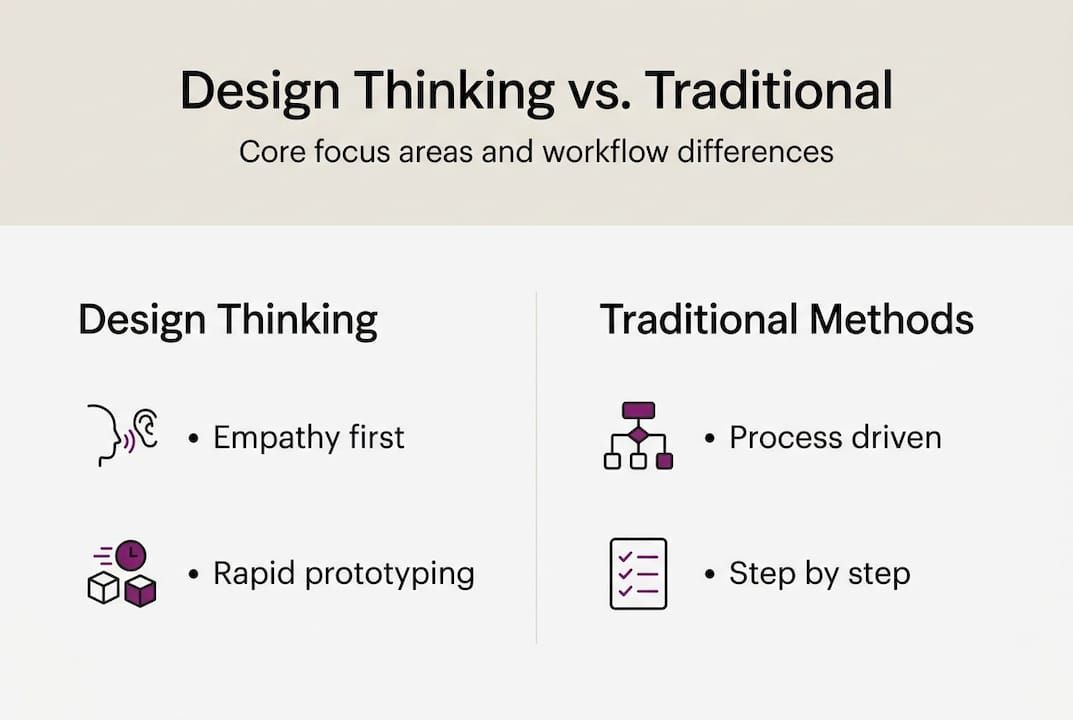
| Factor | Design thinking | Traditional methods |
|---|---|---|
| Starting point | Customer needs and empathy | Internal capabilities or market data |
| Process style | Iterative and flexible | Linear and structured |
| Primary focus | User experience and behavior | Efficiency, cost reduction, compliance |
| Speed to insight | Fast through prototyping | Slower through full development cycles |
| Common pitfall | Can become "innovation theater" | Can miss real customer needs entirely |
Traditional methods like Total Quality Management (TQM) and Lean manufacturing are excellent at reducing waste and standardizing processes. They're built for execution. Design thinking, by contrast, is built for discovery. The real power comes when you blend them.
Here's how to combine design thinking with Lean or TQM for stronger results in manufacturing and service firms:
- Use design thinking to identify the right problem. Lean and TQM assume you already know what to fix. Design thinking helps you find the real issue before you optimize the wrong thing.
- Apply Lean tools to implement the solution. Once you've prototyped and validated a solution through design thinking, use Lean's value stream mapping to scale it efficiently.
- Use TQM to sustain the improvement. Design thinking surfaces the fix; TQM builds the systems to maintain it over time.
- Loop back regularly. Customer needs shift. Schedule quarterly empathy sessions to keep your improvements aligned with reality.
For small-medium manufacturing firms, this blended approach offers the best of both worlds: creative problem-solving paired with disciplined execution.
However, there's a real risk to flag. Design thinking can become"innovation theatre" when there are no clear owners or intermediaries to drive implementation. Workshops feel productive. Sticky notes fill walls. But nothing changes in the business.
Pro Tip: Assign a named owner to every design thinking initiative before the first workshop ends. That person is accountable for moving from idea to implementation. Without that step, even the best insights stall. This is especially relevant when you're also managing digital marketing approaches alongside operational improvements.
Getting started: Practical steps to implement design thinking
Understanding the pros and limitations of design thinking, here's how you can actually put it to work in your business.
- Pick one real customer pain point. Don't try to redesign your entire operation. Choose a specific, observable problem. Talk to five customers about it this week.
- Run an empathy session. Observe the problem in action. Watch how customers interact with your process, product, or service. Take notes on what surprises you.
- Define the problem precisely. Write a single sentence: "[Customer type] needs [specific outcome] because [root cause]." This keeps your team focused.
- Ideate without filters. Give your team 30 minutes to generate solutions. No idea is too wild at this stage. Volume matters.
- Build a rough prototype. This could be a revised intake form, a new workflow diagram, or a physical mock-up. It should take hours, not weeks.
- Test with real customers. Share your prototype with three to five customers and ask for honest feedback. Watch how they use it, not just what they say.
- Iterate and blend. Refine based on feedback. Then use Lean or TQM tools to implement the improved version at scale.
The mechanics emphasize iteration over a linear process, and for manufacturing firms especially, blending with Lean, TQM, or Jidoka (a quality-at-the-source principle) ensures that design thinking solutions hold up under production realities.
Pro Tip: Involve frontline staff from day one. Your machine operators and customer service reps see pain points daily that leadership never hears about. Their involvement builds buy-in and surfaces better solutions faster. For a structured rollout framework, our agency implementation guide walks through how we approach this with clients. And if you want to understand how collaborative communities accelerate adoption, that resource offers a practical lens on team engagement.
The uncomfortable truth about design thinking most leaders miss
Here's what we've observed working with manufacturing and service companies: design thinking gets celebrated in the planning phase and abandoned in the execution phase. Leaders attend a workshop, feel energized, and then return to the same operational pressures that made innovation feel impossible in the first place.
The hard truth is that design thinking is not a creativity exercise. It's a change management commitment. Without leadership buy-in that extends past the workshop room, and without dedicated time and resources for iteration, the process produces insights that gather dust.
As the research puts it, design thinking can become "innovation theatre" when it lacks intermediaries for real implementation and is insufficient alone for systemic change.
We've seen companies avoid this trap by treating design thinking as an ongoing operating rhythm, not a one-time event. Monthly empathy sessions, quarterly prototype reviews, and clear KPIs tied to customer experience metrics keep the process alive. If you want to avoid agency pitfalls and ensure your investment in design thinking produces real results, the discipline of follow-through is non-negotiable.
Unlock innovation at your company with expert design thinking support
Design thinking works best when you have a structured process and experienced partners who've guided it before. The difference between a workshop that energizes your team and one that actually changes your customer experience often comes down to how well the process is facilitated and followed through.
At MyCali Designs, we help manufacturing and service companies translate design thinking into tangible customer experience improvements. From initial empathy research to prototype development and brand alignment, working with a design agency means you get a clear process, not just creative ideas. Explore our full range of agency services to see how we can support your next innovation initiative. Let's build something your customers will actually love.
Frequently asked questions
What are the core stages of design thinking?
The key stages are empathize, define, ideate, prototype, and test, forming a flexible, iterative cycle. An analysis of 221 projects identified six practice sets that vary based on project goals and uncertainty levels.
Does design thinking work for small businesses or just large companies?
Design thinking is especially effective in small and medium businesses because of its low cost, flexible structure, and focus on quick customer wins. Human-centered methods make it accessible regardless of company size or budget.
What is a common mistake to avoid with design thinking?
A frequent pitfall is stopping at workshops and failing to follow through with real implementation, which turns design thinking into "innovation theater." Without implementation intermediaries, even strong insights rarely lead to lasting change.
How does design thinking improve customer experience in manufacturing?
It puts user needs first, resulting in solutions like GE Healthcare's MRI redesign that boosted patient satisfaction by 90% without changing the underlying technology. The same principle applies to any customer-facing process in your operation.
Recommended
Recent Posts