



Industrial Marketing Terminology: 2026 B2B Guide
Industrial Marketing Terminology: 2026 B2B Guide

TL;DR:
- Industrial marketing terminology uses technical language to communicate and measure B2B strategies in industrial sectors. Mastering these terms builds credibility with technical buyers and aligns marketing efforts with long sales cycles. Prioritizing precision and intent-based channels improves pipeline quality and enhances trust among organizational decision-makers.
Industrial marketing terminology is the specialized language that marketing professionals and business owners use to communicate, measure, and execute strategy within business-to-business industrial sectors. Unlike consumer marketing vocabulary, this technical marketing vocabulary centers on specification fit, risk mitigation, buying committees, and pipeline metrics rather than emotional appeals or impulse triggers. Mastering these B2B marketing terms gives you a shared language with engineers, procurement managers, and executives. It signals credibility before a single sales conversation begins.
What is industrial marketing terminology and why does it matter?

Industrial marketing terminology is defined as the set of terms, acronyms, and frameworks used to plan, execute, and measure marketing in industrial B2B environments. The standard industry term for this broader practice is industrial B2B marketing , and the vocabulary that supports it reflects the unique complexity of how industrial buyers make decisions.
Industrial buying cycles can last months, quarters, or even years, with transaction values frequently reaching six or seven figures. That scale means every word in your marketing materials carries weight. A vague claim loses credibility with a procurement committee. A precise technical claim builds it.
Industrial advertising must prioritize technical credibility over emotional appeals, focusing on specification fit, risk mitigation, and verifiable data. This is because purchase decisions are made by internal committees that must justify their recommendations technically. Your terminology has to serve those committee members, not just the person who first clicked your ad.
The difference from consumer marketing language is stark. Consumer vocabulary leans on words like "feel," "love," and "lifestyle." Industrial sales terminology leans on "throughput," "tolerance," "uptime," and "total cost of ownership." Getting that distinction right is the first step toward messaging that actually moves deals forward.
What are the most common industrial marketing terms and acronyms in 2026?
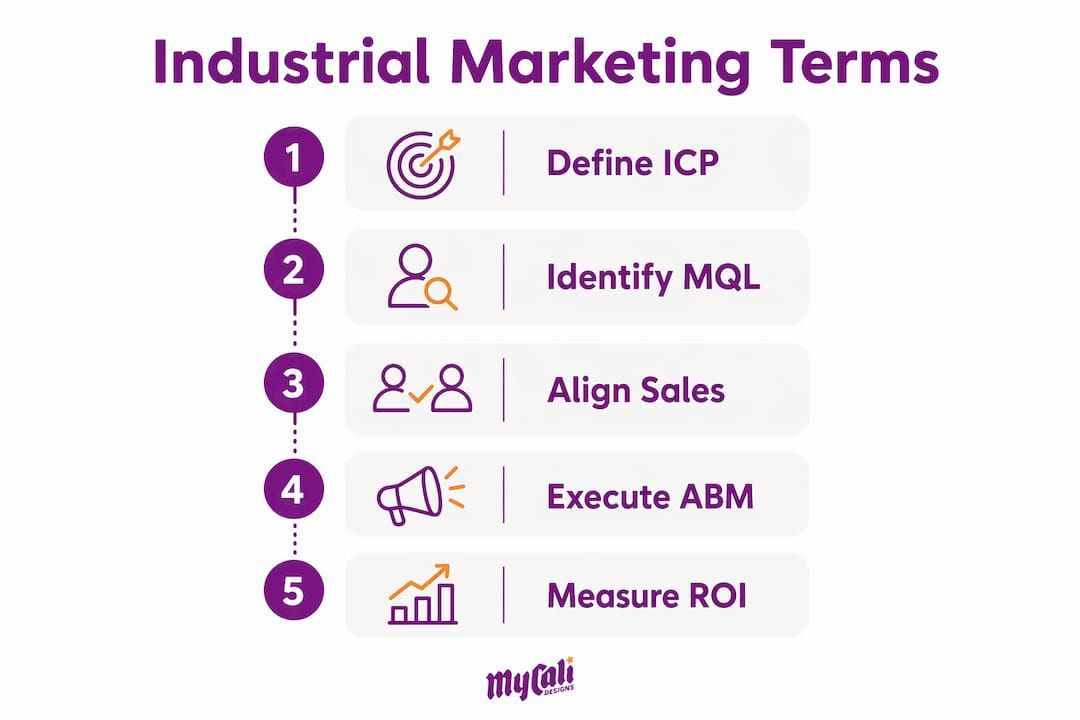
Over 80 common B2B marketing acronyms and phrases are in regular use in 2026. That number can feel like a wall of alphabet soup. The table below covers the terms you will encounter most often, along with their practical application in industrial contexts.
| Term | Definition | Practical application |
|---|---|---|
| ABM (Account-Based Marketing) | Targeting specific high-value accounts with tailored content and outreach | Focus resources on 20 named manufacturers instead of broad awareness campaigns |
| MQL (Marketing Qualified Lead) | A prospect who meets defined engagement criteria set by marketing | A plant manager who downloaded your spec sheet twice and attended a webinar |
| SQL (Sales Qualified Lead) | A lead that sales has reviewed and accepted as worth pursuing | An MQL confirmed by a sales rep as having budget, authority, and a real need |
| ICP (Ideal Customer Profile) | A detailed description of the company type most likely to buy and succeed | Mid-size OEMs in the Midwest with 50–500 employees and a specific production challenge |
| TOFU (Top of Funnel) | Early-stage awareness content targeting buyers who are not yet ready to purchase | Technical blog posts, industry guides, and educational webinars |
| CRM (Customer Relationship Management) | Software and processes for tracking all interactions with prospects and clients | Logging every call, email, and site visit tied to a named account |
| TAL (Target Account List) | A prioritized list of named companies that fit your ICP | The 50 accounts your sales and marketing teams align on for a given quarter |
| SAL (Sales Accepted Lead) | An MQL that sales has formally accepted and committed to follow up | The handoff point between marketing and sales in the lead process |
Pro Tip: Build your ICP before you define your MQL criteria. If your ICP is wrong, your MQL definition will be wrong, and your sales team will waste time on leads that never close.
The terms above form the backbone of most industrial marketing conversations. ABM, in particular, has become the dominant framework for industrial firms because it mirrors how industrial buyers already think: by account, by project, and by relationship rather than by anonymous web traffic.
ABM combines targeted marketing with sales alignment, focusing on personalized messaging for named accounts. That alignment is what separates industrial marketing from broadcast advertising. You are not reaching a demographic. You are reaching a specific company with a specific problem.
How does industrial marketing terminology reflect industrial buying cycles?
Industrial marketing involves longer sales cycles, more technical buyers, higher switching costs, and committee decisions. The terminology used in this space is not arbitrary. Each term maps directly to a stage or dynamic in that complex buying process.
Consider the term pipeline velocity . In consumer marketing, a sale happens in minutes. In industrial marketing, pipeline velocity measures how fast deals move through each stage of a months-long process. Tracking it tells you whether a bottleneck sits in qualification, technical evaluation, or contract approval.
Terms like demand capture and intent-based channels exist because industrial buyers research specifications long before they contact a vendor. By the time a buyer fills out your contact form, they have already read three competitor spec sheets and two trade publication reviews. Demand capture means being present and credible during that research phase, not just at the moment of inquiry.
"Effective industrial marketing uses precise technical terminology, unit measurements, and verifiable data, serving as an extension of engineering expertise." — Hatfield Creative
The distinction from consumer marketing language runs deep. Consumer advertising targets emotions and individual decisions. Industrial advertising language targets rational, multi-person evaluation processes. Terms like risk mitigation , total cost of ownership (TCO) , and specification compliance reflect that buyers are accountable to their organizations for every purchase decision.
Pro Tip: When writing industrial content, replace superlatives like "best-in-class" with measurable claims. "Reduces cycle time by 18 seconds per unit" outperforms "industry-leading performance" every time.
Successful industrial advertising requires tightly coupled marketing and sales functions, with measurement frameworks emphasizing pipeline quality and win rates rather than lead volumes. That is why terms like SAL and SQL exist as separate stages. They force a formal conversation between marketing and sales about lead quality, not just lead quantity.
What channels does industrial marketing terminology describe, and how do they guide strategy?
Trade press, LinkedIn, and paid search remain the primary channels for reaching industrial decision makers. The terminology around these channels tells you not just where to advertise, but how to think about each channel's role in the funnel.
Here is how the most referenced channels map to industrial marketing vocabulary:
- Paid search (PPC): Captures demand from buyers actively searching for solutions. This is the clearest example of "demand capture" in practice. A buyer searching "hydraulic seal manufacturer tolerance specs" is deep in evaluation mode.
- LinkedIn advertising: Supports ABM by targeting named accounts, specific job titles, and company sizes. The TAL-driven approach to LinkedIn means you serve ads only to the 50 companies on your Target Account List.
- Trade publications: Build technical credibility at the TOFU stage. A bylined article in a relevant trade press outlet signals domain expertise to procurement committees before they ever visit your website.
- Industry events and trade shows: Generate SQLs through face-to-face qualification. Events compress the pipeline velocity by allowing technical conversations that would take weeks over email.
- Content marketing: Supports every funnel stage through technical guides, white papers, and case studies. Content marketing is the term for producing materials that answer the questions buyers ask during their research phase.
Intent-based channels outperform broad awareness campaigns when buyers are researching specifications before vendor contact. That finding reshapes how you allocate budget. Spending on LinkedIn ABM and paid search targeting specification-level queries delivers more pipeline than spending on display advertising to a broad industrial audience.
Pro Tip: Align your channel mix to funnel stage. Use trade press and content marketing for TOFU awareness, LinkedIn ABM for mid-funnel account engagement, and paid search for bottom-funnel demand capture.
Industrial advertising measures success on longer cycles, with metrics tied to quarterly and annual pipeline contribution and win rates rather than weekly transaction counts. That means your channel reporting needs to track pipeline influence and revenue contribution, not just clicks and impressions.
How to apply industrial marketing terminology with technical buyers and internal teams
Precise terminology builds trust with technical buyers faster than any creative campaign. Industrial buyers are skeptical of vague marketing language and superlatives. When your content uses the same technical vocabulary they use internally, it signals that you understand their world.
Here is how to apply this vocabulary across your key communication contexts:
- With engineers: Use specification-level language. Reference tolerances, material grades, certifications, and compliance standards. Avoid adjectives that cannot be measured.
- With procurement managers: Frame messaging around TCO, switching costs, and vendor risk. These are the criteria procurement uses to justify decisions upward.
- With executives: Speak in pipeline terms. MQL-to-SQL conversion rates, pipeline velocity, and win rates are the metrics that connect marketing spend to revenue.
- With your internal marketing and sales teams: Use SAL and SQL definitions to create a formal handoff process. Ambiguity at the MQL-to-SAL stage is where most industrial marketing programs lose deals.
The TAL framework in ABM helps identify the strongest prospects by business size, job titles, geography, and fit. That specificity enables tailored content and messaging that improves conversion rates. It also gives sales a clear list of accounts to prioritize, which reduces friction between teams.
Misusing terminology creates the opposite effect. Calling every website visitor an MQL destroys the credibility of your marketing reports. Labeling a cold outreach target as an SQL before any qualification has happened wastes sales capacity. Precision in language is precision in process. The two are inseparable in industrial marketing.
For teams building their industrial branding and messaging from the ground up, aligning on a shared glossary before launching campaigns is the single highest-return activity available.
Key takeaways
Industrial marketing terminology is the foundation of credible communication, precise measurement, and aligned execution in B2B industrial sectors.
| Point | Details |
|---|---|
| Define terms before campaigns | Align your team on ICP, MQL, and SQL definitions before launching any campaign. |
| Match language to the buyer | Use specification-level vocabulary with engineers and pipeline metrics with executives. |
| Prioritize intent-based channels | Paid search and LinkedIn ABM outperform broad awareness for industrial buyers in active research. |
| Measure on longer cycles | Track pipeline contribution and win rates quarterly, not weekly click or impression counts. |
| Terminology signals credibility | Precise technical language reframes your marketing as engineering support, not advertising. |
Why terminology mastery is the real competitive edge in industrial marketing
Most marketing professionals I work with treat terminology as a glossary problem. They want a list of definitions to memorize. That is the wrong frame entirely.
The real value of mastering industrial marketing vocabulary is that it forces clarity in your strategy. When you cannot define your ICP precisely, you cannot build a real TAL. When you cannot distinguish an MQL from an SQL, your sales team stops trusting your leads. The language is not decoration. It is the architecture of your process.
The mistake I see most often is using consumer marketing language in industrial contexts. Teams talk about "brand awareness" and "engagement" without connecting those concepts to pipeline stages or commercial outcomes. Industrial buyers do not reward awareness. They reward relevance and technical fit. Your vocabulary has to reflect that.
Staying current with evolving terms also matters. The shift toward intent-based marketing and ABM over the past several years has introduced a new layer of vocabulary around account selection, personalization, and multi-touch attribution. Teams that have not updated their language are also not updating their strategy.
The link between precision in language and trust in industrial sectors is direct. When your content uses the same terms your buyer uses in internal meetings, you stop being a vendor and start being a peer. That shift is worth more than any creative execution.
For teams working on digital marketing in manufacturing, the vocabulary you use in your content and campaigns is the first signal buyers receive about whether you understand their world.
— Cesar
How Mycalidesigns helps industrial businesses communicate with precision
Industrial firms that struggle with messaging often have the technical expertise. What they lack is a visual and verbal identity that communicates that expertise clearly to buyers, committees, and procurement teams.
Mycalidesigns works with industrial and B2B businesses to build brand identities and custom websites that reflect technical credibility from the first impression. From logo design to full branding systems and SEO-ready web development, we build the foundation that makes your marketing vocabulary land with the right buyers. If your current brand does not match the precision of your product, that gap is costing you pipeline. We can help close it.
FAQ
What is industrial marketing terminology?
Industrial marketing terminology is the specialized vocabulary of B2B marketing in industrial sectors, covering terms like ABM, MQL, SQL, ICP, and pipeline velocity. These terms define how industrial firms plan campaigns, qualify leads, and measure commercial outcomes.
How is industrial marketing different from consumer marketing?
Industrial marketing involves longer sales cycles, committee-based decisions, and technical evaluation criteria rather than emotional appeals. Transaction values frequently reach six or seven figures, which makes precise communication and verifiable data far more important than creative messaging.
What does ABM mean in industrial marketing?
ABM stands for Account-Based Marketing. It is a strategy that targets specific named companies with tailored content and outreach, aligning marketing and sales around a shared Target Account List rather than broad audience segments.
Why do industrial buyers distrust vague marketing language?
Industrial buyers are accountable to their organizations for every purchase decision. Vague superlatives cannot be verified or defended in a committee review. Precise technical language with measurable claims gives buyers the evidence they need to justify a recommendation internally.
What channels work best for industrial marketing?
Paid search, LinkedIn advertising, and trade publications are the most effective channels for reaching industrial decision makers. These intent-based channels reach buyers during active specification research, which is where vendor credibility is established before any sales contact occurs.
Recommended
Recent Posts