




The Role of Websites for the Service Industry
The Role of Websites for the Service Industry

TL;DR:
- A service website is the most important sales asset a business owns that works around the clock to build credibility and generate leads.
- Design quality and fast loading times significantly impact first impressions and customer engagement, influencing search rankings and trust.
A website is the single most important sales asset a service business owns. Over 81% of consumers research services online before making a purchase decision. That number alone tells you where your next customer is looking before they ever call you. The role of websites for the service industry goes far beyond posting your phone number and a list of services. A professional website works around the clock, qualifies leads, builds credibility, and converts visitors into paying customers. Unlike a social media profile or a directory listing, your website is an owned asset. No algorithm can take it away from you.
What key functions must a service website fulfill?
A service website must do more than inform. It must sell, qualify, and direct. Web strategy experts define a high-performing service site as a 24/7 digital salesperson that guides every visitor toward one clear action.
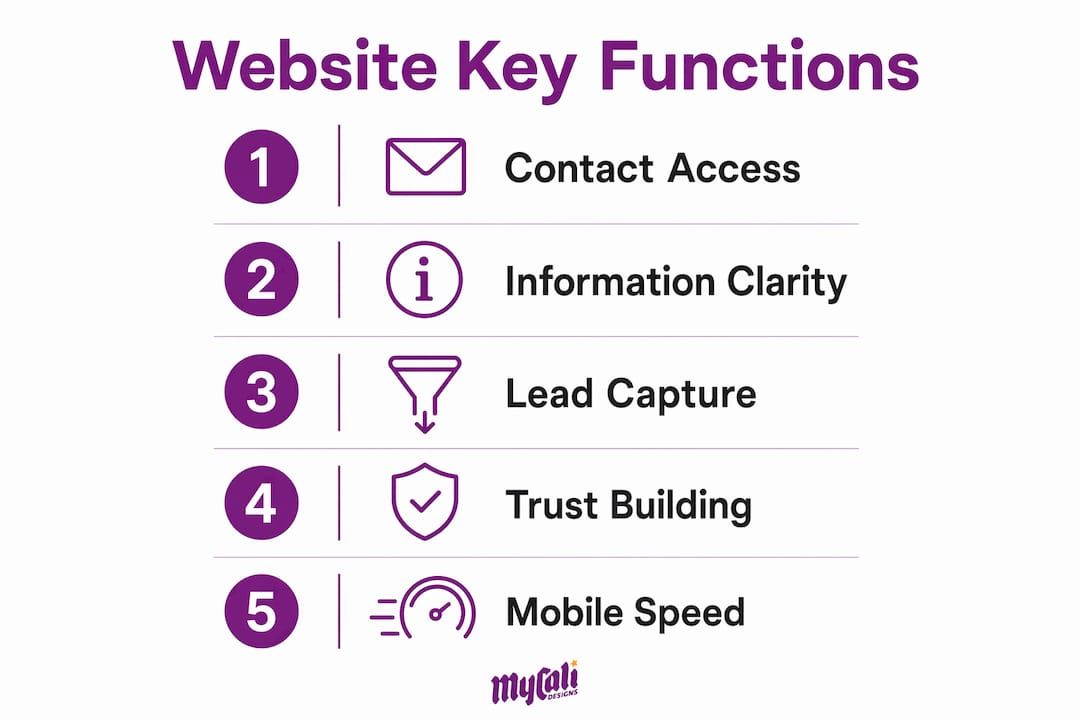
The most effective service websites perform these core functions:
- Trust signal on arrival. Visitors decide within seconds whether to stay or leave. Your design, headline, and social proof must immediately communicate that you are credible and capable.
- Lead qualification. A well-structured site answers the questions prospects ask before they contact you: What do you do? Where do you work? What does it cost? Answering these questions filters out poor-fit leads and warms up the right ones.
- Clear service explanations. Each service you offer deserves its own page with a plain-language description, the problem it solves, and who it is for. Vague service pages lose business.
- Frictionless contact options. Click-to-call buttons, short inquiry forms, and visible phone numbers reduce the effort required to reach you. Every extra step a visitor must take costs you a lead.
- Google Business Profile support. Your website reinforces your Google Business Profile (GBP) by providing the localized, service-specific content that Google uses to rank you in local map results.
Pro Tip: Place your primary phone number and a "Request a Quote" button above the fold on every page. Visitors should never have to scroll to find a way to contact you.
A website that handles these five functions is not just a digital brochure. It is the first conversation you have with every potential client, running every hour of every day.
How does website design impact credibility and customer engagement?
Design quality is the single biggest driver of first impressions. 94% of credibility judgments about a business come from its website design. That means your layout, typography, color choices, and photography are doing more persuasion work than your copy.

Speed is equally critical. 53% of mobile visitors abandon a site that takes longer than 3 seconds to load. Slow sites do not just frustrate visitors. They signal to Google that your site delivers a poor experience, which directly hurts your search rankings.
| Design Factor | Minimum Standard | Business Impact |
|---|---|---|
| Page load speed | Google PageSpeed score above 70 | Reduces bounce rate, improves rankings |
| Mobile responsiveness | Fully responsive on all screen sizes | Captures mobile-first visitors |
| Visual hierarchy | Clear headline, subheads, and CTA | Guides visitors to conversion |
| Professional photography | Custom or high-quality stock images | Builds trust and perceived value |
| Contact accessibility | Phone and form visible on every page | Reduces friction for inquiries |
Custom, professionally designed websites consistently outperform generic templates because they are built around your specific audience and conversion goals. A template gives you a starting point. A custom design gives you a sales tool.
Pro Tip: Run your site through Google PageSpeed Insights monthly. A score below 70 on mobile is costing you leads and search visibility.
Meeting 2026 performance benchmarks requires professional design, full mobile responsiveness, fast load times, and clear contact options working together. None of these elements works in isolation.
What are the best content and structural practices for service industry websites?
Page structure is where most service websites fail. Websites built like brochures rather than sales tools consistently underperform because each page lacks a defined conversion purpose. The fix is straightforward: give every page one job and design it to complete that job.
Here is how to structure the core pages of a service business website:
- Homepage. Route visitors to the right service or next step. Your homepage is a navigation hub, not a sales page. It should answer "Who are you, what do you do, and who do you serve?" in the first screen.
- Service pages. Convert visitors into leads. One page per service, with a keyword-optimized description, the outcome the client receives, and a clear call to action. This structure also supports local SEO targeting by connecting specific services to specific locations.
- About page. Build trust. Share your story, your team, and your values. Clients hire people, not companies. This page closes the gap between a stranger and a trusted provider.
- Testimonials and proof page. Close doubt. Verified reviews, case studies, and before-and-after results answer the question every prospect is silently asking: "Has this worked for someone like me?"
- Pricing or FAQ page. Disarm objections. Transparency about pricing or process reduces the fear of the unknown and pre-qualifies leads before they contact you.
- Contact page. Finish without friction. A short form, your phone number, your service area, and your hours. Nothing else.
Each page has a precise job, and failing to define that job reduces conversions across the entire site. This is not a design opinion. It is a structural principle that separates high-performing service sites from ones that generate no leads.
Local search optimization requires one additional layer. Service and location pages must target transactional and local search queries to capture buyers who are ready to hire. A plumber in Sacramento needs a page titled and written for "plumbing repair in Sacramento," not just "our services." Geographic specificity at the page level is what earns map pack placement.
Content updates matter too. User intent shifts over time, and pages written two years ago may no longer match what your prospects are searching for today. Reviewing and refreshing your top service pages quarterly keeps your site aligned with current demand.
How do websites integrate with other digital assets to boost business growth?
A website does not work alone, but it must be the center of your digital presence. Every other platform you use should point back to it. Here is how the pieces fit together:
- Google Business Profile drives discovery; your website closes the sale. GBP gets you found in local searches. Your website provides the depth of information that converts a curious searcher into a paying client. The two work as a system, not as substitutes for each other.
- Social media builds awareness but cannot replace ownership. Social media and Google Business Profiles are rented platforms. Algorithm changes, account suspensions, or platform shutdowns can eliminate your presence overnight. Your website is immune to those risks.
- Advertising amplifies reach but requires a destination. Google Ads and social ads send traffic somewhere. That destination must be a conversion-focused landing page on your website, not a social profile. Sending paid traffic to a social page wastes your budget.
- Directories and review platforms reinforce trust. Listings on platforms like Google, Yelp, and industry directories build credibility, but they operate under someone else's rules. Your website aggregates that social proof and presents it in a controlled environment.
- Websites provide a focused comparison environment. Professional websites outperform social media when prospects are comparing providers because there are no competing ads, no distracting feeds, and no algorithm deciding what they see next.
Understanding digital footprint management helps service businesses see why the website sits at the center of every channel. It is the one asset you fully control, and it compounds in value over time through SEO, content, and reputation building.
Key Takeaways
A service business website is a fully owned, always-on sales asset that builds credibility, captures leads, and outperforms every rented platform in the long run.
| Point | Details |
|---|---|
| Design drives credibility | 94% of first impressions come from design quality, making professional presentation non-negotiable. |
| Speed determines engagement | Sites loading slower than 3 seconds lose more than half of mobile visitors before a single word is read. |
| Structure defines conversion | Every page needs one job: route, convert, build trust, close doubt, or finish the inquiry. |
| Websites beat rented platforms | Social media and directories can disappear overnight; your website is the only digital asset you own. |
| Local SEO requires page-level specificity | Service and location pages must name specific services and geographic areas to rank in map results. |
What I've learned about service websites after years of building them
Most service business owners treat their website like a business card. They build it once, feel relieved it exists, and move on. That is the most expensive mistake I see.
A website is not a finished product. It is a sales system that needs to be maintained, tested, and refined. The businesses that generate consistent leads from their sites are the ones that treat each page as a working tool with a measurable purpose. They check their contact form monthly. They update their service descriptions when their offerings change. They add new testimonials when they finish strong projects.
The timing of when you build or rebuild your site also matters more than most people realize. Build your website when business is stable, not when you are desperate for leads. A site built under financial pressure tends to be rushed, unfocused, and built around panic rather than strategy. The best sites I have seen come from owners who invested in them during a good period, with clear heads and a real understanding of who their clients are.
One more thing I push hard on: your call-to-action wording. Changing a generic "Submit" button to "Request a Quote" or "Book a Consultation" is one of the highest-return changes you can make. It costs nothing to change and signals to the visitor exactly what happens next. Outcome-driven CTAs consistently outperform generic ones because they reduce uncertainty at the moment of decision.
Your website is the one place online where you control every word, every image, and every path a visitor takes. Use that control deliberately.
— Cesar
How Mycalidesigns builds websites that work for service businesses
Service businesses need websites built around conversion, not just aesthetics. Mycalidesigns designs and develops custom websites built specifically for service industry growth, combining professional design, local SEO structure, and clear conversion paths from the first page to the last.
We also offer integrated branding and identity services that ensure your website, logo, and visual presence work together as a single, trust-building system. From strategy through launch, our team handles the details so you can focus on running your business. If you are ready to turn your website into your best-performing sales asset, we are ready to build it with you.
FAQ
Why does a service business need a website?
A website gives service businesses a fully owned digital presence that works 24/7 to build credibility and capture leads. Over 81% of consumers research services online before purchasing, making a website the first point of contact for most potential clients.
What pages does a service website need?
Every service website needs a homepage, individual service pages, an about page, a testimonials page, and a contact page. Each page should have one clear job, from routing visitors to completing an inquiry.
How does website design affect customer trust?
94% of first impressions about a business's credibility come from its website design. Poor design, slow load times, or a non-mobile-friendly layout signals unprofessionalism and drives visitors away before they read a single word.
What is the difference between a website and a Google Business Profile?
A Google Business Profile drives local discovery in search results, while your website provides the depth of information needed to convert a visitor into a client. The two work together as a system, not as replacements for each other.
How does local SEO work for service business websites?
Service websites must connect specific services to specific geographic locations at the page level. Targeting transactional and local search queries on dedicated service and location pages is what earns placement in Google's local map pack results.
Recommended
Recent Posts