



How to design a logo that elevates your brand
How to design a logo that elevates your brand

Your logo is often the first thing a potential customer sees, and first impressions move fast. A weak, forgettable mark signals amateur status before you say a word, while a strong one builds instant trust. Recognizable logos increase purchase likelihood 25%, which means your brand mark is doing real sales work every single day. This guide walks you through every stage of the logo design process, from laying your brand foundation to testing your final mark in the real world. Whether you're starting fresh or refreshing an existing identity, you'll leave with a clear, actionable path forward.
Table of Contents
Key Takeaways
| Point | Details |
|---|---|
| Start with branding | A clear brand identity is the foundation for an effective and memorable logo. |
| Follow proven steps | Use expert-recommended methods to move from initial concept to polished, versatile logo. |
| Apply design principles | Simplicity, versatility, and relevance make your logo stand out and last. |
| Test before you launch | Real-world testing and iteration catch mistakes and ensure your logo shines everywhere. |
| Invest for growth | A professional, strategic logo drives trust, recognition, and your long-term business success. |
What you need before designing a logo
With the importance of a memorable logo clear, let's start with what you need before you even sketch a line. Jumping straight into colors and fonts is one of the most common mistakes small business owners make. The result is usually a logo that looks fine but says nothing, and a generic logo is almost as damaging as a bad one.
Brand identity is the first step in effective logo design. Before you open any software, you need to answer three foundational questions: What does your business stand for? Who is your ideal customer? What makes you different from competitors? These answers become the filter through which every design decision passes. If you want a deeper look at how identity shapes visual choices, our guide on branding basics is a good place to start.
Next, research your competitors. Look at the logos of five to ten businesses in your space and note what colors, shapes, and styles they use. This isn't about copying. It's about finding the gap where your brand can stand out. Understanding logo design principles at this stage saves you from blending in when you should be standing apart.
What to gather before you start designing:
- A written brand brief (two to three sentences on your mission, values, and audience)
- A mood board of logos, colors, and imagery that resonate with your vision
- A list of competitor logos and what visual territory they occupy
- Basic tools: paper and pencil for sketches, plus access to a vector design tool or logo maker
| Preparation element | Why it matters | Time investment |
|---|---|---|
| Brand brief | Keeps design decisions focused | 30 to 60 minutes |
| Competitor research | Reveals differentiation opportunities | 1 to 2 hours |
| Mood board | Aligns visual direction early | 30 to 60 minutes |
| Tool setup | Reduces friction during execution | 30 minutes |
Pro Tip: Start with a simple mindmap that connects your brand values to visual words (bold, clean, warm, playful). This single exercise prevents generic results and gives your designer or yourself a real creative direction.
Step-by-step logo design process
Once you have your brand foundation and basic materials, it's time to move step-by-step through the design process. A clear roadmap keeps you from spinning your wheels and helps you make confident decisions at each stage.
According to key steps from Figma and Inkbot Design, the core process follows a logical sequence: define your brand, research the market, choose a style, select colors and fonts, sketch concepts, digitize the best ideas, and then test and refine. Here's how that plays out in practice:
- Write your brand brief. Summarize your mission, audience, and personality in a few sentences.
- Research and gather inspiration. Build a mood board and audit competitor logos.
- Choose a logo style. Wordmark, lettermark, icon, combination mark, or emblem. Each suits different business types.
- Select your color palette and typography. Limit yourself to two to three colors and one to two fonts.
- Sketch by hand. Generate at least ten rough concepts on paper before touching a screen.
- Digitize your strongest concepts. Use vector software (Adobe Illustrator, Inkscape, or Figma) to build clean files.
- Test and refine. Check legibility at small sizes, in black and white, and across different backgrounds.
For a deeper look at whether you're ready to invest in a new mark, our logo design readiness guide covers the key signals. You can also explore common questions about the process in our branding FAQs.
| Design stage | DIY approach | Hybrid (AI tools) | Professional designer |
|---|---|---|---|
| Brand brief | Self-written | Self-written | Collaborative discovery |
| Concept sketching | Manual | AI-generated options | Hand-crafted concepts |
| Digitizing | Free tools (Canva, Inkscape) | AI logo makers | Vector software, custom |
| Testing and refinement | Self-directed | Limited feedback | Expert iteration |
| Final file delivery | PNG or low-res | Mixed formats | Full vector package |
For a more detailed full logo design walkthrough, Inkbot Design offers an excellent resource.
Pro Tip: Always sketch ideas by hand first. The screen creates pressure to make things look polished too soon, which kills creative exploration. Paper is forgiving and fast.
Key principles of effective logo design
Now that you know the steps, let's focus on the critical design principles that ensure your logo makes the desired impact. Knowing the process is one thing. Understanding what separates a great logo from a forgettable one is what gives your mark real staying power.
The five core logo design principles every SMB owner should know are:
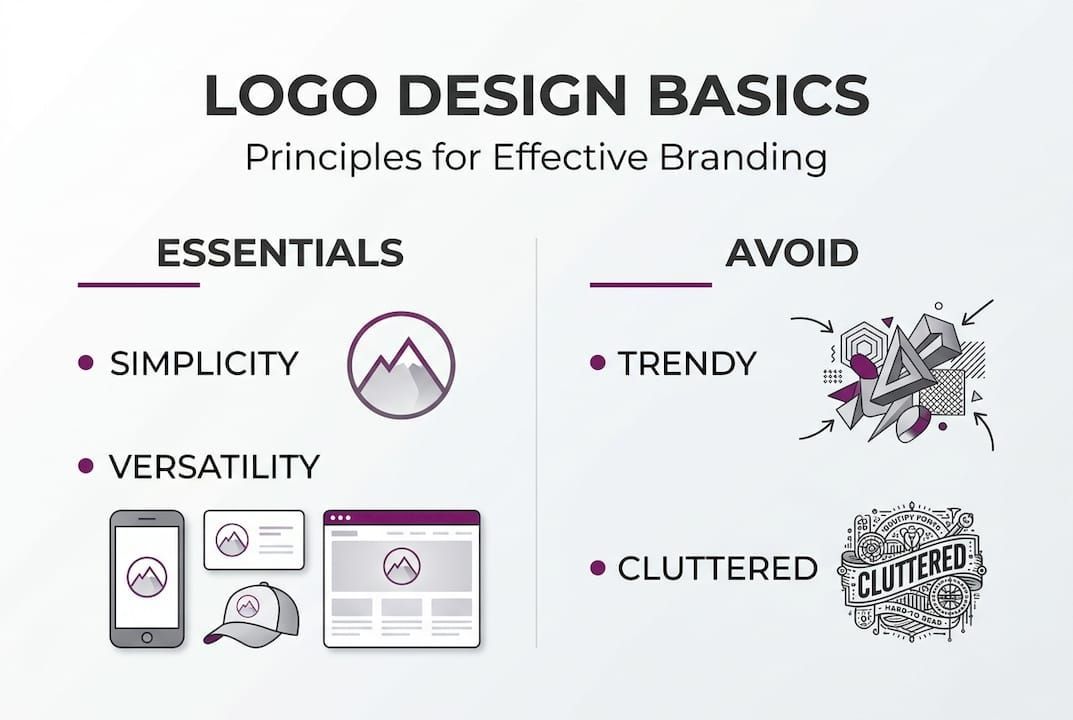
- Simplicity. A simple logo is easier to recognize, reproduce, and remember. If you can't describe it in one sentence, it's too complex.
- Memorability. Strong logos leave a mental impression after a single glance. Think of the Nike swoosh or the Apple icon.
- Versatility. Your logo needs to work on a business card, a billboard, a website favicon, and an embroidered hat. If it breaks at any size or format, it needs more work.
- Timelessness. Trends fade. A logo built around a 2024 design trend will look dated by 2028. Aim for a mark that works just as well in ten years.
- Relevance. The logo should visually communicate something true about your brand, your industry, or your audience. Decoration without meaning is just noise.
"Simplicity passes the favicon test and stands out at any size. If your logo can't be recognized at 16x16 pixels, it's working too hard."
Color deserves special attention. Color boosts brand recognition up to 80%, and simple logos process faster in the brain. That's not a minor detail. It's a competitive advantage. Choose colors that contrast with what your competitors use, not colors that simply look nice to you. You can explore specific questions about color, style, and format in our logo FAQs.

One expert nuance worth remembering: chasing trends is the fastest way to build a logo with an expiration date. A timeless mark always outperforms a trendy one over a three to five year horizon.
Testing, refining, and common pitfalls
With the core principles in mind, let's ensure your new logo will stand the test of real business use with proper testing and refinement. Even a well-designed logo can fail if it isn't tested across the contexts where your customers will actually see it.
Always test at small sizes, in black and white, and across print formats before calling a logo finished. Here's a practical testing sequence:
- Favicon test. Resize your logo to 16x16 pixels. Is it still recognizable? If not, simplify.
- Grayscale check. Remove all color. Does the logo still communicate clearly? Color should enhance meaning, not carry it.
- Real-world mockups. Place your logo on a business card, a website header, a social media profile, and a product or signage mockup.
- Contrast check. Test on both light and dark backgrounds. A logo that only works on white is a limited logo.
- Feedback and iteration. Share with three to five people in your target audience, not just friends and family. Ask what the logo communicates, not whether they like it.
Pro Tip: Save every version of your logo in vector format (SVG, AI, or EPS) at each stage. Vector files scale to any size without quality loss, and having version history makes future tweaks much faster. For more on professional logo testing, Inkbot Design covers the technical side well.
For SMBs doing custom logo work for the first time, these are the most common pitfalls to avoid:
- Too much detail. Intricate illustrations look impressive on screen but fall apart at small sizes or in embroidery.
- Poor color contrast. Low contrast makes logos hard to read and inaccessible to colorblind viewers.
- Unclear shapes. If your icon requires explanation, it's not doing its job.
- Following trends blindly. Gradients, thin lines, and badge styles all have their moment, then fade. Build for longevity.
- Skipping the vector format. A logo delivered only as a PNG will cause headaches every time you need to resize or print it.
A fresh perspective: What most SMBs get wrong about logo design
After these practical steps, it's time for a candid look at what most small businesses miss in their logo journey. We've worked with hundreds of business owners, and the pattern is consistent: most treat their logo as a decoration rather than a strategic asset.
The real problem isn't a bad logo. It's a logo designed without a strategy behind it. "Just looking professional" is a low bar. Your competitors look professional too. What you need is a mark that captures your brand's specific promise and makes it instantly recognizable to the right audience.
We also see owners rush the logo as a last-minute task, something to check off before the website launch. That approach almost always leads to a rebrand within two years, which costs more time and money than doing it right the first time.
Our honest recommendation: start with a DIY or hybrid approach to test ideas early. But once your brand direction is clear, invest in a professional mark. The return comes through better brand-building strategy, stronger customer recall, and a logo that actually scales with your business. True logo success isn't about chasing what looks current. It's about building something your customers remember.
Take your branding further with professional design support
Ready to take the stress out of logo design? Here's how you can level up your brand with professional support.
Building a logo on your own is a great way to explore ideas, but expert guidance saves time, maximizes your return on investment, and creates a mark that scales as your business grows. At Mycali Designs, we combine strategic thinking with creative execution so your logo does more than look good. It works.
Explore our custom branding help to see how we approach identity from the ground up. If you have questions before committing, our common branding questions page covers the most common concerns about process, pricing, and deliverables. Whether you're a local shop or an online business, tailored logo and identity solutions are just a click away.
Frequently asked questions
What is the most important step when designing a logo?
Defining your brand identity and audience is the most crucial first step, as it shapes every design decision that follows, from color to typography to icon choice.
What file format should my final logo use?
Always request vector files such as SVG, AI, or EPS to ensure your logo scales cleanly for any use, from websites to large-format print and merchandise.
How many colors should a business logo use?
Most strong logos use two to three colors at most, which ensures quick recognition, easier reproduction across formats, and a cleaner overall impression.
Is it better to design my logo myself or hire a professional?
DIY works well for early concept testing, but a professional logo delivers the strategic depth, versatility, and file quality that customer-facing brands need to compete.
How do I know if my logo is effective?
Test whether it's memorable at small sizes, legible in black and white, distinct from competitors, and accurately reflects your brand personality to your target audience.
Recommended
Recent Posts