



Why Use Creative Agencies: Boost Growth, Save Costs
Why Use Creative Agencies: Boost Growth, Save Costs

Most service business owners assume creative agencies are a luxury reserved for corporations with massive budgets. That assumption is costing them growth. The real gap isn't about company size. It's about access to the right talent, strategy, and execution at the right time. Whether you run a landscaping company, a law firm, or a home services brand, the question isn't whether you can afford an agency. It's whether you can afford to keep operating without one. This guide breaks down what agencies actually do, what they cost compared to in-house teams, and how they create measurable results for service businesses ready to scale.
Table of Contents
- What do creative agencies actually do?
- Agency vs. in-house: Cost, talent, and flexibility
- How agencies create impact for service businesses
- Common misconceptions about creative agencies
- The real reason creative agencies make SMBs unstoppable
- How MyCali Designs helps service businesses win
- Frequently asked questions
Key Takeaways
| Point | Details |
|---|---|
| Save significant costs | Agencies provide enterprise-level creative services for far less than hiring in-house staff. |
| Access top-tier talent | You get seasoned experts across strategy, design, and marketing with a single partnership. |
| Gain flexibility and speed | Agencies scale with your needs and use proven methods to deliver faster, data-driven results. |
| Bust common myths | Agencies are tailored for SMBs and offer strategic advantages—not just help for big brands. |
| Hybrid approaches work | Combine in-house leadership with agency execution for the best of both worlds. |
What do creative agencies actually do?
Many service business owners picture agencies as expensive design studios that produce logos and brochures. The reality is far broader. A full-service creative agency functions more like a strategic growth partner than a vendor. They bring together disciplines that would take years and multiple hires to build internally.
Here's what a well-rounded agency typically delivers:
- Brand strategy and positioning: Defining who you are, who you serve, and how you stand apart from competitors in your market
- Visual identity and design: Logos, color systems, typography, and brand guidelines that create recognition and trust
- Performance marketing: Paid search, social media advertising, and campaign management that drives measurable lead generation
- Web design and development: Building digital experiences that convert visitors into clients
- Content and SEO: Creating the content and technical structure that earns organic visibility over time
- Analytics and reporting: Tracking what works, cutting what doesn't, and making data-driven adjustments
The agency team expertise behind these services matters enormously. A single in-house hire, even a talented one, cannot cover strategy, design, paid media, and technical SEO simultaneously. Agencies solve this by giving you a coordinated team under one roof.
" Multi-disciplinary expertise in strategy, design, and performance marketing cannot be matched by single in-house hires, offering speed, proven frameworks, and scalability without fragmented hiring."
This is the core value proposition. You're not just buying services. You're buying a system. Agencies have already built the workflows, tested the frameworks, and refined the processes. You benefit from that accumulated knowledge without having to build it yourself.
For service businesses specifically, digital marketing services like local SEO, Google Ads, and social media campaigns are particularly high-impact. These channels require ongoing expertise and attention. An agency keeps them running efficiently while you focus on delivering your service.
Agency vs. in-house: Cost, talent, and flexibility
Let's talk numbers. This is where the conversation shifts for most business owners.
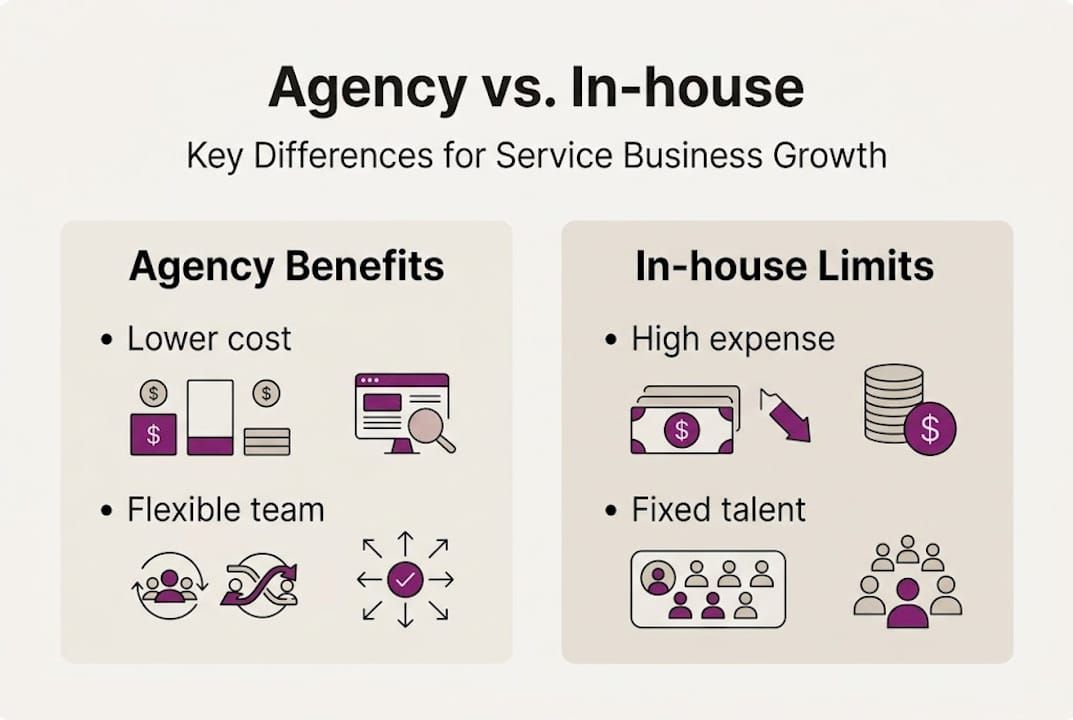
In-house marketing teams cost $400K to $800K annually when you factor in salaries, benefits, and tools. Agencies delivering equivalent scope typically run $60K to $180K per year, making them 3 to 7 times more affordable for businesses with variable needs.

Here's a side-by-side comparison:
| Factor | Agency | In-house team |
|---|---|---|
| Annual cost | $60K to $180K | $400K to $800K |
| Team scope | Multi-disciplinary | Limited by headcount |
| Scalability | Flexible, on demand | Slow, requires hiring |
| Speed to launch | Fast, proven systems | Slower ramp-up time |
| Risk | Low, no long-term contracts | High, fixed overhead |
| Expertise depth | Senior specialists | Generalists or narrow focus |
The cost difference alone is significant. But flexibility is equally important for service businesses. Your marketing needs in January may look nothing like your needs in June. Agencies scale with you. In-house teams don't.
That said, the right model depends on your stage. If your business needs more than 40 hours per week of specialized work in one area, an in-house hire may eventually make sense for that function. But most service-based SMBs aren't there yet. Variable, multi-channel needs are the norm, and that's exactly where agencies shine.
Pro Tip: The fastest-growing model right now is hybrid. You keep strategy and client relationships in-house, and you hand execution to an agency. This gives you control without the overhead. Before committing to either path, review guidance on choosing the right agency to avoid costly mismatches.
How agencies create impact for service businesses
Strategy and cost comparisons are useful, but what does agency partnership actually look like in practice? Here's a typical engagement sequence for a service business:
- Brand audit: The agency reviews your current positioning, visual identity, website performance, and competitive landscape
- Strategy development: Based on the audit, they build a customized plan targeting your specific growth goals
- Execution phase: Design, campaigns, content, and technical work are launched in coordinated phases
- Performance review: Results are tracked against clear benchmarks, and the strategy is adjusted accordingly
This structured approach produces results that feel invisible when done well. Your brand starts attracting better clients. Your website converts more visitors. Your ad spend goes further.
Here's a realistic before-and-after snapshot:
| Metric | Before agency | After 6 months |
|---|---|---|
| Monthly website visits | 800 | 2,400 |
| Lead conversion rate | 1.8% | 4.5% |
| Cost per lead | $85 | $34 |
| Client retention rate | 61% | 78% |
These kinds of shifts are achievable when the right systems are in place. Agencies that use AI in agency workflows are seeing particularly strong efficiency gains. AI tools alone can produce 37.5% faster turnaround times, meaning your campaigns launch sooner and your brand stays responsive to market changes.
The best agencies also bring senior talent directly into your projects. Not junior staff learning on your budget. Experienced strategists who've solved similar problems before.
Pro Tip: When evaluating agencies, don't just ask to see their portfolio. Ask for specific multi-channel marketing results. Request case studies with real metrics. Any agency worth partnering with will have them ready.
Common misconceptions about creative agencies
Even with strong evidence, several persistent myths keep service business owners from making the move. Let's address them directly.
Misconception 1: Agencies are only for big companies. This one is simply outdated. Most agencies today specifically serve SMBs. Their pricing, packages, and processes are built around businesses that don't have enterprise budgets.
Misconception 2: You lose control of your brand. A good agency doesn't override your vision. They clarify and amplify it. You remain the decision-maker. The agency brings structure and expertise to execute your direction more effectively.
Misconception 3: It's too expensive. As the cost data above shows, agencies are typically far more affordable than building an equivalent in-house team. The question is whether you're comparing the right things.
Misconception 4: Agencies won't understand my niche. This concern is valid if you choose the wrong partner. But agencies that specialize in service industries understand local markets, client acquisition cycles, and the specific challenges of selling expertise rather than products. Reading up on avoiding common agency pitfalls helps you choose wisely.
When does in-house actually win? Honestly, when the volume of specialized work exceeds 40 hours per week consistently. That's a high bar most growing service businesses haven't yet reached.
"Hybrid adoption combining in-house strategy with agency execution is rising, now at 46% among growing SMBs, reflecting a smarter, more flexible approach to marketing investment."
The hybrid model is growing because it works. It gives owners the control they want and the execution power they need, without the fixed overhead of a full internal team.
The real reason creative agencies make SMBs unstoppable
Here's what most guides won't tell you. The biggest value an agency brings isn't design or even cost savings. It's outside perspective.
When you're deep inside your business every day, you develop blind spots. You stop seeing your brand the way a potential client sees it. You normalize friction points on your website. You overlook positioning gaps that competitors are quietly exploiting. An agency walks in without those blind spots.
We've seen this pattern consistently at agency operations insights: the service business owners who scale fastest are the ones who delegate creative and marketing work early. Not because they lack talent, but because they recognize that their time and energy belong in their zone of genius, not in design software or ad dashboards.
The real unlock is treating your agency as a long-term partner, not a one-time project vendor. That means sharing your business goals, not just your campaign briefs. It means reviewing performance together and iterating. Agility, trust, and shared context are what turn a good agency relationship into a genuine competitive advantage.
Pro Tip: Set a quarterly business review with your agency. Share revenue goals, not just marketing metrics. The more context they have, the sharper their strategy becomes.
How MyCali Designs helps service businesses win
Ready to experience the difference a creative agency can make? MyCali Designs specializes in helping service-based SMBs build brands that attract better clients, run smarter campaigns, and grow with confidence.
From agency services that cover strategy, design, and execution, to digital marketing solutions built for local service businesses, we bring the full picture together. If you're still figuring out where branding fits into your growth plan, our branding FAQ is a great starting point. We're here to help you move forward with clarity and confidence, not guesswork.
Frequently asked questions
How do creative agencies save money for small businesses?
Agencies provide top-tier talent and tools at a fraction of the cost of an in-house team. In-house teams run $400K to $800K annually, while agencies deliver equivalent scope for $60K to $180K, making them 3 to 7 times more cost-effective for SMBs.
Why not just hire a freelancer instead of an agency?
Freelancers cover one discipline well, but agencies bring coordinated, multi-disciplinary expertise across strategy, design, and performance marketing, along with the reliability and scalability a single freelancer simply can't offer.
What if my business needs change month-to-month?
Agencies are built for exactly that. With agile workflows and AI tools producing up to 37.5% faster turnaround, they adjust strategies and resources as your priorities shift, without the delays of rehiring or retraining.
How do I pick the right creative agency for my brand?
Look for agencies with measurable results in your industry, transparent communication, and a process that includes strategy before execution. A strong cultural fit and clear reporting structure matter just as much as their portfolio.
Recommended
Recent Posts