



Why design matters for small business success
Why design matters for small business success

Nearly 64% of consumers say design directly affects whether they trust or buy from a small business. That's not a minor detail. It means your logo, website, and brand visuals are quietly making or breaking sales every single day. Yet many small business owners treat design as an afterthought, something to worry about once revenue picks up. This guide challenges that thinking. We'll show you exactly how design functions as a business multiplier, how it shapes trust in milliseconds, and what practical steps you can take right now to make your design work harder for your growth.
Table of Contents
- Why design is a business multiplier for small businesses?
- How first impressions drive trust and purchase decisions?
- Branding consistency: The secret to recognition and loyalty?
- Practical frameworks: Making design work for your small business?
- Common design mistakes (and how to avoid them)?
- Our take: What most guides get wrong about small business design?
- Your design partner for business growth?
- Frequently asked questions?
Key Takeaways
| Point | Details |
|---|---|
| Design drives business results | Quality design directly influences trust, revenue, and customer loyalty for small businesses. |
| First impressions matter most | Customers form snap judgments in seconds—good design instantly builds credibility and reduces bounce. |
| Consistency builds recognition | Unified branding across all channels boosts recall, referrals, and repeat purchases. |
| Frameworks beat guesswork | Applying structured design thinking and avoiding common mistakes sets your brand up for long-term growth. |
Why design is a business multiplier for small businesses
Let's be direct: design is not decoration. It is one of the most powerful tools you have for building credibility, attracting customers, and holding their attention long enough to earn their business. When someone lands on your website or picks up your business card, they are not consciously analyzing your logo. They are forming a gut reaction. That reaction is shaped almost entirely by design.
Here's what the numbers tell us. Consistent branding boosts revenue by 23%. That is not a rounding error. For a business doing $200,000 a year, that's an additional $46,000 sitting inside your brand identity waiting to be unlocked. Poor design, on the other hand, causes 41% of consumers to distrust a business entirely. They do not call. They do not browse further. They simply leave.
Research on brand knowledge and business performance confirms that businesses with intentional branding and design earn stronger customer loyalty and a measurable competitive advantage over peers in the same market. This is especially true for small and medium-sized enterprises.
"Design is not just what it looks like and feels like. Design is how it works." — Steve Jobs
Here is a simple comparison that illustrates the gap:
| Business type | Customer trust level | Revenue consistency | Brand recall |
|---|---|---|---|
| Consistent design | High | Strong | 80%+ |
| Inconsistent design | Low to moderate | Volatile | Under 30% |
| No design strategy | Very low | Unpredictable | Near zero |
If you want to explore business branding strategies that drive real outcomes, the data is clear: investing in design is not optional. It is strategic. Learn more about the branding benefits that come with a consistent visual system and you will understand why design-forward businesses consistently outpace those treating it as cosmetic.
Understanding design and customer trust is the first step toward using design as the revenue engine it actually is.
How first impressions drive trust and purchase decisions
With design established as central to your business performance, let's see how fast it actually works on a potential customer's mind.
Scientific research shows that first impressions form in 50ms, and 94% of those reactions are based purely on design. Fifty milliseconds. That is faster than a blink. Before a customer reads a single word, your visual identity has already told them a story about who you are.
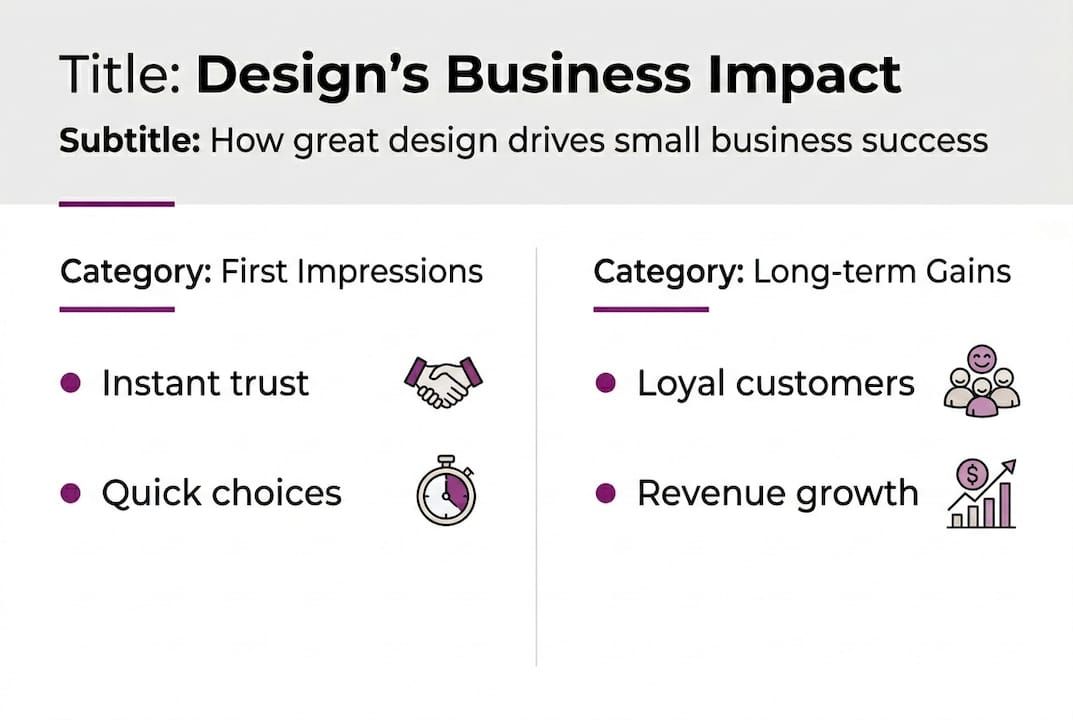
This is what design professionals call the three-second rule. You have roughly three seconds on a website or printed piece to make a potential customer feel confident enough to stay. If your visuals feel dated, cluttered, or inconsistent, that window closes fast.
So what design elements shape those critical first seconds? Here is what moves the needle most:
- Logo clarity: A clean, purposeful logo signals professionalism immediately
- Color psychology: Colors carry emotional weight. Blue communicates trust. Green suggests growth. Red implies urgency
- Typography: Fonts signal personality. Mismatched fonts signal carelessness
- Layout and whitespace: Crowded layouts feel overwhelming. Breathing room signals confidence
- Site speed: A slow-loading page kills credibility even before the design is seen
- Photography and imagery: Authentic, high-quality images elevate perceived value
For local businesses, these factors matter even more. Customers are choosing between you and a competitor down the street. At that level of competition, design is often the deciding factor.
For actionable custom logo design tips that align with these principles, start by auditing how your brand looks to a first-time viewer. Ask someone unfamiliar with your business to describe what they feel within five seconds of seeing your site. Their answer will tell you everything.
Review business design benchmarks to understand where your current visuals stand relative to industry standards. For businesses in competitive local markets, even a refined logo can shift perception dramatically, as shown in work like Davis logo branding projects where updated identities moved the needle on foot traffic and trust.
Branding consistency: The secret to recognition and loyalty
Impressions matter, but consistency turns attention into trust. Here is how to make it stick over time.
Branding consistency means your logo, colors, fonts, tone of voice, and imagery all tell the same story, whether someone finds you on Instagram, visits your website, or picks up a flyer at a local event. When these elements align, recognition builds naturally. When they conflict, confusion sets in and trust erodes.

Businesses with consistent branding earn 23% more revenue and achieve 80% better brand recognition than those without a unified visual system. That is a compounding advantage. The more consistently you show up, the more familiar you become. Familiarity builds trust. Trust drives referrals and repeat purchases.
Here are the brand elements you need to keep unified across every touchpoint:
- Logo: Use the approved version only. No stretched, recolored, or cropped variations
- Color palette: Stick to two or three primary brand colors, consistently
- Typography: Choose two fonts maximum. One for headings, one for body text
- Tone of voice: Your brand should sound the same in an email, a caption, and a proposal
- Imagery style: Consistent photography style, illustration style, or icon set
- Spacing and layout: Consistent margins and grid structures across materials
Pro Tip: Create a one-page brand guide that documents your logo, colors, fonts, and usage rules. Share it with anyone creating content for your business. This single document prevents inconsistency before it starts.
For deeper guidance on consistency in branding, think of it like this: every inconsistency in your brand is a small crack in customer confidence. Over time, those cracks add up. Building a strong visual system from the start, or shoring one up now, is one of the best investments you can make. Explore brand identity tips to start building that foundation today.
Practical frameworks: Making design work for your small business
Consistency requires a plan. Here is how to approach design like high-performing businesses do, without a massive budget.
One of the most effective models is design thinking , a five-step framework used by top-performing companies globally. The steps are: empathize, define, ideate, prototype, and test. Applied to branding, it looks like this:
- Empathize: Research how your current customers perceive your brand. Ask them directly
- Define: Clarify the core problem. Is your brand unclear? Outdated? Misaligned with your audience?
- Ideate: Explore design directions. Don't lock in immediately. Generate options
- Prototype: Create draft versions of your new logo, website, or brand materials
- Test: Gather real feedback before committing to a final direction
Top firms using design thinking outperform competitors by 2x on innovation metrics. This approach is not reserved for Silicon Valley. It is accessible, practical, and especially powerful for small businesses that need every decision to count.
Structured design also saves money. Rebrands can yield a 30% sales lift when approached with clear goals and a defined process. Rushing a rebrand, or doing it without strategy, is where costs spiral.
Avoid these common pitfalls when building your visual system:
- Over-designing: More elements do not equal more impact. Simplicity usually wins
- Cookie-cutter templates: Generic templates make you look like every other business
- Misaligned branding: Your visuals should match what your business actually offers and who it serves
Pro Tip: Before any redesign, assess your brand refresh readiness. A refresh may be all you need rather than a full overhaul. Start with a clear purpose.
For those earlier in the journey, a starting your business guide can help you build your brand correctly from the ground up. Also review foundational design framework principles to understand how structured thinking produces stronger results.
Common design mistakes (and how to avoid them)
Understanding the path forward means knowing the traps that derail even well-intentioned businesses. Here are the most costly ones.
Chasing trends is a fast road to brand confusion. Design trends shift quickly. If your brand identity is built on what looked good last year, you will be redesigning again next year. Strong brands are built on clarity and purpose, not trend cycles.
Copying competitors might feel safe, but it eliminates the very thing that makes your business worth choosing. Customers can't differentiate you from the pack if you look exactly like the pack.
AI design tools are increasingly popular, and they offer real budget advantages. But 35% of people find AI-generated brand assets inauthentic. They can identify something that feels generic or disconnected. For first impressions that build trust, authenticity matters more than speed or cost savings alone.
Design shortcuts often create long-term problems. A logo generated in five minutes may cost you five customers a week.
Budget overruns on redesign projects are more common than most business owners expect. Poor redesign management has resulted in costs exceeding $46,000 in documented cases, far beyond initial estimates. Prevent this by defining scope clearly upfront, getting itemized proposals, and resisting scope creep during the project.
Finally, know how to measure whether your design is actually working. Watch for changes in:
- Website bounce rate (lower is better after a refresh)
- New customer inquiries or walk-ins
- Positive comments about how your brand looks
- Repeat purchase rate and customer referrals
For an example of design done right in a real local market, see successful branding in Dixon and the tangible outcomes a focused identity strategy can produce.
Our take: What most guides get wrong about small business design
After exploring pitfalls and solutions, here is a viewpoint you won't often hear in mainstream advice.
Most design guides obsess over aesthetics. They tell you to pick the right colors, choose a modern font, and make your logo "pop." That advice is not wrong, but it misses the deeper point. Design's real power for small businesses is not persuasion. It is clarity .
When your brand visuals align with your purpose and your audience's expectations, you remove friction. Customers don't have to work to understand who you are or whether you're right for them. That clarity is what drives decisions.
We've also seen firsthand that a focused small agency or a solo designer with the right strategy often produces better results for local businesses than a large firm chasing a generic solution. Strategy and context beat scale almost every time. Branding lessons from Sacramento confirm this: local insight and strategic alignment create results that no template can replicate.
Design is not about looking impressive. It is about removing doubt.
Your design partner for business growth
Every insight in this article points to the same conclusion: strategic design is not a luxury. It is the foundation your business grows on.
At Mycali Designs, we help small businesses translate these principles into results. From logo creation to full business branding services, we build visual systems that build trust and drive sales. Our custom website solutions are designed to convert visitors into customers from the very first impression. If you're ready to make your design work as hard as you do, explore our website design FAQ to see how we approach each project and what working with us actually looks like. Let's build something that grows with you.
Frequently asked questions
How much does professional design impact small business sales?
A focused rebrand or design refresh can lift sales by 30% while increasing customer trust, referrals, and the likelihood of repeat business.
Is it possible to get good design on a tight budget?
Absolutely. Using frameworks like design thinking and prioritizing consistency over complexity gives you strong results without overspending on unnecessary features.
What are quick wins for small business design?
Refresh your logo, align your brand colors and fonts across every channel, and make sure your website loads fast. These three moves boost recognition and trust almost immediately.
How do I know if my design is actually working?
Track your bounce rate, referral volume, and repeat customer rate after any design change. Shifts in these numbers, along with positive feedback, signal that credibility and trust are improving with your audience.
Recommended
Recent Posts