




Web design for business growth: engagement & ROI in 2026
Web design for business growth: engagement & ROI in 2026

A surprising number of small business websites are quietly costing their owners customers every single day. 70% of SMB sites lack clear calls to action, meaning visitors land on the page, look around, and leave without doing anything. That's not a traffic problem. It's a design problem. In this article, we'll walk through why web design is one of the most powerful tools in your growth strategy, what separates high-performing sites from forgettable ones, and the practical steps you can take right now to turn your website into a real business asset.
Table of Contents
- Why web design matters for business success?
- Key elements of effective web design?
- Balancing aesthetics, performance, and accessibility?
- From brochure to ROI driver: making web design work for you?
- Our perspective: web design as a growth mindset for SMBs?
- How MyCali Designs can help transform your web presence?
- Frequently asked questions?
Key Takeaways
| Point | Details |
|---|---|
| Web design drives ROI | A business website should be a growth engine, not just an online brochure. |
| Prioritize user experience | Strategy, speed, usability, and accessibility are critical for conversions. |
| Balance aesthetics and performance | Smart tradeoffs ensure your site looks great and loads fast for all users. |
| Action beats theory | Regularly review, test, and improve your site to stay ahead of competitors. |
Why web design matters for business success
Let's be honest about something. Most small business owners think of their website the way they think of a business card: something you need, but not something that actively works for you. That mindset is expensive.
Your website forms a first impression in under a second. Visitors decide almost instantly whether your business looks credible, professional, and worth their time. If the design feels outdated, cluttered, or confusing, they're gone. No second chances.
But web design isn't just about looking good. It's about building a system that connects your business goals to your audience's needs. A well-designed site guides visitors toward action, whether that's booking a call, making a purchase, or signing up for your newsletter. Every layout decision, color choice, and navigation structure either supports that goal or works against it.
"User-centered design, consistent systems, and SEO integration boost site effectiveness for small and medium businesses significantly."
Here's what a strategic approach to web design actually delivers:
- Credibility and trust — A polished, consistent design signals professionalism before a single word is read.
- Better conversions — Clear navigation and strong calls to action move visitors toward decisions.
- Improved search visibility — SEO for business growth starts with how your site is built, not just what you write.
- Lower bounce rates — Fast, intuitive sites keep people engaged longer.
- Stronger brand recognition — Consistent visuals and messaging reinforce who you are across every page.
When design, performance, and SEO work together, the result is measurable. More traffic, more leads, more sales. That's not theory. That's what happens when a website is treated as a strategic tool rather than a digital placeholder. Building a strong online presence starts with a site that actually performs.
Key elements of effective web design
Understanding design's importance brings us to what actually makes a website effective. It's not one thing. It's a layered process that starts with strategy and ends with continuous improvement.
Research confirms that prototyping and performance budgeting are critical methodologies for building sites that work. Here's how that process looks in practice:
- Define your goals and audience — Who are you trying to reach, and what do you want them to do on your site?
- Map your information architecture — Organize your content so visitors can find what they need without thinking too hard.
- Build wireframes — Sketch the layout before adding any visuals. This keeps the focus on function.
- Develop a prototype — Test the flow before committing to final design decisions.
- Apply visuals and brand elements — Now bring in color, typography, and imagery that reflect your brand identity.
- Test with real users — Watch how actual people interact with your site and adjust based on what you learn.
Let's look at how traditional and modern design approaches compare:
| Approach | Traditional design | Modern iterative design |
|---|---|---|
| Process | Linear, one-time build | Ongoing, test-and-improve cycles |
| Flexibility | Low, hard to update | High, adapts to user feedback |
| SEO integration | Often added later | Built in from day one |
| User focus | Designer's preference | Data-driven and user-tested |
| Cost over time | High redesign costs | Lower, incremental improvements |
The modern approach wins every time for SMBs because it keeps your site aligned with how your customers actually behave, not how you assumed they would.
Pro Tip: Set a performance budget of under 500kb per page. This forces smart decisions about image sizes, scripts, and fonts, keeping your site fast without sacrificing quality.
Balancing aesthetics, performance, and accessibility
Next, let's address the balancing act that defines truly successful sites. This is where many SMB websites fall apart. Owners want something beautiful. Developers want something fast. And accessibility? It often gets skipped entirely.
Here's the reality: heavy visuals slow load times, and bold design choices can conflict with accessibility standards. These aren't minor issues. Slow sites lose visitors. Inaccessible sites exclude customers and can create legal exposure.

Look at how common design choices affect performance and conversions:
| Design element | Impact on load time | Impact on conversions |
|---|---|---|
| Large uncompressed images | High negative impact | Reduces engagement |
| Custom web fonts (3+) | Moderate negative impact | Minimal visual gain |
| Compressed, optimized images | Minimal impact | Positive visual quality |
| Simple, system fonts | No impact | Clean, fast experience |
| Video backgrounds | Very high negative impact | Often distracts from CTA |
Mobile traffic now dominates how people browse, but desktop users still tend to convert at higher rates. That means your site needs to look and function well on both. You can't sacrifice one for the other.
Here are practical tips for building lightweight, accessible sites:
- Compress all images before uploading (tools like TinyPNG make this simple)
- Use contrast ratios that meet WCAG 2.1 standards for text readability
- Avoid autoplay video or audio, which frustrates users and slows pages
- Choose readable fonts at appropriate sizes, especially on mobile
- Add alt text to every image for screen readers and SEO
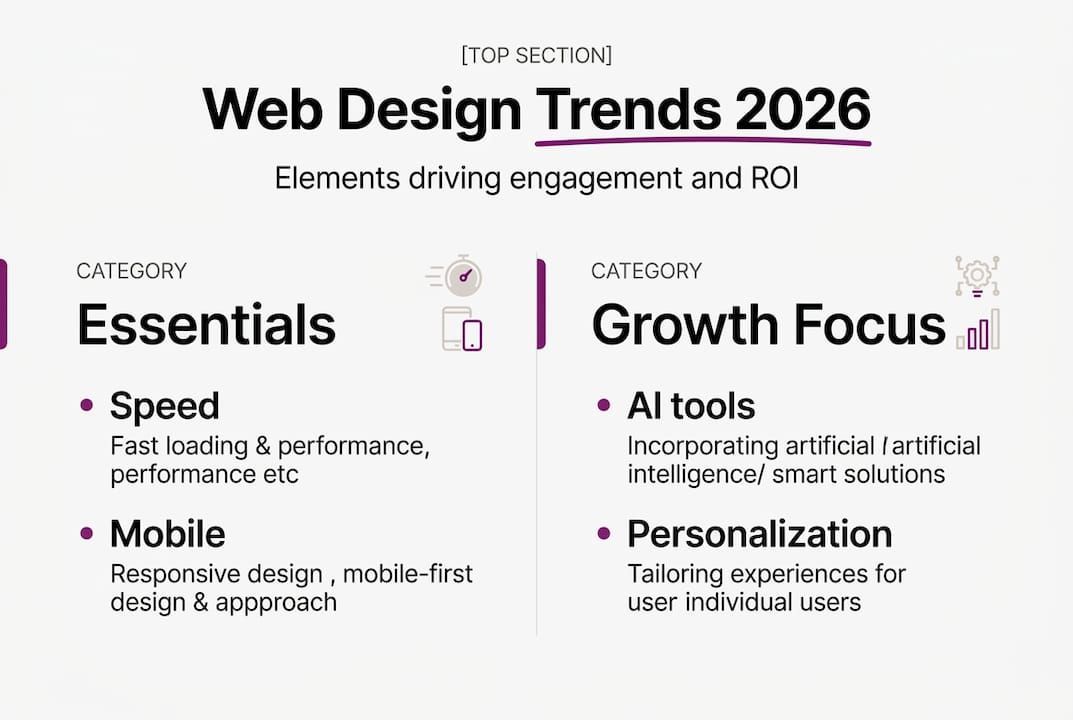
Personalization tools powered by AI for personalization are also changing what's possible for SMB sites in 2026. And pairing strong design with website and SEO integration ensures your site works harder across every channel.
Pro Tip: Run your site through Google Lighthouse (free, built into Chrome) to get a performance and accessibility score. Aim for 90 or above on both. It takes 10 minutes and reveals issues you'd never spot manually.
From brochure to ROI driver: making web design work for you
Equipped with knowledge of design tradeoffs, let's translate that into action for your business. The shift from a static brochure site to an active growth engine isn't complicated. But it does require intention.
Start here:
- Audit your current site for CTAs — Does every key page have a clear next step? A button, a form, a phone number? If not, that's your first fix.
- Set up analytics — Google Analytics 4 is free and shows you exactly where visitors drop off, what pages perform, and where your best traffic comes from.
- Prioritize mobile loading speed — Test your site on a real phone, not just a desktop browser. Mobile-first design drives better ROI for SMBs.
- Integrate SEO from the start — Page titles, meta descriptions, heading structure, and internal linking all contribute to how Google reads your site.
- Connect digital marketing to your site — Your ads, social posts, and emails should lead back to pages designed to convert.
Real businesses see real results from these changes. A local service company that added a prominent "Get a free quote" button above the fold reported a 40% increase in form submissions within 30 days. No redesign. No new traffic. Just a clearer path for visitors to take action.
Remember: 70% of sites still miss clear calls to action. That's not a statistic to gloss over. It means most of your competitors are leaving money on the table, and you have a real opportunity to stand out.
Pro Tip: Review your site analytics monthly. Look at your top 5 pages by traffic and ask: does each one have a clear CTA? Is the bounce rate under 60%? Small, consistent adjustments compound into significant growth over time.
Our perspective: web design as a growth mindset for SMBs
Let's step back and share a perspective few small business owners hear. We've worked with businesses across industries, and one pattern shows up constantly: the website gets built, launched, and then forgotten. "Set and forget" is the most common web design mistake we see.
Your website isn't a brochure. It's your best salesperson. It works 24 hours a day, speaks to every potential customer before you do, and shapes their first impression of your business. Treating it as a one-time expense rather than an ongoing investment is like hiring a great salesperson and then never giving them updated materials or feedback.
Design thinking extends beyond visuals. Every touchpoint, from how fast your page loads to how easy it is to find your contact information, is part of the experience. Markets shift. User habits change. New technologies emerge. Your site needs to adapt with them.
The businesses that win online aren't always the ones with the biggest budgets. They're the ones that stay curious, keep testing, and treat their website as a living part of their growth strategy. If you're not sure where to start, choosing a business-focused web partner who understands both design and business outcomes makes all the difference.
How MyCali Designs can help transform your web presence
If you're ready to apply these insights, here's how to take your business website to the next level.
At MyCali Designs, we build conversion-focused, mobile-optimized websites that are designed to grow with your business. We don't just make things look good. We build sites that attract the right visitors, guide them toward action, and support your broader marketing goals.
Whether you need custom website development, a full package combining website and SEO services, or a complete brand refresh starting with branding and logo design, we have the tools and experience to help. Reach out today to request a free site review and see exactly where your current site is leaving growth on the table.
Frequently asked questions
What is the difference between a template site and a custom-designed site?
A template site uses pre-made layouts that limit how well your site reflects your brand and goals. Custom design is built around user research and your specific business objectives, giving you a stronger competitive edge.
Why is mobile-first design important for small businesses?
Mobile traffic dominates web usage in 2026, and a site that loads slowly or looks broken on a phone will lose visitors before they ever read a word.
How does web design affect SEO and search rankings?
Site structure, page speed, and clean code all influence how search engines crawl and rank your pages. SEO integration from the start of the design process gives you a measurable advantage over competitors who add it as an afterthought.
What is a performance budget in web design?
A performance budget sets a maximum file size per page, typically under 500kb, to keep load times fast. Performance budgets improve user experience and reduce bounce rates across all devices.
Can web design really improve my business's bottom line?
Absolutely. Websites with clear CTAs and user-centered design consistently drive higher engagement, more leads, and stronger revenue for small and medium businesses.
Recommended
Recent Posts