




The Role of Design in Conversions: 2026 Guide
The Role of Design in Conversions: 2026 Guide

TL;DR:
- Design influences user trust and guides subconscious decisions, significantly boosting conversion rates.
- Strong visual hierarchy, trust signals, and mobile-first layouts are crucial for quick, confident user actions.
The role of design in conversions is to shape user experience and visual communication so that more visitors become paying customers. This is not a soft creative goal. 73% of consumers will pay more for better-designed products, and 72% say design directly influences their purchase decisions. McKinsey research consistently links strong visual branding to measurable revenue growth. Design is a business lever, and the marketers who treat it that way outperform those who treat it as decoration.
What design principles most influence conversions?

Conversion-Centered Design (CCD), a framework popularized by Unbounce, defines design as a system built to guide one specific user action. Every element on a page either supports that action or competes with it. The goal is to remove competition.
Several principles consistently move the needle:
- Visual hierarchy: Users scan before they read. Bold headlines, contrasting call-to-action buttons, and directional cues tell the eye where to go. When hierarchy is clear, users reach the conversion point faster.
- Simplicity and Hick's Law: Decision time increases with every additional choice. Removing one form field can lift conversion rates by up to 50%. Fewer options mean faster decisions.
- Trust signals: Security badges, money-back guarantees, client logos, and professional photography all tell users the brand is credible. Trust signals are the foundation of converting landing pages across every demographic.
- Color and consistency: Color communicates emotion and brand identity before a word is read. Consistent use of color, typography, and spacing across pages reduces cognitive friction and builds familiarity.
Pro Tip: Run a five-second test on your landing page. If a new visitor cannot identify your main offer and call to action within five seconds, your visual hierarchy needs work before you touch copy or traffic.
These principles are not aesthetic preferences. They are conversion mechanics. A page that looks polished but buries the CTA in a sea of competing elements will underperform a simpler page every time. The importance of user experience starts with making the right action obvious.
How do psychological factors in design increase conversion?
"Design is not just what it looks like and feels like. Design is how it works." — Steve Jobs
That quote captures exactly how design affects user behavior at a psychological level. Good design does not ask users to think hard. It activates what behavioral economists call System 1 thinking, the fast, intuitive, subconscious processing that drives most purchase decisions.
System 1 thinking is guided by color hierarchies, trust cues, and clear calls to action. When these elements are well-designed, users feel confident and move forward without hesitation. When they are missing or inconsistent, users pause, question, and often leave.
Emotional response is another powerful mechanism. Research on visual merchandising shows that:
- Positive emotional responses such as pleasure, urgency, and confidence drive impulse purchases beyond pure aesthetics.
- Interactive promotions and smooth navigation amplify those emotional states.
- Visual page design contributes to buying behavior even when the user did not plan to purchase.
Social influence adds a third layer. In social commerce environments, eWOM (electronic word of mouth) mediates purchase intention more strongly than hedonic visual appeal alone. This means user reviews, social proof widgets, and community-generated content carry more conversion weight than a beautiful product photo. The role of aesthetics in selling is real, but it works best when paired with social validation.
Reducing cognitive load ties all of this together. Every unnecessary element on a page adds a mental tax. When you strip away clutter, users process information faster, feel less overwhelmed, and convert at higher rates. This is why the best-converting pages in e-commerce tend to be the simplest ones, not the most visually complex.
How do design strategies compare in driving conversion rates?
Not all design strategies deliver equal results. The right approach depends on your audience, platform, and conversion goal. Here is how the most common strategies stack up.
| Strategy | Best For | Key Outcome |
|---|---|---|
| Trust-first design | All demographics, especially first-time visitors | Reduces skepticism; increases form completions and purchases |
| Personalization targeting | Ages 35–44 show highest value response | Lifts engagement for returning users; limited impact on cold traffic |
| Mobile-first visual design | Platforms where 94.8% of impressions are mobile | Higher engagement and lower bounce rates on social and search |
| Video-led content | Product pages and social ads | Video interaction is 10x higher than text; boosts time on page |
| Consistent visual branding | Brand-building and repeat purchase cycles | McKinsey links strong visual branding to 32% higher revenue growth |
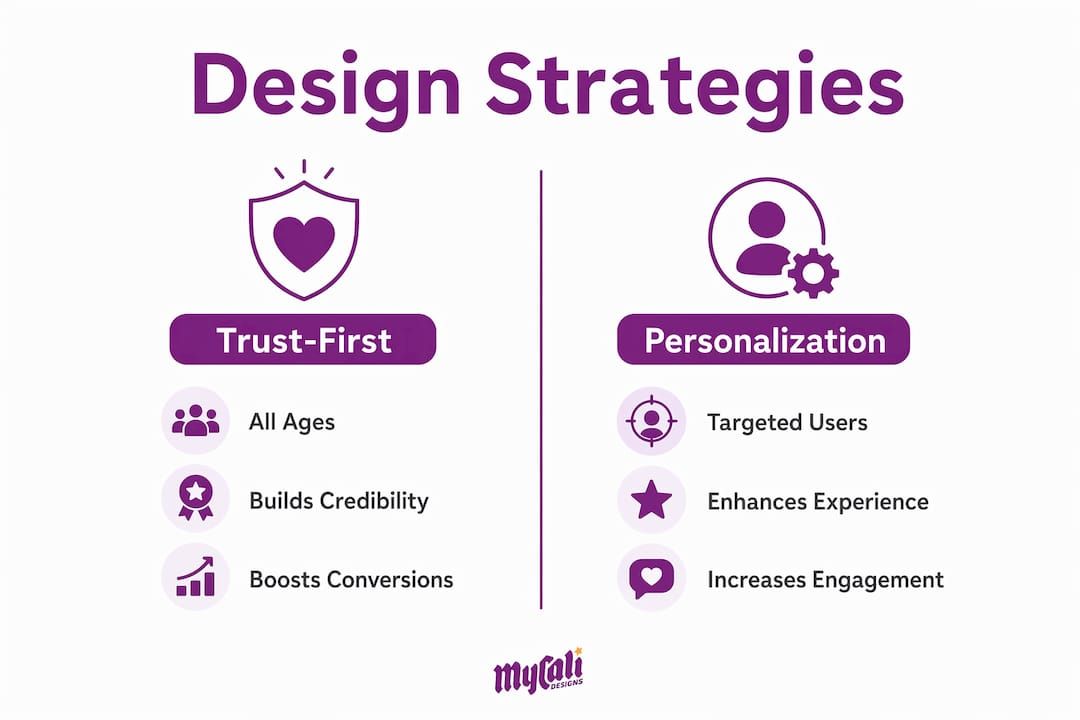
The data on trust versus personalization is worth pausing on. A Springer study found that personalization is valued most by the 35–44 age group, while trust signals perform across all demographics. The practical implication: build trust first, then layer personalization on top for returning segments. Skipping the trust layer to chase personalization is a common and costly mistake.
Mobile-first design deserves its own emphasis. Bold text, high contrast, and clear focal points are not just good mobile practice. They are the baseline for any platform where users are scrolling fast and deciding in seconds. Platform-native formats consistently outperform generic images in driving conversions, which means designing for the specific context where your audience lives.
Pro Tip: Before investing in personalization technology, audit your current trust signals. Check that every page has visible security indicators, real customer reviews, and a clear refund or guarantee policy. These elements lift conversion rates across the board before any personalization layer is added.
Visual branding consistency also compounds over time. Users who recognize your brand across touchpoints convert at higher rates because familiarity reduces risk perception. Mycalidesigns works with clients on digital branding strategies that build this kind of recognition systematically, not just visually.
What steps can marketers take to improve design for conversions?
Theory becomes revenue only when it is applied. Here is a practical sequence for using design to drive measurable conversion improvements.
-
Audit your current pages for cognitive load. Open each key landing page and count the number of choices, form fields, and competing calls to action. Every unnecessary element is a conversion leak. Remove or consolidate anything that does not directly support the primary action.
-
Establish trust signals on every conversion page. Add customer reviews, security badges, and a visible guarantee or return policy above the fold. Do not assume users will scroll to find reassurance. Place it where the decision happens.
-
Apply a clear visual hierarchy. Your headline should be the largest element. Your CTA button should contrast sharply with the background. Supporting copy and images should guide the eye toward that button, not away from it. Use tools like Figma or Adobe XD to prototype and test hierarchy before publishing.
-
Optimize for mobile first. Use bold typography, high-contrast color combinations, and single-column layouts. Test every page on actual mobile devices, not just browser simulations. Given that mobile impressions dominate most social platforms, a desktop-first approach leaves significant conversion volume on the table.
-
Add video where it supports the decision. Product explainer videos, testimonial clips, and demo walkthroughs increase time on page and reduce purchase hesitation. 89% of consumers expect more video content in 2026. Meeting that expectation on key conversion pages is a direct revenue opportunity.
-
Measure, test, and iterate. Use Google Optimize, VWO, or similar A/B testing tools to test one design variable at a time. Track conversion rate, bounce rate, and scroll depth. Let data confirm what your instincts suggest.
Pro Tip: Start your design audit with your highest-traffic, lowest-converting page. That is where design improvements deliver the fastest measurable ROI. Fix the biggest leak first, then work down the funnel.
These website design tips apply whether you are running an e-commerce store, a service business, or a lead generation site. The mechanics of conversion are consistent across categories.
Key takeaways
Design directly determines conversion rates by shaping user trust, reducing cognitive friction, and guiding subconscious decision-making toward the intended action.
| Point | Details |
|---|---|
| Trust signals convert universally | Add reviews, guarantees, and security badges to every conversion page before testing personalization. |
| Simplicity drives faster decisions | Removing form fields and competing choices can lift conversion rates by up to 50% per element removed. |
| Mobile-first is non-negotiable | With 94.8% of Facebook impressions on mobile, bold contrast and clear focal points are baseline requirements. |
| Video outperforms text | Video interaction runs 10x higher than text; use it on product and landing pages to reduce purchase hesitation. |
| Branding consistency compounds | Consistent visual identity across touchpoints builds familiarity, which reduces perceived risk and increases repeat conversions. |
What i've learned after years of design-driven growth
Most marketers I talk to treat design as the last step. Copy gets written, the offer gets built, and then someone asks, "Can you make it look good?" That sequence is backwards. Design is not the wrapper. It is the delivery mechanism.
The biggest conversion wins I have seen come from the simplest changes. Removing a navigation menu from a landing page. Changing a gray CTA button to a high-contrast orange. Replacing a stock photo with a real client photo. None of these are complex. All of them moved numbers.
The other pattern I notice is that teams underestimate the cost of inconsistency. A brand that looks polished on the website but generic on social media creates a trust gap. Users notice the mismatch even when they cannot articulate it. That gap costs conversions silently, over time.
My honest recommendation: treat design and marketing as one function, not two. When your visual identity, your messaging, and your user experience are built together with a shared conversion goal, the results are measurably better. Collaboration between designers and marketers is not a nice-to-have. It is the structure that makes everything else work.
The role of design in marketing is not to make things pretty. It is to make the right action feel obvious, trustworthy, and easy. That is the standard worth holding every design decision to.
— Cesar
How Mycalidesigns helps you convert more customers
If this article has shown you anything, it is that design decisions have direct revenue consequences. At Mycalidesigns, we build brand identities, websites, and visual systems with conversion as the core objective, not an afterthought.
Whether you need a brand identity that builds immediate trust or a website built for conversions with SEO built in, we bring the strategy and the craft together. Our process is collaborative, clear, and focused on outcomes you can measure. If you are ready to make your design work as hard as your marketing does, we would love to talk.
FAQ
How does design directly affect conversion rates?
Design shapes user trust, reduces cognitive friction, and guides attention toward the conversion action. Research shows that removing unnecessary choices and adding trust signals can lift conversion rates significantly on any page type.
What are the most important trust signals in design?
User reviews, security badges, money-back guarantees, and professional photography are the most effective trust signals across all demographics. These elements reduce purchase hesitation before personalization features add any additional value.
Does visual content really improve conversions?
Yes. Content with visual elements sees 650% higher engagement, and video interaction runs 10x higher than text. Adding video to key conversion pages is one of the highest-ROI design decisions available in 2026.
How does mobile design impact conversion rates?
Mobile-first design with bold text, high contrast, and clear focal points outperforms desktop-adapted layouts on platforms where mobile impressions dominate. Designing for mobile first is now the baseline, not a bonus consideration.
Should i prioritize trust or personalization in my design strategy?
Prioritize trust first. Personalization delivers the strongest lift for users aged 35–44, but trust signals improve conversion across every demographic. Build the trust layer before investing in personalization technology.
Recommended
Recent Posts