




Why Data-Driven Marketing Wins for SMB Growth
Why Data-Driven Marketing Wins for SMB Growth

TL;DR:
- Data-driven marketing uses measurable data to guide advertising decisions and improve results. It offers SMBs higher retention, lower wasted spend, and faster learning cycles. Success depends on integrating data across channels and fostering a culture that relies on evidence rather than intuition.
Data-driven marketing is the practice of using measurable customer and campaign data to guide every marketing decision, replacing assumptions with evidence. Organizations that adopt this approach are 23 times more likely to acquire customers and six times more likely to retain them. Companies using data-driven methods also report 5–8 times higher marketing ROI than those relying on intuition. For small to medium-sized businesses, understanding why data-driven marketing matters is not optional. It is the difference between spending money and growing revenue.
Why data-driven marketing outperforms intuition-based approaches
Data-driven marketing is a methodology, not a technology. It means every campaign decision, from audience selection to budget allocation, is grounded in real customer behavior, transaction history, and demographic patterns rather than gut feeling. The industry term for this practice is "evidence-based marketing," and it applies across every channel, digital or traditional.
The contrast with intuition-based marketing is stark. Traditional marketing relies on experience, brand instinct, and broad demographic assumptions. A business owner might run the same radio ad every quarter because "it worked before." Data-driven marketing asks instead: what does the conversion data actually show? Which customer segment responded? What was the cost per acquisition?
This shift matters because marketing spend without data is wasted at a rate of 40–60%. That means for every $10,000 a small business spends on marketing without data processes in place, up to $6,000 may produce no measurable return. Fixing that inefficiency does not require a massive budget. It requires a commitment to measuring what you do.
The compounding effect is what makes early adoption so valuable. Continuous optimization creates a widening competitive advantage over time. Businesses that start measuring and refining their campaigns today will be significantly ahead of competitors who wait another year to begin.
What benefits does data-driven marketing offer to SMBs?
The benefits of data-driven marketing are concrete and measurable, not theoretical. For SMBs with limited budgets, the gains in efficiency alone justify the shift.
- Budget efficiency. Eliminating the 40–60% of wasted spend frees up real dollars for campaigns that convert. A business spending $5,000 per month on ads could recover $2,000–$3,000 in effective budget simply by cutting underperforming placements identified through analytics.
- Personalized customer engagement. Behavioral and transactional data lets you speak to customers based on what they actually do, not what you assume they want. Personalized campaigns consistently outperform generic ones in open rates, click-through rates, and purchase conversion.
- Improved targeting accuracy. Combining behavioral, transactional, and demographic data creates audience segments that reflect real buying patterns. You stop paying to reach people who will never buy and start concentrating spend on those most likely to convert.
- Faster learning cycles. When every campaign is measured, every result teaches you something. You accumulate knowledge about your customers faster than competitors who run campaigns without tracking outcomes.
- Long-term competitive advantage. The compounding nature of data use means the gap between data-driven businesses and their competitors grows wider every quarter.
Real-time data activation adds another layer of value. When a customer abandons a cart, a data-driven system triggers a follow-up email within the hour. When a paid ad underperforms by midday, budget shifts automatically to the better-performing variant. These are not luxuries. They are standard capabilities available to SMBs through accessible marketing platforms today.
Pro Tip: Start with one channel, measure it thoroughly for 30 days, and use those findings to justify expanding your data practice. Early wins build internal support faster than any presentation.

For a broader view of how digital marketing benefits translate to SMB growth, the principles align closely with data-driven strategy.
How does data-driven marketing differ from traditional and digital marketing?
This is one of the most common points of confusion among business owners. Digital marketing and data-driven marketing are not the same thing. Understanding the distinction helps you invest in the right capabilities.
Digital marketing is channel-focused. It describes where you market: search engines, social media, email, display advertising. Data-driven marketing is a methodology. It describes how you make decisions across all of those channels, and even across traditional ones like direct mail or events.
You can run a digital marketing campaign with zero data discipline. You can also apply data-driven thinking to a print catalog. The methodology is what matters, not the medium.
| Dimension | Traditional marketing | Digital marketing | Data-driven marketing |
|---|---|---|---|
| Decision basis | Intuition and experience | Channel performance metrics | Evidence from unified customer data |
| Measurement | Delayed or estimated | Real-time by channel | Cross-channel attribution |
| Optimization | Periodic, campaign-level | Ongoing within channels | Continuous, hypothesis-driven |
| Customer view | Broad demographic segments | Channel-specific audiences | Unified identity profiles |
| Scope | Offline channels | Online channels | All channels, integrated |
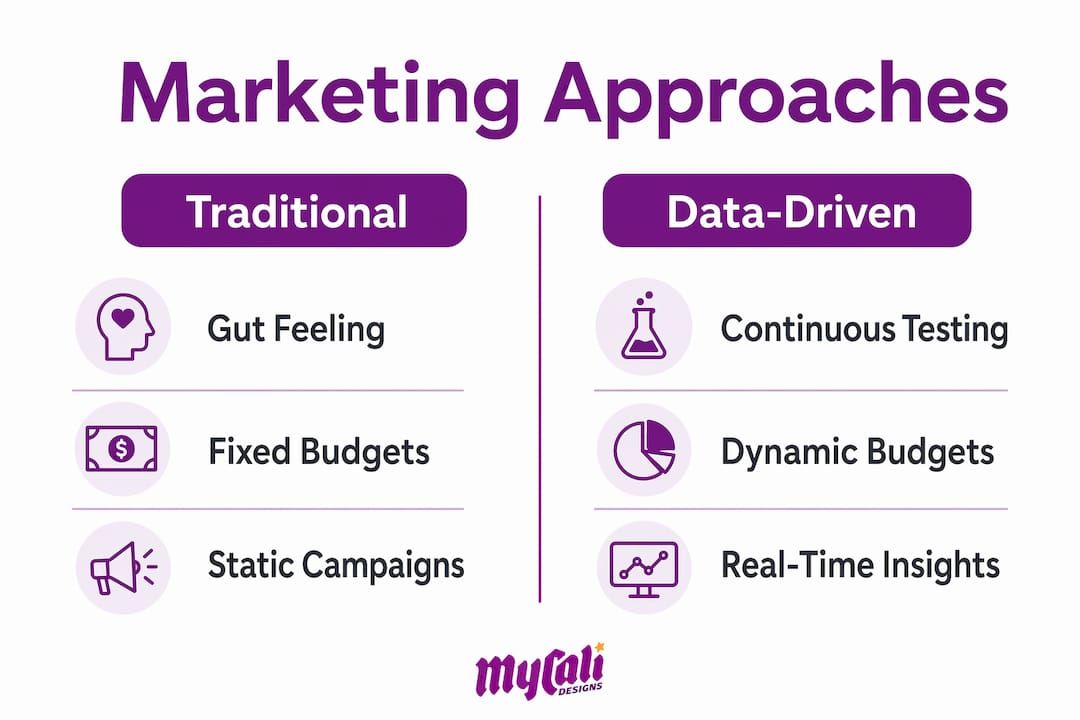
The key differentiator is continuous measurement and hypothesis-driven experimentation. Data-driven marketers do not just track results. They frame every campaign as a test, form a hypothesis before launch, and use results to inform the next decision. This is what analytics in marketing practitioners call "closing the loop," and it is what separates reporting from actual decision-making.
Identity resolution is another defining feature. Data-driven marketing builds unified customer profiles by connecting data from multiple touchpoints: a website visit, an email open, an in-store purchase. This unified view is what makes personalization at scale possible. For a plain-language breakdown of marketing methodology terms, the distinctions become even clearer.
What challenges do SMBs face when adopting data-driven marketing?
Adoption is harder than it looks, and the barriers are mostly organizational, not technical. Knowing them in advance saves significant time and frustration.
Data fragmentation across 10–20 tools is the single biggest technical barrier. Most SMBs use separate platforms for email, social media, paid ads, and their website. Each platform holds a piece of the customer picture. Without integration, you cannot see the full story, and decisions stay siloed.
Leadership intuition overriding data is the biggest cultural barrier. When a founder or senior manager dismisses a data finding because it contradicts their experience, the entire data practice loses credibility. This pattern is common in SMEs and it stalls progress more reliably than any technical problem.
Other common barriers include:
- Lack of data literacy. Marketers who cannot read a confidence interval or interpret a cohort analysis cannot act on data effectively. Training is not optional.
- Poor data quality. Duplicate records, inconsistent naming conventions, and missing fields make analysis unreliable. Garbage in, garbage out.
- No clear ownership. When nobody is accountable for data quality and reporting, both deteriorate quickly.
- Underinvestment in infrastructure. Self-service analytics dashboards require upfront setup. Skipping this step forces every insight request through a bottleneck.
Fewer than 30% of enterprises successfully convert data insights into marketing action due to organizational silos. That number is even lower for SMBs without dedicated analytics resources. The solution is not more data. It is better processes for turning data into decisions.
Pro Tip: Assign one person as the data accountability lead, even part-time. Accountability without a named owner defaults to nobody. That one change reduces data quality problems faster than any tool upgrade.
Overcoming digital marketing challenges requires both technical fixes and cultural ones. The cultural side takes longer but matters more.
How can SMBs implement data-driven marketing strategies?
Implementation does not require a data science team. It requires a clear sequence and consistent follow-through.
- Audit your data quality first. Before analyzing anything, check what you actually have. Identify duplicate contacts, incomplete records, and disconnected platforms. Clean data is the foundation everything else depends on.
- Build unified customer profiles. Connect your email platform, website analytics, and CRM so you can see each customer's full interaction history. Even basic identity resolution, matching an email address to a website session, dramatically improves targeting.
- Frame every campaign as a hypothesis. Before launching, write down what you expect to happen and why. "We expect this subject line to increase open rates by 10% because it addresses a specific pain point." Hypothesis-driven teams consistently outperform peers who simply run campaigns and review results afterward.
- Run structured A/B tests. Test one variable at a time: subject line, call to action, image, audience segment. Document results in a shared log so findings accumulate into institutional knowledge.
- Set up self-service dashboards. Your marketing team should be able to check campaign performance without filing a request to IT or an analyst. Tools like Google Looker Studio connect to most SMB platforms at no cost and produce clear visual reports.
- Close the loop from insight to action. A weekly review meeting where data findings directly change next week's budget or creative brief is the minimum viable data practice. Without this step, data becomes decoration.
- Balance data with judgment. Data informs but does not replace human expertise. Use data to reduce uncertainty, not to eliminate the need for experienced marketing judgment.
The goal is not perfection from day one. The goal is a system that gets smarter every week. Small businesses that build this habit early create a compounding advantage that is very difficult for late adopters to close.
Key Takeaways
Data-driven marketing delivers its greatest returns when measurement, unified customer data, and hypothesis-driven testing work together as a continuous system rather than isolated tactics.
| Point | Details |
|---|---|
| Customer acquisition and retention | Data-driven adopters are 23 times more likely to acquire customers and 6 times more likely to retain them. |
| Budget efficiency | Without data processes, 40–60% of marketing spend is wasted or poorly allocated. |
| Methodology vs. channel | Data-driven marketing is a decision-making approach, not a channel; it applies across digital and traditional media. |
| Biggest adoption barrier | Data fragmentation across 10–20 tools prevents unified customer views and blocks informed decisions. |
| Compounding advantage | Continuous optimization creates a widening performance gap between data-driven businesses and those that delay adoption. |
Data-driven marketing is a capability, not a purchase
I have worked with enough SMBs to know the most common mistake: treating data-driven marketing as a software problem. A business buys a new analytics platform, sets up a dashboard, and considers the job done. Six months later, nothing has changed because the data never influenced a single decision.
Having a dashboard is not the same as being data-driven. The real test is whether your data changes what you spend, what you say, and who you target. If the answer is no, you have data as decoration, not data as decision infrastructure.
The cultural shift is harder than the technical one. Leadership has to model data-based decisions visibly and consistently. When a founder says "the data shows X, so we are changing Y," the entire team learns that data has real authority. When leadership overrides data with instinct repeatedly, the team stops trusting the process and stops contributing to it.
The businesses I have seen succeed with this approach share one trait: they treat every campaign result as a lesson, not a verdict. They do not celebrate wins and ignore losses. They ask why in both cases. That habit, more than any tool, is what builds genuine data-driven capability over time.
— Cesar
Mycalidesigns can help you put data to work
Building a data-driven marketing practice requires more than analytics. It requires a website that captures the right data, a brand that earns trust, and digital campaigns that are built to be measured from day one.
Mycalidesigns works with SMBs to build the full foundation: from digital marketing and Google Ads to website development and branding systems that support measurable growth. Our website and SEO services are built with data collection and performance tracking in mind, so your marketing decisions are grounded in real evidence from the start. If you are ready to build a marketing system that gets smarter over time, we are ready to help you build it.
FAQ
What is data-driven marketing in simple terms?
Data-driven marketing means using real customer and campaign data to decide where to spend, who to target, and what message to send. It replaces guesswork with evidence from behavioral, transactional, and demographic sources.
How does data-driven marketing improve ROI?
Companies using data-driven methods report 5–8 times higher marketing ROI than those relying on intuition, primarily by eliminating wasted spend and concentrating budget on high-converting audiences.
What is the biggest barrier to adopting data-driven marketing?
Data fragmentation across multiple tools is the leading technical barrier, while leadership intuition overriding data findings is the leading cultural one. Both must be addressed for adoption to succeed.
Do SMBs need a data science team to get started?
No. SMBs can start with clean CRM data, a free dashboard tool like Google Looker Studio, and a habit of framing campaigns as testable hypotheses. The process matters more than the headcount.
How is data-driven marketing different from digital marketing?
Digital marketing describes the channels you use. Data-driven marketing describes how you make decisions across all channels, including traditional ones. You can practice data-driven marketing in print just as effectively as in paid search.
Recommended
Recent Posts