



What is brand identity? Guide for small business success
What is brand identity? Guide for small business success

Most small business owners assume that getting a logo designed means their brand is done. It's a natural shortcut, but it leaves out the deeper work that actually drives customer trust and loyalty. Brand identity covers the visible elements of your business, including logos, colors, design, and consumer perceptions, and extends to every customer experience from service to messaging. When all of those pieces align, your business becomes recognizable, credible, and positioned to grow. This guide breaks down what brand identity really means, why it matters financially, how to build it step by step, and the pitfalls that cost SMBs the most.
Table of Contents
- Defining brand identity: What it really means
- Why brand identity matters for your business
- Core elements of effective brand identity
- Brand identity in action: Case studies, archetypes, and common pitfalls
- Why most SMBs get brand identity backwards — and what actually works
- Ready to elevate your brand identity?
- Frequently asked questions
Key Takeaways
| Point | Details |
|---|---|
| Brand identity is multifaceted | It's much more than your logo; every customer impression shapes how your business is perceived. |
| Consistency drives trust | Applying your brand identity systematically can boost customer trust and your bottom line. |
| Start with strategy | Successful brand identity begins with a clear mission, values, and understanding of your audience. |
| Small changes, big results | Refining visuals or messaging can measurably increase recognition and revenue. |
Defining brand identity: What it really means
Many business owners use "logo" and "brand identity" as if they mean the same thing. They do not. Your logo is one element inside a much larger system. Understanding the difference is the first step toward building something that actually works.
"Brand identity is the visible elements of a company's brand, including logos, colors, design, and consumer perceptions, extending to all customer experiences like service and messaging to shape perception and build trust." — Investopedia
That definition tells us something important: brand identity is both visual and experiential. It lives in your color palette, yes. But it also lives in how your team answers the phone, the tone of your email newsletters, and whether your Instagram feed matches your business cards.
Research confirms that the psychological impact of branding goes far deeper than a logo mark. Customers form subconscious impressions within seconds of encountering your business, and those impressions are shaped by the full system of signals you send, not just one graphic.
Here is what brand identity actually includes:
- Logo and visual mark — the graphic symbol that represents your business
- Color palette — the specific set of colors used consistently across all materials
- Typography — the fonts that shape the personality of your written content
- Messaging and tone — the words you choose and how they sound to your audience
- Customer experience — how people feel at every touchpoint with your business
- Values and mission — the beliefs that guide your decisions and connect with customers
Think of brand identity as a personality. A person's identity is not just their appearance. It is also how they speak, how they treat others, and what they stand for. Your brand works the same way. When every element is aligned and intentional, customers know exactly what to expect from you, and that predictability builds trust faster than any single design asset ever could.
For SMBs especially, clarity here is a competitive advantage. Larger companies have marketing teams and budgets to smooth over inconsistencies. Smaller businesses win by being coherent, intentional, and memorable from the very first interaction.
Why brand identity matters for your business
Now that we know what brand identity includes, let's explore why it matters for your business growth.
The business case for brand identity is not just anecdotal. The numbers are clear. Consistent branding can yield 10 to 20% revenue growth, customers are 81% more likely to remember your brand colors when used consistently, and strategic rebranding can boost sales by as much as 30%.
| Branding action | Potential impact |
|---|---|
| Consistent color use | 81% higher brand recall |
| Consistent branding overall | 10 to 20% revenue growth |
| Strategic rebrand | Up to 30% sales increase |
Those numbers translate into real dollars for small businesses. A 10% revenue lift on $500,000 in annual sales is $50,000. That is not a design luxury. That is a growth strategy.
Professional presentation also sets businesses apart in crowded markets. When a potential customer is comparing two service providers, the one with a polished, consistent identity signals reliability even before any conversation takes place. First impressions happen fast, and they stick.
Here is how brand identity drives business results in practical terms:
- Builds trust immediately — Consistent visuals and messaging signal that your business is organized and dependable.
- Improves memorability — Customers who remember you are more likely to refer you and return.
- Justifies your pricing — A professional identity communicates value, which supports premium pricing.
- Supports marketing efficiency — Clear brand guidelines make every campaign faster and cheaper to produce.
Pro Tip: Before investing in ads or social media campaigns, make sure your brand identity is solid. Sending traffic to a confusing or inconsistent brand experience wastes your marketing budget.
If you have branding questions about where your business currently stands, starting with an honest audit of your visual and verbal consistency is a smart first move.
Core elements of effective brand identity
Understanding brand identity's impact, let's examine its essential building blocks and how to apply them.
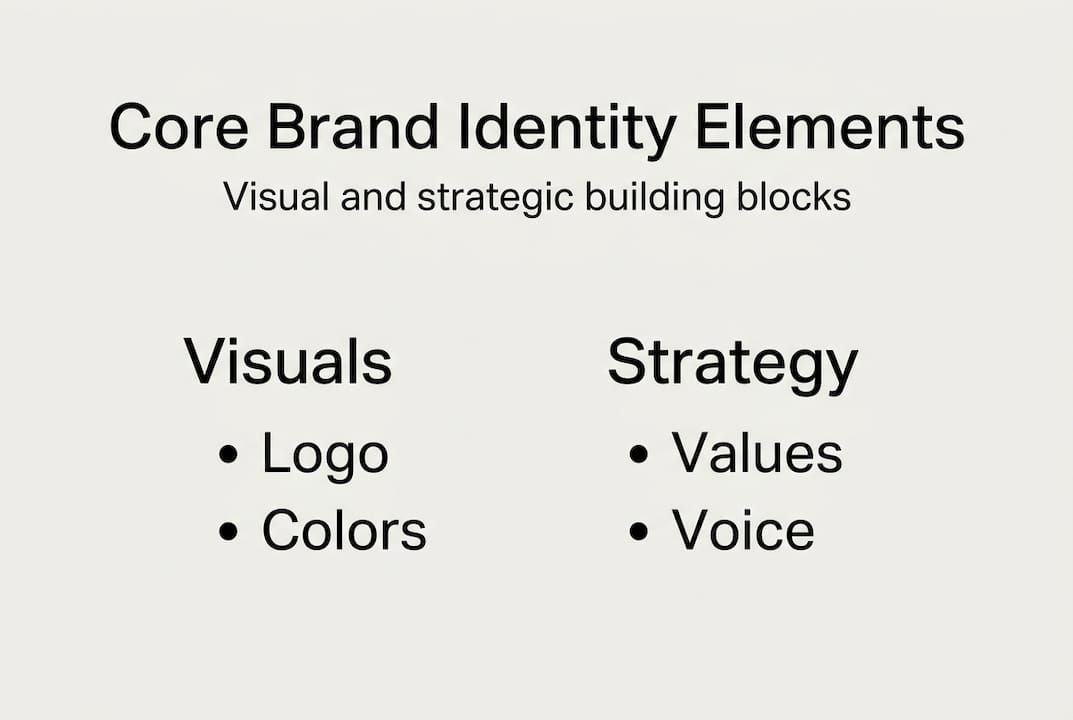
Building a strong brand identity follows a logical sequence. Skipping steps, especially the early strategic ones, is the most common reason SMBs end up with visuals that feel disconnected from their actual business.

The core methodology for SMBs follows five stages: define core values, mission, audience, and unique proposition; develop visual elements like logo, colors, and typography; create verbal identity including voice, tone, and messaging; build a style guide; then apply and evolve continuously.
Here is how each stage works in practice:
- Define your foundation — Clarify what your business stands for, who you serve, and what makes you different. This strategy layer informs every design decision that follows.
- Develop your visual identity — Work with a designer to create a logo, select a color palette, and choose typography that reflects your brand personality. These elements should feel intentional, not accidental.
- Build your verbal identity — Define how your brand sounds. Are you warm and conversational or precise and authoritative? Consistent tone across all content builds recognition.
- Create a style guide — Document every visual and verbal rule in one reference document. This is what keeps your brand consistent across team members, vendors, and platforms.
- Apply and evolve — Launch your identity across all touchpoints and revisit it annually to make sure it still fits your business stage.
| Stage | What it covers | Common SMB mistake |
|---|---|---|
| Foundation | Values, mission, audience | Skipping to visuals too fast |
| Visual identity | Logo, colors, typography | Using inconsistent versions |
| Verbal identity | Voice, tone, messaging | No defined tone at all |
| Style guide | Rules and standards | Never creating one |
| Application | All touchpoints | Inconsistent rollout |
Pro Tip: Your style guide does not need to be a 60-page document. Even a one-page reference covering your logo, colors, fonts, and tone of voice will save you enormous time and keep your brand coherent as your team grows.
Our brand identity guide walks through how these elements come together for real businesses. If you are starting from scratch or updating an existing identity, creating custom logos that align with your full brand system is where the visual foundation begins.
Brand identity in action: Case studies, archetypes, and common pitfalls
Let's bring theory to life with stories and pitfalls relevant to growing businesses.
When a new business launches, the instinct is often to jump straight to a logo mark, that iconic symbol approach favored by established brands. But research shows that new SMBs often benefit more from starting with a wordmark, a text-based logo using your business name. Why? Because recognition needs to be built before abstraction can work. A symbol earns meaning over time. A name communicates immediately.
Beyond logo style, brand archetypes offer a useful framework for defining the personality behind your identity. Three especially relevant ones for SMBs are:
- The Sage — Positions your business as a trusted expert. Works well for consultants, agencies, and professional services firms where credibility is the primary currency.
- The Innocent — Communicates simplicity, purity, and trustworthiness. Fits businesses in wellness, food, or community-focused sectors.
- The Creator — Centers originality and craftsmanship. Ideal for design studios, makers, and businesses where the creative process is part of the value.
According to recent SME research, inconsistent branding actively erodes trust at a neurological level. Customers who encounter mismatched signals from a business experience a kind of cognitive friction that registers as unreliability, even if they cannot articulate why.
"The psychological impact of branding goes far deeper than aesthetics. Inconsistency does not just confuse customers — it signals instability." — Springer Research
Common pitfalls we see SMBs fall into include:
- Redesigning the logo repeatedly without addressing the underlying strategy
- Using different fonts, colors, or tones across different platforms
- Building an identity that reflects the owner's personal taste rather than the target audience's expectations
- Treating brand identity as a one-time project rather than an ongoing system
If your visuals, messaging, or market positioning feel misaligned right now, our brand refresh readiness resource can help you evaluate whether it is time for an update.
Why most SMBs get brand identity backwards — and what actually works
After seeing real-world applications, it is worth reflecting on a common but costly error we observe constantly.
Most small businesses start with the question, "What should my logo look like?" The better question is, "What do we stand for, and who are we trying to reach?" Visuals should answer a strategic question, not precede it.
We have seen businesses invest thousands in design work, only to rebrand within two years because the visuals never connected with their actual customers. The problem was not the designer. It was the sequence.
Strategic consistency is what drives the revenue gains and trust we cited earlier. A beautiful logo inside a fragmented identity system will not move the needle. A modest logo inside a coherent, consistently applied brand system will. The uncomfortable truth is that brand identity is not a deliverable you receive once and file away. It is a living system you manage continuously.
Treat it like infrastructure, not decoration. Our brand strategy insights reflect exactly this approach: strategy first, design second, consistency always.
Ready to elevate your brand identity?
Building a strong brand identity takes more than a great logo. It takes strategy, consistency, and a clear understanding of who you are and who you serve.
At MyCali Designs, we help SMBs build brand identities that actually work. Whether you need custom brand identity creation from the ground up, professional logo services that align with your full brand system, or a brand refresh evaluation to see if your current identity is holding you back, we are here to help. Let's build something that grows with your business.
Frequently asked questions
Is brand identity just a company's logo?
No. Brand identity includes your logo, colors, typography, messaging, tone of voice, and the full customer experience your business delivers. The psychological impact of branding extends far beyond any single visual element.
How does consistent branding impact my revenue?
Consistent branding is shown to boost small business revenue by 10 to 20% and can significantly increase customer recognition and long-term loyalty.
What is the first step to building a strong brand identity?
Start by defining your core values and mission, your ideal audience, and what makes your business genuinely different from competitors before touching any visual design.
How do I know if my brand identity needs a refresh?
If your visuals, messaging, or market positioning feel outdated or inconsistent, that friction is a signal. Inconsistency erodes trust neurologically, meaning customers may distrust you without knowing why.
What are common brand identity mistakes SMBs make?
The most costly mistake is starting with visuals rather than strategy, followed by applying the brand inconsistently across platforms and treating brand identity as a one-time project rather than an ongoing system.
Recommended
Recent Posts