




Service business branding ideas to stand out and win trust
Service business branding ideas to stand out and win trust
Most service businesses compete on quality alone, then wonder why growth stalls. The truth is, customers can't directly evaluate your skills before they hire you, so they make decisions based on perception. Strong branding fills that gap. It signals professionalism, builds trust before the first conversation, and keeps you top of mind long after the job is done. Long-term brand building is directly linked to sustained commercial success, and that applies just as much to a local landscaper or cleaning service as it does to a Fortune 500 company. This article walks you through a practical, proven branding roadmap built specifically for small and medium-sized service businesses.
Table of Contents
- Clarifying your service brand: Core criteria before ideation
- Inspirational branding ideas: Fresh strategies for service businesses
- Branding ideas in action: What top service businesses are doing
- Choosing the right branding tactics for your service
- The overlooked power of emotional brand cues in service businesses
- Bring your brand vision to life with expert help
- Frequently asked questions
Key Takeaways
| Point | Details |
|---|---|
| Start with brand basics | Clarify your value, voice, and visual identity before testing new ideas. |
| Modern branding works | Tools like video, content marketing, and story-driven cues can transform service business visibility and trust. |
| Consistency grows trust | Keep branding elements and customer experience uniform across all touchpoints for maximum impact. |
| Prioritize and adapt | Choose branding tactics that fit your audience, budget, and growth stage for real results. |
Clarifying your service brand: Core criteria before ideation
Before you brainstorm logos or post on social media, you need a clear picture of where your brand currently stands. Jumping into new branding initiatives without this foundation is like repainting a house before fixing the walls. The paint will look nice for a week, then the cracks come back.
Start by asking four foundational questions:
- Who exactly is your target customer? Get specific. "Homeowners" is too broad. "Homeowners aged 35 to 55 in suburban areas who value reliability over price" gives you something to work with. The more clearly you define your audience, the more precisely you can design every touchpoint around their expectations and preferences.
- What makes your service genuinely different? This is your unique value. It could be response time, a signature process, a specialization, or the way you communicate. Write it out in one sentence. If you can't, that's your first branding problem to solve. Your differentiator should drive every creative decision you make going forward.
- What personality do you want your brand to project? Pick three to five words that describe how you want customers to feel when they interact with your business. Words like "reliable," "modern," "approachable," or "premium" act as filters for design, language, and behavior. When someone on your team isn't sure how to respond to a customer, these words guide them.
- Do you have documented brand guidelines? Brand style guides are a core lever for stronger customer perception and easier day-to-day execution. A style guide doesn't need to be a 50-page document. Even a simple one-page reference covering your logo usage, brand colors, typography, and tone of voice will keep your team aligned and your brand looking consistent across every interaction.
"A brand without guidelines is like a team without a playbook. Everyone's working hard, but they're not always moving in the same direction."
Once you have these answers documented, you're ready to build on a solid foundation. We recommend reviewing our branding checklist to make sure nothing critical is missing before you move forward. If you want a deeper look at the visual side, our visual branding process guide walks you through each step from concept to execution.
Pro Tip: Color choices carry a lot of psychological weight. Blue signals trust and dependability. Green suggests growth and eco-consciousness. Orange conveys energy and warmth. Choose colors that match the personality words you've identified, not just ones you personally like.
Inspirational branding ideas: Fresh strategies for service businesses
With your core criteria in place, here are high-impact branding ideas tailored for service businesses at various stages and budgets. These aren't theoretical. They're strategies that real service businesses use to attract better clients and keep them coming back.
Leverage video and educational content. Video and content marketing are consistently linked to measurable lead generation increases in the service industry. A short "before and after" video of your work, a 60-second tip related to your service area, or a behind-the-scenes clip of your team builds enormous trust without a big production budget. Customers want to see who they're inviting into their home or business. Video answers that question before they even pick up the phone.
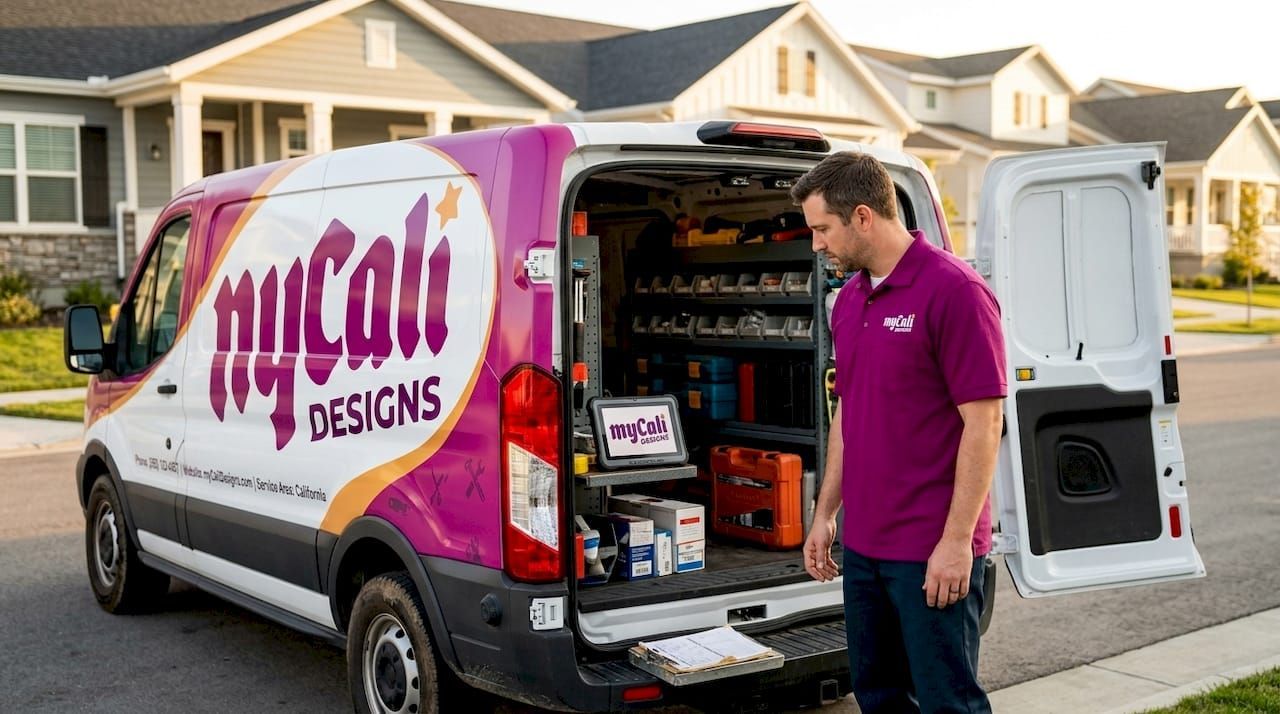
Invest in everyday physical branding. Your van, truck, uniform, or storefront is a moving billboard. Branded vehicle wraps and team uniforms create instant recognition in local communities and signal that you're a serious, organized business. This kind of physical presence reinforces your brand every single day without additional ad spend. Consistency across these touchpoints is especially powerful because people see them repeatedly in familiar settings.
Build a branded content library. Create templates for your quotes, proposals, follow-up emails, and invoices. Every document your business sends out is a brand touchpoint. When they all look cohesive and professional, the cumulative effect builds confidence. Maintaining a brand style guide with logo rules, typography, colors, voice guidelines, and channel-specific specs ensures your templates stay consistent even as your team grows.
Apply sensory and story-driven branding. This is where smaller service businesses can genuinely surprise their clients. Think about how your brand smells, sounds, and feels. A cleaning company that uses a consistent, pleasant-smelling product across every job creates a sensory memory. A contractor who always leaves a handwritten thank-you note creates an emotional one. These small, repeatable actions become the signature moments clients remember and talk about.
Maintain personality across all digital channels. Your Google Business profile, Instagram, website, and email all need to feel like they belong to the same company. Use the same profile image, bio language, color scheme, and tone everywhere. Check out our smart social media tips for practical ways to maintain brand personality across platforms without burning out.
"Branding isn't what you say about your business. It's what customers feel every time they interact with it."
Pro Tip: Your website is often the first serious brand impression a customer forms. Make sure it loads fast, clearly explains what you do and who you serve, and includes real photos of your work and team. A generic stock-photo website undercuts even the best branding. Our website conversion guide covers exactly what service businesses need to turn visitors into booked clients.
Branding ideas in action: What top service businesses are doing
Let's look at how successful service businesses translate these strategies into real customer experiences. You don't need a national brand to execute at a high level. The best local and regional service brands share a few consistent traits.
| Business type | Key branding tactic | What smaller businesses can adapt |
|---|---|---|
| Premium cleaning service | Branded uniforms, scented products, post-service checklist card | Create a "service signature" that customers experience every visit |
| Landscaping company | Before-and-after video series, consistent truck branding | Post transformation photos weekly on Google Business and Instagram |
| Home renovation contractor | Detailed proposals with branded templates, customer story spotlights | Invest in professional proposal design and collect video testimonials |
| Digital marketing agency | Thought leadership blog, consistent visual identity across all platforms | Start a monthly email newsletter with one genuinely helpful insight |
What these standout businesses have in common goes beyond design. They've thought about brand voice, imagery, typography, and channel-optimized specs as a system, not a checklist of individual items. Their branding feels cohesive because it is cohesive. Every customer-facing element has been considered as part of a larger experience.
Here's what smaller service businesses can apply immediately:
- Consistency beats creativity. Showing up with the same look, tone, and level of care every single time matters more than a flashy rebrand. Customers feel safe with familiar, predictable brands.
- Your story is a competitive advantage. Why did you start this business? What do you care about? Authentic origin stories create emotional connection that competitors with bigger budgets can't buy.
- Omnichannel design means every channel feels like you. When someone moves from your Instagram to your website to your invoice, none of those should feel like a different company. Refer to our branding execution steps to audit your current channels against this standard.
Choosing the right branding tactics for your service
With a clear set of ideas and real-world inspiration, the next step is narrowing your focus. Trying to do everything at once is a recipe for inconsistency. Instead, identify your top two or three priorities and build outward from there.
Here's a simple framework for evaluating branding priorities:
-
Identify your weakest touchpoint. Where do you most often lose trust or fail to make a strong impression? If your website looks outdated, start there. If your physical presence is weak, uniforms and signage might be the first move.
-
Match tactics to your budget and capacity. A video content strategy requires either time or money. Branded templates require a one-time design investment. Evaluate what you can sustain consistently, because inconsistency is worse than simplicity.
-
Set a 90-day trial window. Pick one or two tactics, implement them fully, and measure the effect after 90 days. Look at inquiries, conversions, and customer feedback. Adjust based on what the numbers tell you, not just how it feels.
The data supports prioritizing digital channels as a foundation. 68% of service industry marketers allocate over 50% of their budget to digital channels like SEO and PPC, and associate that with a 22% average increase in lead generation. That's a meaningful return on a focused investment.
At the same time, don't underestimate physical brand assets. For many service businesses, the truck, the uniform, and the in-person experience carry as much weight as anything digital.
| Branding investment area | Budget range (monthly) | Expected impact timeline |
|---|---|---|
| Logo and brand guidelines | One-time investment | Immediate and long-term |
| Website redesign or refresh | One-time to moderate | 2 to 4 months |
| Social media content creation | Low to moderate | 3 to 6 months |
| Vehicle wrap or signage | One-time investment | Immediate, ongoing |
| Email marketing templates | Low | 1 to 3 months |
| Video content series | Moderate | 3 to 6 months |
93% of industry leaders agree that long-term brand building is essential to business growth. That means the businesses you're competing against that are growing consistently are almost certainly investing in their brand, not just their advertising. Start with a step-by-step branding process to make sure your investment builds a brand that compounds over time.
The overlooked power of emotional brand cues in service businesses
Here's something most branding articles won't tell you: the tactical steps we've covered work, but they mostly get you to baseline competency. They help you look professional. What actually separates memorable service brands from forgettable ones is something deeper. It's emotional.
We've worked with service businesses that had polished logos, professional websites, and consistent social media, and still struggled to generate referrals or repeat business. When we looked closer, the branding was technically correct but emotionally flat. Customers remembered the service but didn't feel anything about the business.
Neurobranding offers a useful framework here. It works by engineering peak moments across customer touchpoints, using story alignment to create what researchers call "neural coupling" (where a customer's brain mirrors the emotions in a brand story), and applying consistent sensory and symbolic cues that prime emotional responses before a customer is even consciously aware of them. These aren't abstract concepts reserved for big brands. They're principles any service business can apply on a modest budget.
The most powerful version of this is the "signature cue." Pick one emotional or sensory element that becomes unmistakably yours. It could be a specific phrase your team uses at the end of every service call, a small branded gift left with the finished job, a signature color used on every document and vehicle, or even a consistent playlist in your reception area if you have a physical location. The goal is to create a moment that customers associate with you and only you.
Small businesses actually have a structural advantage here. You're closer to your customers than any national chain can be. That proximity lets you design personal, authentic brand experiences that a large competitor simply cannot replicate at scale. Use that. Lean into your story, your people, and the specific things you do that no one else does quite the same way.
Our brand readiness guide can help you assess whether your current brand is built to support these kinds of deeper emotional connections, or whether a refresh would serve you better.
Bring your brand vision to life with expert help
Reading about branding strategy is one thing. Turning it into a consistent visual system, a compelling website, and a professional brand presence across every touchpoint is where most service business owners hit a wall.
That's exactly where we come in. At Mycali Designs, we specialize in helping small and medium-sized service businesses build brands that look professional, communicate clearly, and attract the right customers. Whether you're starting from scratch or refreshing what you have, our business branding services are built around your growth goals, not just your aesthetic preferences. Explore our branding FAQs to see how we approach brand strategy and execution, or connect with our local logo design team if you're ready to start building a brand that works as hard as you do.
Frequently asked questions
How can small service businesses build a consistent brand?
Documenting clear brand guidelines covering your logo, voice, colors, and imagery is the most effective first step. Consistency in brand presentation is a core lever for stronger customer perception and easier day-to-day execution across your team and channels.
Which digital channels have the highest branding ROI for service businesses?
Social media, video content, and content marketing consistently deliver the strongest branding results for service providers. Digital-channel tactics like video are directly linked to lead generation growth in the service industry, making them a smart starting point for most budgets.
Is it worth investing in a brand refresh or redesign?
Yes, especially if your current brand no longer reflects the quality of your service or attracts the wrong type of client. 93% of business leaders agree that long-term brand building is essential to growth, making a thoughtful refresh one of the highest-return investments a service business can make.
What is neurobranding and can small businesses apply it?
Neurobranding uses sensory consistency and story-driven experiences to create memorable emotional brand associations. Even small service businesses can apply it by identifying one signature sensory or emotional cue and repeating it consistently across every customer interaction.
Recommended
Recent Posts