



Industrial branding: A complete guide for business growth
Industrial branding: A complete guide for business growth
TL;DR:
- Most small and medium-sized businesses treat branding as just a visual design project, neglecting buyer perceptions. Industrial branding encompasses every impression, interaction, and promise, directly influencing trust, loyalty, and market positioning. Building a comprehensive, consistent brand across all touchpoints is essential for commanding premium pricing and gaining a competitive advantage.
Most small and medium-sized manufacturing and service businesses treat branding as a design project. They commission a logo, update their website colors, print new business cards, and consider the job done. But that approach leaves a significant gap between what your business looks like and what buyers actually think of you. Branding for manufacturers is the full set of buyer perceptions formed before, during, and after every commercial relationship, not just the visual assets that live on your letterhead. This guide unpacks what industrial branding truly means, how it drives trust and sales, and exactly what steps you can take to build a brand that works as hard as you do.
Key Takeaways
| Point | Details |
|---|---|
| Branding is holistic | Industrial branding is about the entire business reputation, not just aesthetic elements. |
| Drives buyer trust | A strong industrial brand encourages buyers to choose, trust, and refer your business. |
| Consistency matters | Branding only works when every interaction delivers the same promise and professionalism. |
| Go beyond your logo | True branding aligns visuals, messaging, and customer experience for maximum impact. |
| Action brings results | Applying branding strategically leads to measurable growth and competitive edge. |
Defining industrial branding: More than a logo
Let's start by separating two things that get mixed up constantly: branding and brand assets.
A brand asset is anything you can see or touch. Your logo, your color palette, your website layout. These are tools. Branding, on the other hand, is what happens in the mind of your buyer every time they encounter your business. It is the accumulation of every impression, every interaction, every promise kept or broken.
"A logo is an asset. Branding is the lasting impression that asset creates, and the trust it either builds or destroys."
This distinction matters enormously for manufacturing and service businesses. Your buyers, whether they are procurement managers, facilities directors, or general contractors, are making high-stakes decisions. They are not choosing a product off a shelf. They are committing budget, reputation, and operational continuity to a vendor. That means their trust threshold is much higher than a consumer buying shoes online. Treating industrial branding as merely a logo refresh is one of the most common and costly missteps we see.
So what does industrial branding actually include? Here is a working list:
- Positioning: How you define your place in the market relative to competitors
- Messaging: The specific language you use to describe your value, your process, and your promise
- Visual identity: Yes, this includes your logo, but also your typography, imagery, and design system
- Service promise: What buyers can reliably expect every single time they work with you
- Trust-building actions: Case studies, testimonials, certifications, and consistent follow-through
- Buyer experience: Every touchpoint from the first email to the final invoice
Building a broader brand identity that covers all of these elements is what separates businesses that command premium pricing from those that constantly compete on cost alone. If you have ever wondered why some competitors win contracts without being the cheapest bid, this is usually the answer. Understanding what brand identity means in practice is the first step toward building one that actually performs.
How industrial branding shapes buyer trust and loyalty
With a clear definition in mind, let's explore what a strong industrial brand actually delivers to your business and bottom line.
Buyers in industrial and service markets do not trust companies they do not recognize. This is not cynicism. It is psychology. Before a buyer signs a purchase order or service agreement, they are running a mental checklist: Does this company look established? Do they communicate clearly? Have others vouched for them? Does everything I see from them feel consistent?
The impact of branding on trust is measurable and direct. When all of your touchpoints, your website, your proposals, your job site signage, your email signatures, feel like they come from the same confident, organized company, buyers relax. When they feel inconsistent, buyers get nervous. And nervous buyers either delay decisions or choose a safer, more familiar competitor.
Here is how the outcomes compare across key business metrics:
| Business metric | Strong industrial brand | Weak or inconsistent brand |
|---|---|---|
| Customer trust | Established quickly, maintained long-term | Slow to build, fragile |
| Referral likelihood | High, buyers actively recommend you | Low, buyers hesitant to stake reputation |
| Price sensitivity | Lower, brand justifies premium | High, constant pressure to discount |
| Time to close deals | Shorter, trust is pre-established | Longer, buyers need more reassurance |
| Repeat business rate | Strong, buyers return by default | Inconsistent, buyers shop around each time |
The table above reflects a reality we observe across industries. Industrial brand perception is formed before, during, and after every commercial relationship. That means your brand is either working for you or against you at every stage of the sales cycle.
Pro Tip: Consistency across all touchpoints multiplies trust exponentially. Even small inconsistencies, like different logo versions on different documents or mismatched tone between your website and your proposals, can quietly erode the credibility you have worked hard to build. Audit every place your business appears and ask: does this feel like the same company?
Building trust with visual identity is one lever. But the real multiplier is consistency across messaging, experience, and delivery. When all three align, buyers stop questioning and start committing.
Core elements of successful industrial branding
Having seen the impact, it is time to roll up our sleeves and look at what actually goes into a successful industrial branding foundation.
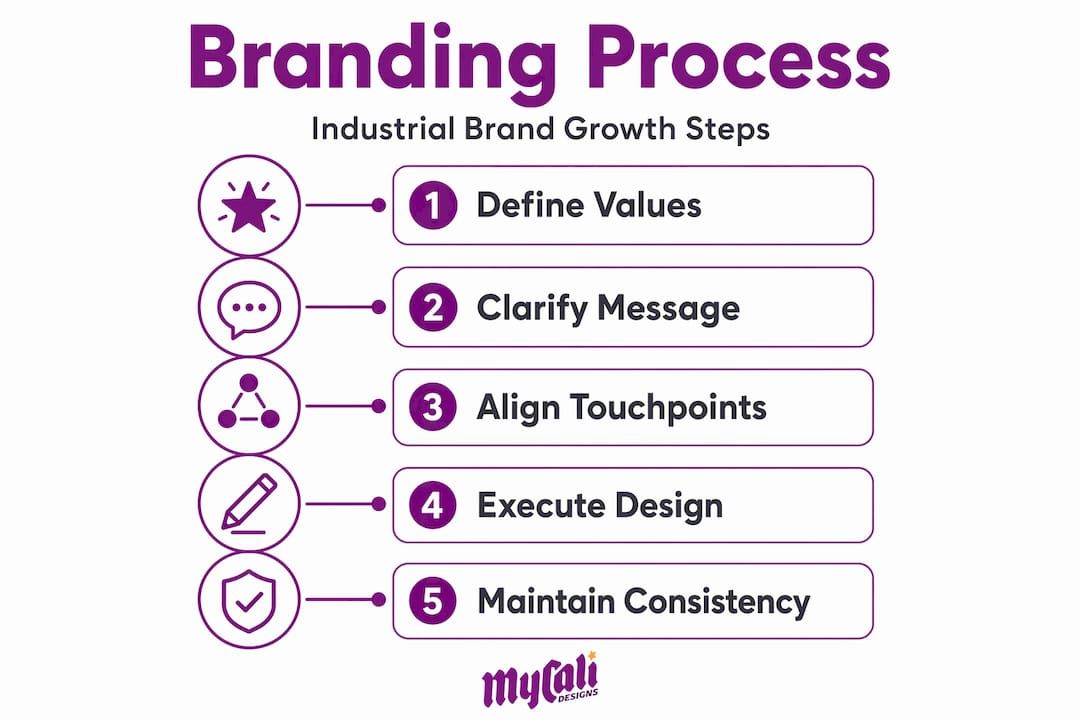
Think of industrial branding as a structure. The logo is the paint on the wall. It matters, but the building stands or falls based on what is underneath. Here are the five pillars that form a complete industrial brand:
-
Positioning: Decide specifically who you serve, what problems you solve, and why you are the right choice over alternatives. Vague positioning, like "we serve all industries," signals uncertainty. Sharp positioning, like "we specialize in custom fabrication for food-grade processing facilities," signals expertise.
-
Messaging: Develop clear, consistent language that communicates your value at every stage of the buyer journey. This includes your tagline, your website copy, your email tone, and even how your team answers the phone.
-
Visual identity: Build a design system that includes your logo, color palette, typography, and image style. This system should be documented and applied uniformly so that every piece of communication looks like it comes from the same organized, professional company.
-
Buyer experience: Map the journey a typical buyer takes from first awareness through contract signing and delivery. Identify every touchpoint and ask whether the experience reinforces your brand promise or contradicts it.
-
Consistent communication: Establish standards for how your business communicates internally and externally. Proposal templates, email signatures, follow-up cadences, and social media content should all reflect the same voice and values.
Here is a direct comparison of what "just a logo" looks like versus a full branding approach:
| Approach | What buyers see | Business result |
|---|---|---|
| Logo only | Polished visuals, inconsistent everything else | Confusion, slow trust, price pressure |
| Full branding | Cohesive identity across all touchpoints | Fast trust, premium positioning, loyalty |
| No branding effort | Amateur or inconsistent presentation | Lost bids, low referrals, high churn |
Industrial branding is built at every touchpoint, not just in the design file. That is the insight that changes everything for most business owners we work with.
Pro Tip: Even the most beautifully designed logo fails without strategic messaging behind it. Before you invest in visual refresh, make sure you can clearly answer: What do we do? Who do we do it for? Why should they trust us? If those answers are not crisp and consistent, a new logo will not fix the underlying problem.
Proven branding strategies for industry always begin with strategy before execution. An effective brand strategy maps your position, message, and experience before a single design decision is made. Investing in brand community building is also worth exploring as your brand matures, since buyers who feel connected to your values become your strongest advocates.
Real-world examples: Industrial branding in action
Theory is useful, but nothing drives the point home like stories from businesses that went through the process. Let's see what industrial branding looks like in practice.
Consider these common scenarios we see across manufacturing and service businesses:
-
The manufacturer who standardized their brand: A mid-sized metal components manufacturer had a solid reputation locally but struggled to win contracts beyond their immediate region. Their proposals used three different logo versions. Their website looked like it was built in 2012. Their sales team described the company differently depending on who was pitching. After standardizing their brand identity, updating their messaging, and creating consistent proposal templates, their referral rate increased significantly because buyers finally felt confident enough to recommend them to colleagues.
-
The service company that won on clarity: A commercial HVAC service company was consistently losing bids to competitors who were not technically better. The problem was their marketing materials were cluttered and their service promise was vague. After clarifying their core message ("guaranteed response within four hours, documented service reports every visit"), they began winning contracts they previously could not get past the shortlist stage. Clear messaging communicated reliability before a single conversation happened.
-
The SMB that caught the inconsistency problem early: A regional industrial cleaning company noticed that their sales team was getting warm leads but struggling to close. An audit revealed the issue: their website presented them as a premium operation, but their trucks, uniforms, and on-site behavior sent a very different message. Buyers were experiencing a gap between expectation and reality. Addressing the brand experience at the field level, not just online, changed their close rate.
"We thought we had a sales problem. It turned out we had a branding problem. Once we fixed how we showed up everywhere, not just on our website, everything got easier."
These examples reflect a pattern we see repeatedly. Treating branding as merely a logo refresh leaves real revenue on the table. The branding steps for small businesses that actually move the needle always address experience and messaging alongside visuals. For service businesses specifically, there are service business branding ideas that go well beyond aesthetics and directly target buyer confidence. Reviewing branding success steps from a broader strategic perspective can help you spot gaps in your own approach before they cost you contracts.
Perspective: Why industrial branding is your market edge, not just a nice-to-have
Here is the uncomfortable truth most business owners do not hear until they are in a price war or losing ground to a competitor they know they outperform technically. Branding is not marketing decoration. It is competitive infrastructure.
We have seen well-run manufacturing businesses lose bids to objectively inferior competitors, simply because the competitor presented as more organized, more reliable, and more trustworthy. In an industrial context, where the stakes of a wrong vendor choice are high, buyers will default to the company that feels safer. A strong brand makes your business feel safe to choose.
Most of your competitors are still stuck in the logo-first mindset. They invest in a new website design, maybe refresh their colors, and then wonder why nothing changed. Real differentiation comes from the holistic brand: the sum of everything buyers see, hear, read, and experience when they engage with you. That is the gap worth filling, and most of your market has left it wide open.
Businesses that invest in lasting brand growth early are significantly more resilient when markets shift. They weather price wars better because their buyers are not choosing them on price alone. They attract better talent because employees want to work for companies that look and feel credible. They weather economic downturns because loyal, trusting customers stay longer and refer more.
Waiting for a crisis to address your brand is like waiting for a roof leak before you inspect the building. By the time buyers are actively choosing someone else, the damage is already done. The right time to build your brand is when business is good and you have the attention and resources to do it properly.
Pro Tip: When refreshing or building your brand, start with buyer pain points, not design preferences. Ask your best customers what they valued most about working with you, and build your messaging around those answers. That exercise alone will surface insights that no design brief can capture.
Ready to elevate your industrial brand?
The gap between where your brand is today and where it needs to be to command premium positioning is almost always smaller than it looks. It starts with clarity about who you serve, what you promise, and how consistently you deliver that promise at every touchpoint.
At Mycali Designs, our business branding services are built specifically to help manufacturing and service businesses move from scattered presentation to a cohesive, trust-building brand identity. We work through strategy first, visuals second, so that every design decision serves a real business goal. Whether you need a brand audit, a complete identity system, or guidance on where to start, our team is ready to help. Visit our branding services page to explore your options and connect with us directly. Your market position is too important to leave to chance.
Frequently asked questions
What is the difference between a logo and industrial branding?
A logo is a single visual asset, while industrial branding is the complete set of buyer perceptions shaped by every interaction with your business. As research confirms, branding encompasses perceptions formed before, during, and after any commercial relationship, not just what buyers see in a design file.
How does industrial branding help my small business compete?
Strong industrial branding builds buyer trust quickly, differentiates you from competitors who look and sound similar, and increases both repeat and referral business. Brand trust and differentiation are directly tied to competitive advantage in markets where buyers make high-stakes vendor decisions.
Do I need to rebrand if I already have a good logo?
Not necessarily. Rebranding makes sense only when your current brand fails to support your strategic goals or sends inconsistent signals to buyers. Confusing branding with logo design is common, so evaluate the full picture before committing to a visual overhaul.
What are the first steps to build an industrial brand?
Start by defining your unique value proposition, clarifying your core message for your target buyer, and auditing your customer experience for consistency. Strategy always comes before design in an effective brand-building process.
Can improving my industrial branding increase sales?
Yes, and often significantly. Strong branding positions your business as the trusted, reliable choice, which means buyers are more likely to choose you, pay premium rates, and recommend you to others. Brand trust drives pricing power and sales velocity in industrial and service markets.
Recommended
Recent Posts