



Digital marketing terms explained: A practical guide for businesses
Digital marketing terms explained: A practical guide for businesses
Most small business owners have sat through a marketing meeting and nodded along while secretly wondering what half the terms actually mean. CTR, impressions, bounce rate, ROI — they get thrown around constantly, yet rarely explained. That confusion is not just frustrating; it can cost you real money. When you don't understand what your campaigns are measuring, you can't make smart decisions about where to spend your budget. This guide changes that. We'll walk you through the most important digital marketing terms in plain language, show you how they connect to real business results, and give you the confidence to ask better questions of any agency or team you work with.
Table of Contents
- Why understanding digital marketing terminology matters
- 10 must-know digital marketing terms for 2026
- How digital marketing terms work together in real strategies
- How to put your digital marketing knowledge into action
- What most marketing guides get wrong about terminology
- Need digital marketing clarity for your business?
- Frequently asked questions
Key Takeaways
| Point | Details |
|---|---|
| Core terms clarified | Understanding the top digital marketing terms boosts your business results and helps you avoid wasted budget. |
| Application drives value | It's not just definitions—knowing how metrics connect leads to smarter strategy decisions. |
| Practical next steps | You can now confidently interpret reports and agency recommendations with clarity. |
| Ongoing learning matters | Staying informed about terminology keeps your business ahead as digital marketing evolves. |
Why understanding digital marketing terminology matters
There's a common belief that digital marketing is best left to the experts while business owners focus on running their business. We understand the appeal of that approach. But here's the problem: when you hand over full control without understanding the language, you lose the ability to evaluate whether your investment is working.
Think of it like hiring a contractor to renovate your building. You don't need to swing a hammer yourself, but you do need to understand what "load-bearing wall" means before you approve demolition. The same principle applies here.
When business owners struggle with marketing jargon, several costly problems tend to follow:
- Wasted budget on campaigns nobody properly monitors
- Missed opportunities because reports go unread or misread
- Poor vendor relationships built on one-sided communication
- Slow response to underperforming ads because red flags go unrecognized
- Over-reliance on external teams with no internal checks in place
"Clear understanding of terms like CTR allows better strategy decisions, empowering business owners to evaluate performance with confidence and engage meaningfully with their marketing teams."
Once you understand the vocabulary, you can see digital marketing in action the way an expert does. You'll read a campaign report and spot problems before they become budget drains. You'll have more productive conversations with your agency. And you'll feel genuinely confident steering your marketing strategy rather than simply approving whatever gets placed in front of you.
Grasping SEO basics alone, for example, can shift how you think about your website, your content, and your long-term visibility online. That's the kind of clarity this guide is designed to give you.
With the stakes clear, let's identify the most essential terms you need to know.
10 must-know digital marketing terms for 2026
Armed with awareness of why these terms matter, here's your reference guide to the terms you'll encounter daily.
The core definitions
SEO (Search Engine Optimization) is the process of improving your website so it appears higher in unpaid search results on Google and other search engines. When someone searches "best flooring company near me," SEO determines whether your business shows up on page one or page five. It involves your website's content, structure, loading speed, and the quality of links pointing to it from other sites.

SEM (Search Engine Marketing) is a broader term that covers both paid and organic efforts to appear in search results. In practice, many marketers use SEM to refer specifically to paid search advertising, which is where Google Ads fits in.
PPC (Pay-Per-Click) is a paid advertising model where you only pay when someone actually clicks your ad. You're not charged for simply displaying your ad. This makes it an efficient model because every dollar spent represents a real visitor sent to your website.
CTR (Click-Through Rate) tells you what percentage of people who saw your ad or content actually clicked on it. According to industry calculations, CTR is calculated as (Clicks / Total Impressions) * 100. A higher CTR generally means your message is resonating with your audience.
Conversion Rate measures how many of those clicks turned into a meaningful action, such as a purchase, a phone call, or a form submission. You could have a fantastic CTR but a poor Conversion Rate if your website doesn't follow through on the ad's promise.
Impressions refer to the total number of times your ad or content was displayed to users. An impression counts every time your content appears on a screen, whether or not anyone clicks it.
Reach is closely related but counts the number of unique people who saw your content. If the same person sees your ad five times, that's five impressions but only one in reach.
ROI (Return on Investment) is the ratio of profit gained from your marketing spend. If you spend $1,000 on ads and generate $4,000 in sales directly from those ads, your ROI is 300%. It's the ultimate measure of whether your marketing is actually working.
Bounce Rate measures the percentage of visitors who land on your website and leave without clicking anything else. A high Bounce Rate often signals that your landing page isn't delivering what the visitor expected based on your ad or search result.
Engagement refers to any meaningful interaction with your content, including likes, shares, comments, saves, and click-throughs on social media. High engagement tells you your audience finds your content relevant or interesting.
Quick reference table
| Term | What it measures | Why it matters |
|---|---|---|
| SEO | Organic search visibility | Long-term, free traffic growth |
| SEM | Paid + organic search presence | Total search channel performance |
| PPC | Paid clicks only | Advertising cost efficiency |
| CTR | Clicks per impression | Ad relevance and messaging strength |
| Conversion Rate | Actions per click | Revenue potential of traffic |
| Impressions | Total content displays | Awareness and reach scope |
| Reach | Unique viewers | Actual audience size |
| ROI | Return on ad spend | Overall campaign profitability |
| Bounce Rate | Single-page sessions | Landing page relevance |
| Engagement | Audience interactions | Content resonance and quality |
Pro Tip: When reviewing any report from an agency or platform, always ask them to define the primary metric they're optimizing for. If they can't explain it in plain English, that's a signal worth noting. Our Google Ads guides walk through these metrics in a practical campaign context so you can see exactly what to look for.
For more ways to apply these metrics across channels, explore our website and social media tips where we break down strategy by platform.
How digital marketing terms work together in real strategies
Having learned the definitions, it's time to see these terms in action through practical application.
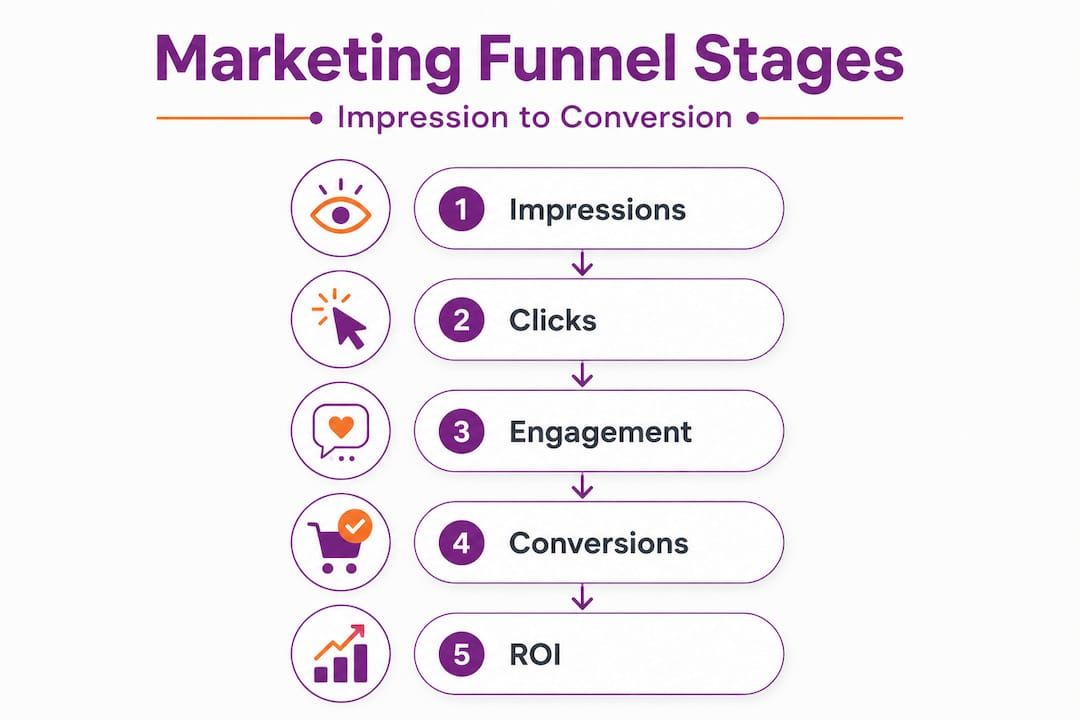
Digital marketing metrics don't exist in isolation. They tell a story together, and that story follows a clear path called the sales funnel. Understanding how each term fits into that funnel is what separates business owners who get results from those who simply generate activity.
The journey from impression to sale
Here's a stepwise example showing exactly how these terms connect in a typical paid advertising campaign:
- Impressions are generated. Your ad is shown 10,000 times to your target audience on Google.
- CTR reveals which calls-to-action truly engage your audience. If 300 people click, your CTR is 3%.
- Bounce Rate kicks in. Of those 300 visitors, 150 leave immediately because the landing page didn't match the ad. That's a 50% Bounce Rate.
- Conversion Rate tells the final story. Of the remaining 150 engaged visitors, 15 complete a purchase. That's a 10% Conversion Rate.
- ROI ties it all together. If each purchase averages $100 and you spent $200 on the campaign, you generated $1,500 in revenue for a strong positive return.
Walk through that sequence once and it suddenly becomes clear why obsessing over impressions alone is misleading. More eyeballs don't automatically mean more revenue. Each stage of the funnel has its own metric, and each metric points to a specific fix when something goes wrong.
Before and after: Term mastery in action
| Scenario | Without term clarity | With term clarity |
|---|---|---|
| Low CTR | "The campaign isn't working" | "The ad copy or audience targeting needs adjustment" |
| High Bounce Rate | "The website needs a redesign" | "The landing page message doesn't match the ad promise" |
| Low Conversion Rate | "People aren't buying" | "The call-to-action, form, or offer needs optimization" |
| Declining Reach | "Our posts are getting fewer views" | "The platform algorithm is reducing organic distribution" |
The difference is remarkable. Without the right vocabulary, your response to a problem is vague and expensive. With it, your response is targeted and efficient.
For strategies focused on improving engagement and ROI, your website design plays a critical role in converting the traffic your campaigns generate. And integrating social media strategy with your paid campaigns amplifies the results even further.
How to put your digital marketing knowledge into action
Now that you've seen these terms at work, here's how to use this knowledge immediately for tangible results.
Reading reports with confidence
The next time your agency sends a performance report, run through this checklist before responding:
- Identify the primary goal. Is this campaign meant to drive awareness (impressions and reach) or conversions? The metrics should reflect that goal.
- Check CTR against industry benchmarks. A Google Search Ad CTR below 2% is generally worth investigating. Social media campaigns may run lower, around 0.5% to 1.5%.
- Compare Bounce Rate to your Conversion Rate. If Bounce Rate is high and Conversion Rate is low, the issue is likely your landing page, not your ad.
- Demand ROI clarity. Every campaign should show a clear path from spend to revenue. If ROI isn't part of the report, ask for it explicitly.
- Look for Engagement trends over time. A single snapshot is less useful than a trend. Are your engagement metrics improving, flattening, or declining?
Questions that reveal true expertise
When vetting a new agency or freelancer, these questions will quickly show you whether they know their craft:
- "How do you calculate ROI for a campaign with both immediate and long-term results?"
- "What Bounce Rate would concern you on a PPC landing page?"
- "How do you differentiate between Reach and Impressions in your reporting?"
- "What CTR benchmarks do you target for this type of campaign?"
An experienced professional will answer these confidently and in plain language. Vague or overly technical responses that circle back to jargon without explanation are a warning sign.
Using terms correctly improves strategy and communication with your teams, leading directly to faster problem-solving and better allocation of your marketing budget.
Pro Tip: If a campaign is underperforming, use the funnel framework from the previous section as your diagnostic tool. Start at the top — impressions and reach — and work your way down. The first metric that looks off is usually where the fix lives. Pair this with a solid understanding of SEO and you'll be troubleshooting campaigns like a seasoned marketer.
What most marketing guides get wrong about terminology
Here's the perspective that most guides skip entirely: knowing definitions is only half the game, and honestly, it might be the easier half.
We've worked with business owners who memorized every term in a glossary and still made poor marketing decisions. Why? Because they treated the vocabulary like a badge rather than a tool. They knew what CTR stood for but didn't know which CTR benchmarks applied to their specific industry or ad type. They understood ROI conceptually but accepted inflated projections without pressing their agency on the methodology.
The real value of learning digital marketing terminology is not that you sound more informed in meetings. It's that you start asking better questions. Questions that prevent bad decisions. Questions that hold vendors accountable. Questions that connect marketing activity to actual business outcomes.
There's another uncomfortable truth here. Most marketing resources hand you definitions and then leave you to figure out the application on your own. That gap between "I know what Bounce Rate means" and "I know why my Bounce Rate is 78% and what to do about it" is where most business owners get stuck.
The shift happens when you start treating metrics as symptoms rather than scores. A low CTR isn't a "bad grade." It's a symptom pointing to either a weak offer, the wrong audience, or unclear messaging. A high Bounce Rate isn't a website failure. It's a signal that your ad and landing page are having two different conversations with the same person.
Successful business owners we've worked with share one habit: they demand clarity from their partners. Not just results, but explained results. When you explore real-world strategy advice from a team you trust, the terminology becomes a shared language rather than a wall between you and your marketing performance.
That's the real differentiator. Not the glossary, but the conversation it makes possible.
Need digital marketing clarity for your business?
If this guide helped clarify the terms you've been seeing in reports and agency pitches, imagine what a focused conversation with our team could do for your actual campaigns.
At Mycali Designs, we work with small and medium-sized businesses to cut through the noise and build marketing strategies that make sense from the ground up. Whether you need help evaluating your current campaigns, understanding what your reports actually mean, or launching a new digital presence that connects with your audience, we're here to make the process clear and manageable. Explore our digital marketing help to see how we approach campaigns, or reach out directly to start a conversation. We'll speak plainly, work collaboratively, and focus on results that actually grow your business.
Frequently asked questions
What is the difference between CTR and Conversion Rate?
CTR measures the percentage of people who click a link after seeing it, while Conversion Rate tracks how many of those visitors complete a desired action such as a purchase or form submission. A strong CTR calculation means your ad attracts attention, but only a strong Conversion Rate means your website closes the deal.
Why do I need to understand Bounce Rate?
Bounce Rate signals how many visitors leave your site after viewing just one page, which helps you pinpoint whether your landing page is truly relevant to the traffic you're attracting. A high Bounce Rate often reveals a mismatch between your ad message and the page experience you're delivering.
How can digital marketing metrics improve my marketing budget?
Knowing metrics like Impressions, CTR, and ROI lets you identify exactly which parts of a campaign are generating returns and which are draining spend. Key metrics directly impact how efficiently you allocate your budget across channels.
Are these terms still important with AI-powered platforms?
Absolutely. Core metrics like CTR and ROI are used to measure performance across both traditional and AI-driven marketing tools. CTR applies universally to any platform measuring user interactions, making it a permanent part of the digital marketing vocabulary.
Where can I find ongoing support for digital marketing terminology?
Trusted agencies, reputable marketing blogs, and platform-specific help centers all offer updated glossaries as terms evolve. Continued education helps small business owners stay competitive as platforms, algorithms, and strategies continue to change.
Recommended
Recent Posts