




Service design: frameworks, principles, and real benefits
Service design: frameworks, principles, and real benefits
TL;DR:
- Effective service design integrates front- and back-end processes to create seamless customer experiences. It focuses on holistic system improvements rather than surface-level fixes, emphasizing continuous iteration and staff involvement. Implementing tools like journey maps and blueprints helps SMEs identify operational gaps and enhance overall service quality.
Two coffee shops sit side by side on the same street. Same price point, similar menus, comparable staff. Yet one always has a line out the door while the other quietly struggles. The difference rarely comes down to branding or training alone. It comes down to how the entire service system is designed, from the moment a customer walks in to the moment they leave. Service design is the practice of coordinating front-stage customer experiences with back-stage people, processes, and infrastructure so the experience feels seamless to customers and sustainable for your team. This article breaks down exactly what that means for your business and how to apply it.
Key Takeaways
| Point | Details |
|---|---|
| Service design views services as systems | Success depends on coordinating frontstage experiences and backstage operations for both customers and your team. |
| Follow five core principles | Design around user research, involve stakeholders, sequence the journey, create tangible service artifacts, and address the whole ecosystem. |
| Iterate for real-world results | Plan on cycling back: improvement requires regular mapping, testing, and refining, rather than a straight-line process. |
| Use practical tools and artifacts | Journey maps, service blueprints, and stakeholder maps make it easier to spot trouble areas and keep everyone aligned. |
| Address edge cases and meaningful metrics | Focus on common breakdowns and measure what actually improves customer experience—not just impressive numbers. |
The basics: What is service design?
Before we dive into the details, let's clear up what service design does and does not mean.
Service design is an end-to-end approach. It asks: "How does every part of our operation contribute to the customer experience?" That includes your website, your intake forms, your staff communication, your invoicing process, and everything in between. According to the Interaction Design Foundation, service design coordinates front-stage experiences with back-stage people, processes, and infrastructure so the result is coherent for customers and efficient for the organization.
Here is what service design is not :
- Customer service: That is the front-line response to issues. Service design is the system that prevents those issues in the first place.
- Branding: Branding and trust shape perception, but branding alone cannot fix a broken booking process or a slow internal handoff.
- Simple process improvement: Process improvement often targets one department. Service design looks at the full picture, including how departments interact and how those interactions affect customers.
"Good service design makes complex systems feel effortless from the outside. The best services are the ones where customers never have to think about how they work."
| Concept | What it focuses on | What it misses alone |
|---|---|---|
| Customer service | Individual interactions | System-level causes |
| Branding | Perception and identity | Operational flow |
| Process improvement | Single department efficiency | Cross-functional experience |
| Service design | The full customer and operation system | Nothing, when done right |
The reason this matters for transforming customer experience is that a fractured system will eventually create a fractured experience, no matter how good your logo looks or how well your staff smiles. You can layer branding for customer experience on top of a broken system, but the cracks will always show through.
Core service design principles every business should know
Now that the boundaries are clear, let's explore the foundational principles that make service design effective.
Practitioners widely recognize five core principles: user-centered, co-creative, sequencing, evidencing, and holistic. Each one plays a distinct role, and ignoring even one can cause the whole system to feel off.
- User-centered: Every design decision starts with real research about real users. For an SME (small to medium-sized enterprise), this might mean interviewing three or four customers to understand where they feel confused or frustrated. You do not need a large research budget. You need honest conversations.
- Co-creative: The people who experience your service every day, including your front-line staff and your customers, hold valuable insight. Involving them in the design process surfaces problems that managers often miss. Think of it this way: the person answering the phone knows why customers keep calling back with the same question. That knowledge is gold.
- Sequencing: This principle says you should map your service across time, step by step, not just by channel. A customer does not experience your business as a website, then a phone call, then an appointment. They experience it as one continuous journey. Mapping that journey across channels reveals the gaps between your touchpoints that individually look fine but together create friction.
- Evidencing: Services are intangible. A customer cannot touch your expertise. Evidencing means making the service experience tangible through artifacts, things like confirmation emails, branded packaging, progress updates, and certificates. These artifacts signal professionalism and build trust at every step.
- Holistic: Thinking holistically means considering the full ecosystem. That includes your suppliers, your partners, your physical environment, and even the emotional state of your staff. If your team is burned out from a clunky internal process, that stress will eventually reach your customers.
| Principle | Core question | SME example |
|---|---|---|
| User-centered | What do customers actually need? | Interview existing clients about pain points |
| Co-creative | Who else can inform the design? | Workshop with staff and loyal customers |
| Sequencing | What happens step by step? | Map the journey from inquiry to invoice |
| Evidencing | How do we make the service feel real? | Branded confirmation emails and follow-ups |
| Holistic | What else affects the experience? | Consider supplier reliability and staff workload |
Pro Tip: Pick one principle to focus on this month. Start with sequencing. Draw out every step your customer takes from first contact to final delivery and identify where they have to wait, repeat themselves, or guess what happens next.
Design for business success often starts here, with a clear view of the journey your customers actually experience versus the one you think you are delivering.

How service design works: The Double Diamond and iterative process
With the principles in mind, let's break down how the process unfolds in practice, especially for small and growing businesses.
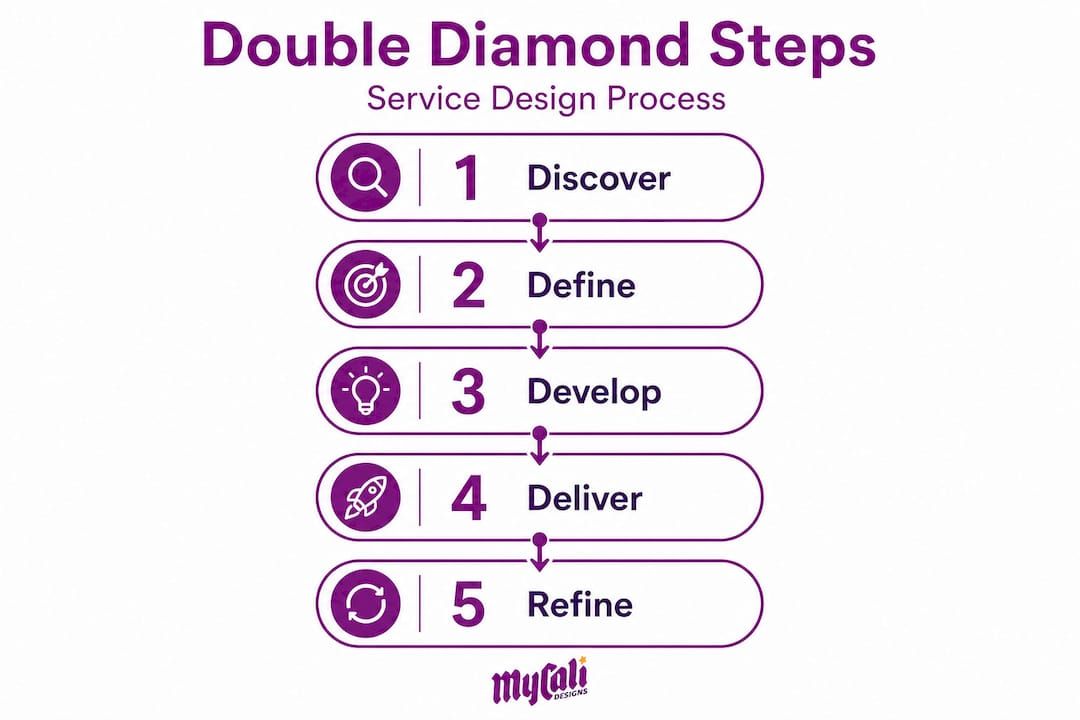
The Double Diamond framework is one of the most widely used models in service design. It describes four stages: Discover, Define, Develop, and Deliver. The "diamond" shape represents how you first expand your thinking (to understand the problem broadly) and then narrow it (to define the real problem), then expand again (to generate solutions) and narrow once more (to deliver the best one).
- Discover: Gather information without jumping to solutions. Talk to customers. Shadow your staff. Review complaints and compliments. The goal is to understand the reality of your service, not the version that exists in your head.
- Define: Analyze what you found and pinpoint the real problem. Often, what looks like a customer satisfaction issue is actually a staff communication breakdown or an unclear process handoff.
- Develop: Generate ideas for solutions. Involve your team. Prototype quickly and cheaply. A printed paper version of a new booking form works just as well as a digital mockup for testing purposes.
- Deliver: Test, refine, and launch. But this is not a finish line. Iteration in service design means you keep evaluating after launch, because real-world behavior always reveals new opportunities to improve.
The biggest mistake we see SMEs make in this process is treating it like a straight line. They define the problem once, build a solution, and move on. But service design demands looping back. A new solution creates new behavior, which creates new data, which often reveals a deeper issue you could not have seen before starting.
Pro Tip: After any major service change, schedule a 30-day check-in with your team to review what is working and what is not. This single habit creates a culture of continuous improvement without requiring a formal design program.
Building a conversion-focused service website follows the same logic. You launch, you measure, you refine. It is never truly "done."
Tools, methods, and service artifacts: Turning ideas into action
Once the process is set, these are the practical tools that bring service design to life.
Service design tools provide the methods that translate strategy into operational reality. Three stand out as most useful for SMEs:
- Journey maps: A journey map is a visual representation of every step your customer takes, from first awareness to post-purchase. It captures what they are doing, thinking, and feeling at each stage. Journey maps are powerful because they force you to see your service from the outside in.
- Service blueprints: A blueprint goes deeper than a journey map. It layers in what your staff is doing behind the scenes at each customer-facing step. This is where you spot handoff issues. For example, if your customer receives their confirmation email three hours after booking because the confirmation is manually sent by a staff member who handles twelve other tasks, the blueprint reveals that broken handoff clearly.
- Stakeholder maps: These visually identify every person or group that touches or is affected by your service. Suppliers, partners, staff, customers, and even regulators all belong here. Mapping them helps you understand who influences your service quality and where dependencies exist.
Pro Tip: Start your journey map with your most common customer complaint. Work backward to find the root cause inside the system. You will almost always find it in a back-stage process the customer never sees but definitely feels.
Using design for ROI means connecting these tools to real business outcomes. A well-drawn service blueprint that eliminates one redundant step can save your team hours each week and directly improve customer wait times.
Avoiding failure points: Edge cases, metrics, and the real-world test
No process is perfect. Here is how to handle the messy reality when things go off-script.
Most service failures do not happen on the "happy path," which is the ideal scenario where everything goes exactly as planned. Edge cases are where service quality breaks down, and they are far more common than most business owners expect. A customer who misspells their email address, a delivery that arrives damaged, a booking made for the wrong date. These moments reveal whether your service system is truly designed or just optimized for the best-case scenario.
Here is what designing for edge cases looks like in practice:
- Build recovery paths: What happens when an order fails? Who gets notified? How quickly? What does the customer see? Every failure point should have a designed response, not an improvised one.
- Design for errors gracefully: If a customer fills out a form incorrectly, your system should guide them to the fix rather than returning a generic error message.
- Audit your assumptions: Most journey maps are built on assumptions about what customers will do. Regularly revisit them with data from real interactions.
On the metrics side, Thoughtworks cautions against impressive-number OKR metrics that do not demonstrably improve the user experience. A high Net Promoter Score (NPS) average might hide significant pain in a specific customer segment. A fast average response time means nothing if certain request types take days. Focus your measurement on what customers actually experience, including efficiency, speed, manual steps, and human interventions.
The real-world test of any service design is this: what happens when something goes wrong? If your answer involves improvisation, you have more design work to do.
Why most small businesses get service design wrong (and how to do it better)
Having covered the frameworks and tools, let's explore what most businesses miss when trying to improve services.
Here is the uncomfortable truth: most SMEs approach service improvement from entirely the wrong direction. They either focus on cutting costs, training staff harder, or refreshing their brand. These are not bad actions. But they are surface-level fixes applied to systemic problems.
We see this pattern repeatedly. A business notices that customers are not returning after the first purchase. They assume the issue is pricing or product quality. So they run a discount campaign. Short-term bump, same long-term problem. What they actually needed was to map the post-purchase experience and discover that customers never receive a follow-up, never get clear guidance on next steps, and never feel like the business noticed whether they came back or not.
The system was the problem. Not the price.
Another common mistake is treating service design as a one-time project. A business hires a consultant, gets a set of recommendations, implements them, and considers it done. But services live in real-world conditions that change constantly. Staff turn over. Customer expectations shift. Technology evolves. Service design is not a project. It is a practice.
The businesses that get this right tend to share three habits. They involve front-line staff in problem-solving conversations regularly. They treat customer complaints as data, not nuisances. And they revisit their service journey maps at least once a year.
Leveraging outside expertise can accelerate this process significantly, especially when internal teams are too close to the work to see the gaps. A fresh perspective often reveals what years of familiarity have hidden.
The businesses that struggle are the ones that wait for a crisis to trigger a redesign. By that point, the cost of fixing the system is far greater than the cost of maintaining it would have been.
Take your first step toward better service design
Ready to put these insights into practice? Here is how to get expert help.
Understanding service design is one thing. Applying it to your specific business context is another. At Mycali Designs, we work with SMEs to translate these principles into practical, growth-focused outcomes. Whether you need to clarify your customer journey, build a stronger brand system, or identify where operational friction is costing you customers, we have the experience to help you move forward with clarity and confidence.
Our business branding services are built around the same system-level thinking that makes service design effective. We do not just make things look good. We help you build a brand and customer experience that works as a coherent whole. Explore our business consulting solutions to see how we have helped businesses identify their real challenges and design smarter paths forward. The first conversation is always the most valuable one.
Frequently asked questions
How does service design improve customer experience?
Service design coordinates all touchpoints and back-end operations so every customer interaction feels consistent and friction-free. When front-stage and back-stage systems are aligned, customers experience a service that feels effortless even when the underlying complexity is significant.
Is service design only for large companies?
Not at all. Small and medium-sized businesses benefit enormously by reducing internal friction and mapping better experiences, often using simpler, lower-cost tools like paper journey maps and team workshops.
What is a journey map in service design?
A journey map is a visual outline of every step a customer takes with your service, highlighting moments of delight or friction along the way. It helps teams see the experience from the customer's perspective rather than the organization's perspective.
Can service design help fix problems with staff handoffs or process delays?
Yes. By mapping the full service including employee actions, service design regularly uncovers operational breakdowns that staff handoffs, rework, and delays create, often making the fix obvious once the system is visible.
How do I start with service design in my business?
Begin by mapping out your customer journey using the Double Diamond process, starting with discovery conversations with both customers and staff. You do not need a large budget to start. You need honest observation and the willingness to redesign based on what you find.
Recommended
Recent Posts