




Explaining Data-Driven Design for Business Owners
Explaining Data-Driven Design for Business Owners

TL;DR:
- Data-driven design utilizes real user behavior and analytics to inform, rather than replace, human judgment.
- Adopting this approach reduces task completion time and user errors, delivering measurable business value.
Data-driven design is the practice of using real user behavior, analytics, and structured feedback to make design decisions instead of relying on opinions or assumptions. The industry term for this approach is "data-informed design," a phrase that captures an important nuance: data guides decisions, but human judgment still interprets the evidence. Whether you call it data-driven or data-informed, the core principle is the same. You replace gut instinct with measurable evidence, and your designs get better as a result.
Teams that adopt this approach see 40% faster task completion and 20% fewer user errors compared to intuition-based designs. That gap represents real business value: fewer support tickets, higher conversion rates, and users who actually complete the tasks you designed for. Tools like Google Analytics, Mixpanel, and Amplitude make it possible to collect this evidence at scale, while methods like user interviews and usability testing fill in the motivations behind the numbers.
What is data-driven design and why does it matter?
Explaining data-driven design starts with understanding two types of evidence: quantitative and qualitative. Neither type alone gives you the full picture, and the most effective teams use both together.
Quantitative data tells you what users do. This includes:
- Clickstream data and heatmaps from tools like Hotjar or Microsoft Clarity
- Conversion funnels and drop-off rates tracked in GA4 or Amplitude
- A/B test results that measure the impact of design variants with statistical confidence
- Session duration, bounce rates, and task completion rates
Qualitative data tells you why users do it. Combining interviews and usability testing with quantitative data reveals motivations and context that numbers alone cannot capture. A heatmap shows you that users ignore your call-to-action button. A five-minute user interview tells you they ignored it because they didn't trust the page yet.
The core principles that hold data-driven design together are iteration, measurement, and user focus. You ship a change, measure its effect, learn from the result, and repeat. This loop is not optional. It is the mechanism that turns data into better design over time. The distinction between "data-driven" and "data-informed" matters here: a purely data-driven mindset treats metrics as the final authority, while a data-informed approach uses metrics as one input alongside designer judgment and user empathy. Experts advocate for the data-informed model because it preserves the creative and empathetic thinking that data cannot replace.

Pro Tip: When starting out, pick one outcome metric that directly reflects user success, such as task completion rate or time-on-task, and track it consistently before adding more metrics to your dashboard.
How do leading teams implement the data-driven design process?
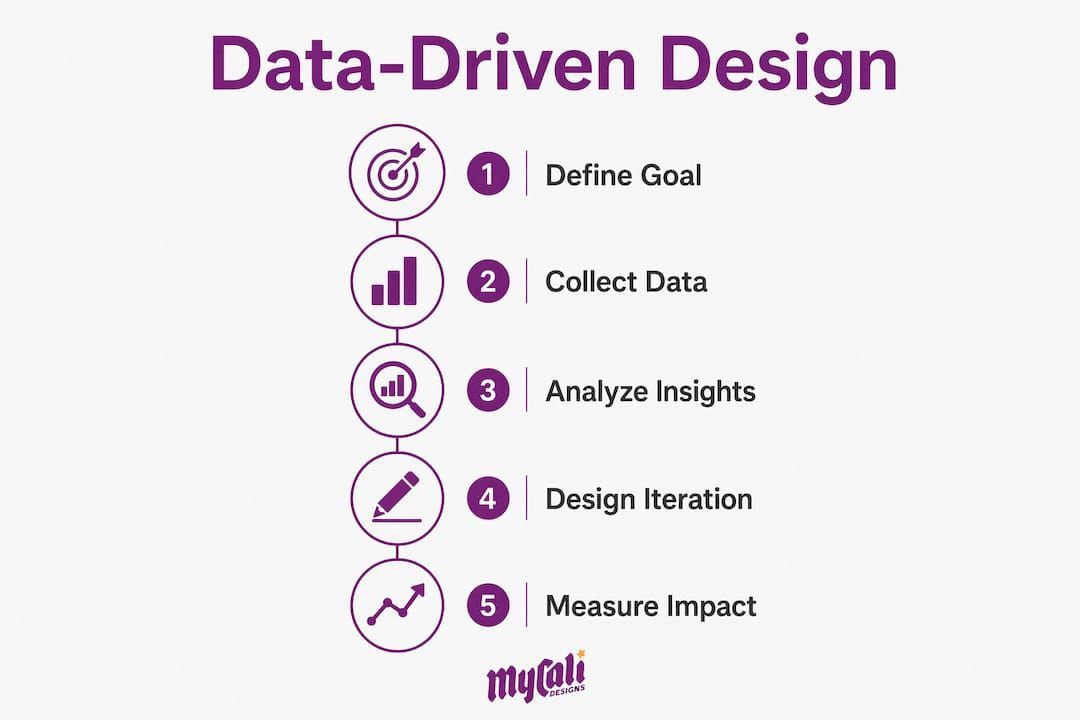
The data-driven design process follows a repeatable loop: define a question, collect data, analyze findings, make a design change, and measure the outcome. Leading UX teams establish their research stack and analytics layer before they collect a single data point. Skipping that setup step is the most common reason teams end up with unreliable data six months into a project.
Here is how a structured implementation looks in practice:
- Define your research question. Start with a specific, testable question: "Why do users abandon the checkout flow after step two?" Vague questions produce vague data.
- Set up your analytics layer. Configure event tracking in GA4, Amplitude, or Mixpanel with a consistent naming convention. Every event name should follow the same schema, such as "[object]_[action]`, so your data stays clean and comparable over time.
- Run qualitative research in parallel. Schedule usability tests or user interviews while your quantitative data accumulates. Qualitative findings give you hypotheses to test with the numbers.
- Form a hypothesis and design a test. A/B testing validates assumptions and guides decisions with statistical confidence. Never redesign a full page when a single variable test can answer your question faster.
- Ship, measure, and document. Record what you changed, what metric you tracked, and what the result was. This documentation becomes your team's institutional knowledge.
- Repeat the loop. The iterative cycle of shipping, measuring, and learning is what reduces guesswork and minimizes risk over time.
| Phase | Primary tool | Output |
|---|---|---|
| Discovery | GA4, Hotjar | Drop-off points, behavior patterns |
| Research | User interviews, surveys | Motivations, pain points |
| Testing | Optimizely, VWO | Validated design variants |
| Measurement | Amplitude, Mixpanel | Outcome metrics, trend data |
One detail most teams overlook: poorly structured event naming creates "data debt," a situation where your analytics data becomes so inconsistent that analysis takes three times longer than it should. Treat your data architecture like your codebase. Clean it up early, or pay for it later.
Pro Tip: Before your team adds any new analytics event, write a one-sentence description of what business question that event will answer. If you cannot write that sentence, you do not need the event.
A GA4 and Tag Manager setup handled by specialists can save your team weeks of cleanup work and give you a reliable foundation from day one.
What challenges and misconceptions affect data-driven design?
The biggest misconception about data-driven design is that data removes subjectivity from the process. It does not. Data shifts subjectivity from the design decision itself to the interpretation of the data. Someone still decides which metrics matter, how to segment users, and what counts as a meaningful improvement. That person brings their own assumptions to every analysis.
Several specific pitfalls show up repeatedly in teams that over-rely on data:
- Vanity metrics trap. Tracking page views and social shares feels productive, but outcome metrics tied to real user success, like task completion rate and cognitive load reduction, are what actually predict business results.
- Micro-optimization tunnel vision. Teams can spend months optimizing button colors and headline copy while missing a fundamental navigation problem that affects every user. Data shows you what is happening at the surface. It rarely shows you the structural issue underneath.
- Analysis paralysis. A data-driven mindset that demands more evidence can become a way to avoid making creative decisions. At some point, you have to design something and test it.
- Missing the "why." Raw metrics tell you a user dropped off. They do not tell you whether that happened because of a confusing label, a slow load time, or a trust issue. Deeper investigation uncovers the true cause, and that investigation almost always requires qualitative research.
"Data alone shows what users did, not their motivations. Designers must interpret data thoughtfully alongside qualitative insights." — UX Design Pro
The practical fix is to treat data as a partner in the design conversation, not the final word. When a metric surprises you, your first response should be a question: "What else could explain this?" That question leads you to better answers than the metric alone ever could.
What real-world examples show the impact of data-driven design?
The clearest examples of data-driven design in action come from companies that made it a core part of their product process. Netflix and Airbnb both use iterative cycles of data-driven design to improve engagement and reduce friction continuously. Netflix tests thumbnail artwork at scale, running thousands of simultaneous experiments to determine which image drives the most plays for a given title. Airbnb used data analysis to identify that professional photography of listings dramatically increased booking rates, a finding that led to a company-wide photography program.
Dropbox applied data-informed design to its onboarding flow. By analyzing where new users dropped off during setup, the team identified a specific step where confusion spiked. A redesign of that single step, informed by both analytics and user interviews, produced measurable gains in activation rates.
| Company | Design change | Measurable outcome |
|---|---|---|
| Netflix | Thumbnail A/B testing at scale | Higher play rates per title |
| Airbnb | Professional listing photography | Increased booking conversion |
| Dropbox | Onboarding flow redesign | Improved activation rate |
These cases share a common pattern. None of these teams redesigned everything at once. They identified a specific friction point using data, formed a hypothesis, tested a change, and measured the result. That discipline is what separates teams that improve consistently from teams that redesign on instinct and hope for the best.
For smaller businesses, the same principles apply at a smaller scale. A local service business can use Google Analytics to identify which pages drive phone calls, then redesign those pages to remove friction between the visit and the conversion. You do not need Netflix's engineering team to practice data-driven design. You need a clear question, a way to measure the answer, and the discipline to act on what you find. Mycalidesigns has documented several of these approaches in our client case studies for businesses across different industries.
Understanding how design influences marketing results is a natural complement to the data-driven approach, especially for small businesses connecting design decisions to revenue outcomes.
Key takeaways
Data-driven design works because it replaces opinion with evidence, creating a repeatable loop of measurement and improvement that compounds over time.
| Point | Details |
|---|---|
| Combine both data types | Use quantitative data for what users do and qualitative data for why they do it. |
| Build clean data architecture | Consistent event naming in GA4 or Amplitude prevents data debt and unreliable analysis. |
| Focus on outcome metrics | Track task completion and error rates, not vanity metrics like page views. |
| Treat data as a partner | Data shifts subjectivity; human judgment still interprets and acts on the evidence. |
| Iterate in small cycles | Ship one change, measure one metric, learn, and repeat rather than redesigning everything at once. |
Why I think most teams are using data-driven design wrong
After working with businesses of all sizes on branding and digital design, I have noticed a consistent pattern. Teams adopt analytics tools, set up dashboards, and then use the data to confirm decisions they already made. That is not data-driven design. That is data-decorated design, and it is more common than anyone admits.
The teams that actually improve their products use data to challenge their assumptions, not validate them. When a metric tells you something unexpected, that is the moment the process earns its value. The uncomfortable finding, the drop-off you did not expect, the feature nobody uses despite months of development, those are the signals worth acting on.
I also think the industry undersells the storytelling side of this work. Data does not persuade stakeholders on its own. A chart showing a 15% drop in checkout completion is interesting. A story that connects that drop to a specific user frustration, backed by three interview quotes and a heatmap, is what gets a redesign approved and funded. Analytical skill and empathetic communication are both required. Neither works without the other.
The designers and business owners who get the most from this approach are the ones who stay genuinely curious about their users. They use data to ask better questions, not to stop asking questions altogether.
— Cesar
How Mycalidesigns helps you design with confidence
At Mycalidesigns, we build brands and websites that are designed to perform, not just look good. Every project starts with a clear understanding of your business goals and the users you are trying to reach. We apply data-informed thinking to logo design, brand identity, and custom website development so that every visual and structural decision connects to a measurable outcome.
If you are ready to move beyond guesswork and build a digital presence that grows your business, our team is here to help. Explore our brand identity services or reach out directly to start a conversation about your project.
FAQ
What is data-driven design in simple terms?
Data-driven design is the practice of using real user behavior data, analytics, and research to make design decisions instead of relying on opinions. The goal is to create experiences that measurably improve user success and business outcomes.
What is the difference between data-driven and data-informed design?
Data-driven design treats metrics as the primary decision-maker, while data-informed design uses data as one input alongside designer judgment and qualitative research. Most experts recommend the data-informed approach because it preserves human insight and creativity.
What tools do teams use for data-driven design?
Leading teams rely on analytics platforms like GA4, Amplitude, and Mixpanel for quantitative data, and on user interviews, surveys, and usability testing for qualitative insights. Analytics platforms consistently show measurable ROI improvements when used to inform design decisions.
How do I start implementing data-driven design?
Start by defining one specific question about user behavior, set up event tracking with a consistent naming convention, and run a small A/B test or usability session to gather evidence. Build the habit of documenting what you changed and what result you measured before expanding your process.
Can small businesses benefit from data-driven design?
Yes. Small businesses can use free tools like GA4 to identify which pages drive conversions, then make targeted improvements based on that data. The principles scale down to any project size; what matters is the discipline of measuring before and after each change.
Recommended
Recent Posts