




Brand strategy: Your path to lasting business growth
Brand strategy: Your path to lasting business growth

Most business owners believe branding is about picking the right logo or choosing a color palette. That belief is costing them customers, revenue, and market position. Brand strategy is the backbone of how customers see, trust, and choose your business. It shapes every interaction, from your first social media impression to the moment someone decides to buy. Harvard Business School defines brand strategy as a plan that defines a company's identity, purpose, positioning, messaging, and relationships to drive competitive advantage. In this article, we break down what brand strategy actually means, why it matters for your bottom line, and how to build one that works.
Table of Contents
- What is brand strategy? The foundation of your business identity
- The business benefits of strong brand strategy
- Types of brand architecture: Should you use a branded house or house of brands?
- Building your brand strategy: A practical step-by-step guide
- Why most small businesses misunderstand brand strategy
- Next steps: Bring your brand strategy to life
- Frequently asked questions
Key Takeaways
| Point | Details |
|---|---|
| Brand strategy essentials | A true brand strategy covers identity, purpose, positioning, and messaging for long-term impact. |
| Measurable business value | Clear branding leads to more visibility, higher revenue, and lasting market strength. |
| Choosing architecture | Selecting the right brand structure, like branded house or house of brands, is critical for growth. |
| Action pays off | Implementing brand strategy using a step-by-step approach drives results for small and medium businesses. |
What is brand strategy? The foundation of your business identity
Now that we've set the stage, let's break down exactly what makes up a brand strategy and why it's much more than just a logo.
A brand strategy is not a mood board or a tagline. It's a business-wide framework that defines who you are, what you stand for, and why customers should choose you over every other option. Think of it as the operating system behind your business's public face. Your logo is just the icon on the screen.
According to Harvard Business School, "a brand strategy is a long-term plan that defines a company's identity, purpose, positioning, messaging, and relationships between brands." That definition alone tells you this goes far beyond visual design.
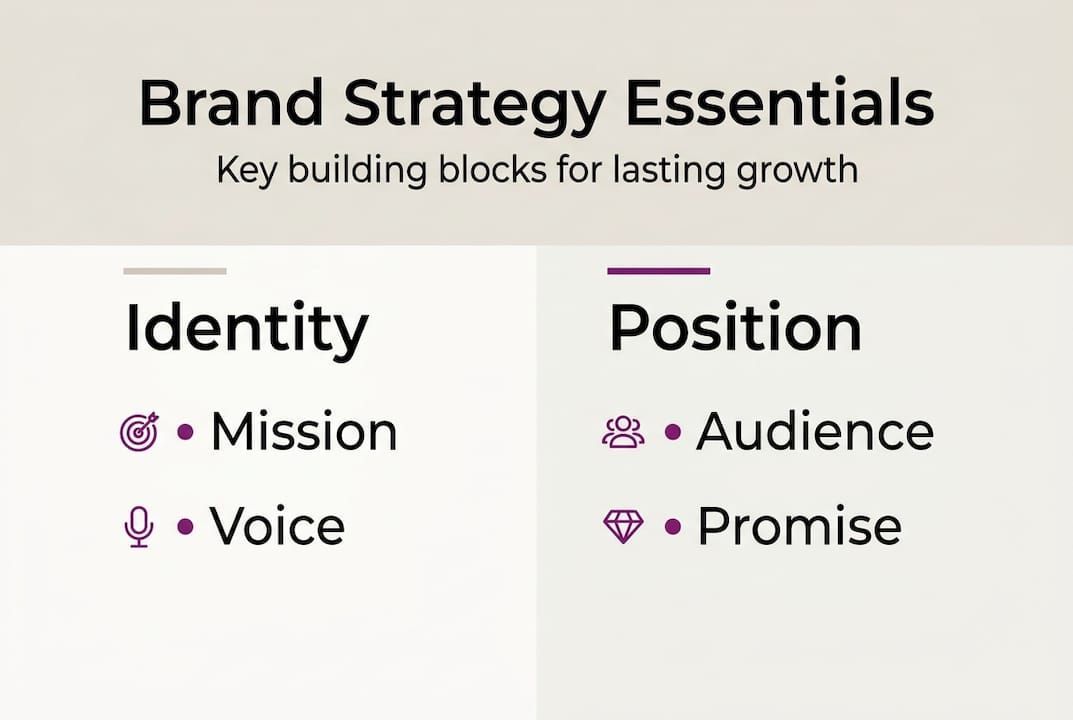
A strong brand strategy is built from five core elements:
- Identity: How your business looks, sounds, and feels across every touchpoint.
- Positioning: Where you sit in the market relative to competitors and what makes you distinct.
- Purpose: The deeper reason your business exists beyond making a profit.
- Messaging: The words and narratives that connect your brand to your audience's needs.
- Brand relationships: How your products, services, and sub-brands connect and support each other.
When any one of these elements is missing or misaligned, the whole strategy weakens. Customers sense inconsistency, even when they can't name it. They feel it as distrust or confusion. That's why understanding brand identity basics is often the first step we help clients tackle.
Here's a common mistake we see with small businesses: they invest in a logo, launch a website, and call it branding. Six months later, they wonder why new leads aren't converting. The issue isn't effort. It's that without a clear strategy underneath the visuals, the brand has no foundation to stand on.
Brand strategy answers three questions your customers are silently asking: Who are you? Why should I trust you? Why should I choose you over someone else? If your business can't answer those questions clearly and consistently, you're leaving growth on the table.
The business benefits of strong brand strategy
With the fundamentals explained, let's look at why all of this matters. What payoff can you actually expect from investing in brand strategy?
The returns are measurable and significant. According to Harvard Business Review, organizations with clear brand architecture achieve 3.5x more visibility , consistent branding yields 23% higher revenue , and strong brands deliver 3x higher economic value . Those aren't soft, feel-good metrics. They're business outcomes.
| Brand strategy benefit | Impact |
|---|---|
| Clear brand architecture | 3.5x more market visibility |
| Consistent branding | 23% higher revenue |
| Strong brand equity | 3x higher economic value |
Visibility is your ability to be found and recognized before competitors. When your messaging is sharp and your identity is consistent, customers remember you. They refer you. They return. That compounding effect is how brands build lasting market presence.
Revenue growth from branding isn't magic. It's the result of trust. When customers recognize your brand across different platforms and experiences, they feel more confident buying from you. Inconsistency, on the other hand, breeds doubt.
Here's what a strong brand strategy delivers in practical terms:
- Higher conversion rates because your messaging speaks directly to the right audience.
- Reduced customer acquisition costs because recognition lowers hesitation.
- Greater pricing power because trusted brands command premium prices.
- Stronger customer loyalty because people buy from brands they feel connected to.
Pro Tip: Review your brand strategy benchmarks before deciding where to invest in brand development. Knowing where you stand makes the strategy clearer.
If you're unsure where your brand currently sits, assessing your readiness for branding is the smartest first move. It helps you identify gaps before spending resources on tactics that won't land.
Types of brand architecture: Should you use a branded house or house of brands?
To put your brand strategy into practice, you'll need to decide how to organize your brands and products under one business identity.
Brand architecture refers to how you structure the relationship between your business name and the products or services you offer. There are two primary models, and choosing between them has real implications for your growth.
Branded house means one master brand covers everything. Think of it like one strong umbrella that all your products or services live under. Customers associate all offerings with your main brand name.

House of brands means each product or service operates under its own distinct brand, with the parent company staying in the background. Each brand targets different market segments independently.
| Model | Strength | Risk |
|---|---|---|
| Branded house | Unified equity, lower marketing cost | One crisis affects all products |
| House of brands | Targeted positioning per segment | Complex to manage, higher cost |
Here's how to think through which model fits your business:
- Do you serve very different customer segments? If yes, a house of brands lets you speak directly to each without confusing your core audience.
- Is your business name already trusted and recognized? If yes, a branded house lets you extend that trust to new offerings quickly.
- How large is your marketing budget? A house of brands requires maintaining multiple brand identities, which multiplies cost and complexity.
- What's your growth plan? If you plan to acquire or launch new ventures in different industries, a house of brands protects each one from the others' reputation risks.
Pro Tip: Most small to medium-sized businesses benefit most from the branded house model early on. You build stronger recognition faster with fewer resources. You can always evolve your structure as you scale.
Exploring brand strategy frameworks alongside your architecture decision helps you align your marketing and brand identity design from the start.
Building your brand strategy: A practical step-by-step guide
Understanding models is vital, but how do you actually create a practical, results-driven brand strategy?
The good news is that building a brand strategy doesn't require a large team or a massive budget. It requires clarity, consistency, and commitment. Long-term branding is essential for 93% of executives, which signals how seriously competitive businesses treat this investment.
"The brands that win long-term are the ones that stay consistent even when trends change and markets shift."
Follow these steps to build your brand strategy from the ground up:
- Audit your current brand. Take stock of all the ways your business currently appears to customers: website, social media, proposals, packaging, email signatures. Look for inconsistencies in tone, visuals, or messaging.
- Define your brand purpose. Ask why your business exists beyond revenue. What problem do you solve? What change do you create for customers? This becomes your north star.
- Clarify your target audience. Get specific. Describe your ideal customer's goals, frustrations, and how your brand addresses both. Vague audiences lead to vague messaging.
- Develop your core messaging. Build a clear value proposition. Write your brand story. Define the tone of voice you use in every piece of communication.
- Build your visual identity. Align your logo, color system, typography, and design style with your brand purpose and audience expectations.
- Apply consistently across touchpoints. Your website, social profiles, and marketing materials should all feel like the same brand showing up in different places.
- Measure and refine. Track recognition, engagement, and conversion over time. A strategy that isn't measured can't be improved.
This guide to business branding walks through the early-stage decisions in more depth, and understanding social media branding helps you apply your strategy where your customers are most active.
Why most small businesses misunderstand brand strategy
With actionable steps in hand, it's important to pause and see what most business owners miss when thinking about brand strategy.
Here's the uncomfortable truth: most small businesses treat branding as a one-time project rather than an ongoing business practice. They invest in a logo, launch a website, and assume the branding work is done. Then they wonder why the results aren't showing up.
Brand strategy is not a campaign. It's not a color palette. It's a business decision that touches hiring, pricing, customer service, and communications. When your brand is aligned across all of those, growth compounds. When it isn't, every marketing dollar works harder than it should.
We've seen businesses run expensive ads with a brand that sends mixed signals, and the campaigns fall flat. Not because the ads were bad, but because the brand underneath wasn't doing its job. Short-term tactics can't compensate for a weak foundation.
Our advice: before chasing the next marketing trend, invest time in understanding your brand strategy explained. Focus on alignment first. Get your purpose, audience, and messaging locked in. Consistency across those elements will outperform any trendy tactic, every single time.
Next steps: Bring your brand strategy to life
If you're ready to act on what you've learned, here are practical services and resources to guide your brand growth.
Knowing what brand strategy is and actually building one are two very different things. That's where we come in.
At Mycali Designs, we help small and medium-sized businesses move from brand confusion to brand clarity. Whether you need professional branding services to build your identity from scratch, answers to your most pressing questions through our branding FAQ, or digital marketing solutions to amplify what you've built, we're here to support every stage of the journey. Let's build something that actually grows your business.
Frequently asked questions
How does brand strategy differ from just having a logo?
A brand strategy is a long-term business plan covering your identity, purpose, messaging, and customer relationships. A logo is one visual element within that larger strategic framework.
What is the 'branded house' versus 'house of brands' model?
A branded house uses one master brand for all products, while a house of brands gives each product or segment its own distinct brand identity. The right model depends on your audience, budget, and growth plan.
What real business value does a brand strategy deliver?
Strong brand strategy delivers 3.5x more visibility, 23% higher revenue, and 3x higher economic value. These are measurable business outcomes, not just marketing metrics.
How long does it take to see results from a brand strategy?
Most businesses notice improved customer recognition and engagement within a few months of applying consistent branding. The full compounding benefits build steadily over several years of alignment and consistency.
Recommended
Recent Posts