




What is brand architecture? A practical guide for growing businesses
What is brand architecture? A practical guide for growing businesses

Without a clear brand structure, your marketing dollars scatter in too many directions, your customers get confused, and your growth stalls before it should. Brand architecture, the strategic framework organizing relationships between your brands, products, and services, is not just a Fortune 500 concern. Small and medium-sized businesses face the same risks when structure is missing. This guide breaks down what brand architecture really means, which models fit growing businesses, and how to put a practical framework in place without overcomplicating things.
Table of Contents
- What is brand architecture? Why does it matter?
- The main types of brand architecture models
- How to design and implement your brand architecture
- Pitfalls and advanced scenarios: what to watch out for
- Why brand architecture is business strategy, not just marketing
- Put your brand architecture into action with expert help
- Frequently asked questions
Key Takeaways
| Point | Details |
|---|---|
| Brand clarity matters | A well-defined brand architecture reduces confusion, drives visibility, and improves marketing results. |
| Start simple, scale smart | Most SMBs should begin with a Branded House or Endorsed model before considering complex hybrids. |
| Review as you grow | Revisit your brand structure every year or after big business changes to keep it working. |
| Strategy, not just style | True brand architecture is about business strategy, not just naming and logos. |
What is brand architecture? Why does it matter?
Now that you've seen the importance of a strategic approach, let's break down what brand architecture really means and why it's relevant at every business size.
At its simplest, brand architecture is the organizing system behind your business. It defines how your parent brand, sub-brands, product lines, and services relate to each other in the eyes of your customers. Think of it like the floor plan of a building. Every room has a purpose, and the layout tells visitors where to go and what to expect.
" Brand architecture acts as a blueprint for organizing brands, products, and services and communicating their relationships."
Many SMB owners assume this kind of thinking only applies to multinational corporations with dozens of product lines. That's a costly myth. Even a local business with two service offerings needs a clear structure so customers understand what you do and why they should trust you across every touchpoint.
Here's why brand architecture matters for businesses at any stage:
- Prevents customer confusion. When your offerings are clearly organized, customers know exactly what they're buying and from whom.
- Streamlines marketing spend. You avoid duplicating campaigns or building separate audiences for things that could share a message.
- Supports growth. When you add a new product or service, a defined architecture tells you exactly how to position it.
- Boosts visibility and revenue. Organizations with clear architecture achieve 3.5x more visibility than those without structure.
Brand architecture is not just a logo hierarchy or a naming exercise. It's a strategic decision that shapes how customers perceive your value, how your team communicates internally, and how efficiently your marketing actually works. If you're unsure where your business stands, exploring our branding FAQs or taking a brand readiness assessment is a smart first step.
The main types of brand architecture models
With the strategic value in mind, which brand architecture style should your business consider?
There are four primary brand architecture models that most businesses fall into. Understanding each one helps you choose the right fit for your goals, your budget, and your customers.
Branded House means one master brand covers everything. Google is the textbook example. Every product carries the Google name. For SMBs, this is the most straightforward approach because all marketing efforts reinforce a single identity.
House of Brands is the opposite. Each product or service operates as its own independent brand. Think of P&G owning Tide, Pampers, and Gillette. Each brand stands alone. This model suits businesses entering very different markets where a shared identity could actually hurt credibility.

Endorsed Brand blends both approaches. A sub-brand operates with its own identity but carries visible parent brand support. Marriott Courtyard is a strong example. Customers trust the sub-brand partly because they recognize the parent.
Hybrid models combine elements from multiple approaches. They offer flexibility but require much more governance to avoid confusion.
| Model | Cost to manage | Brand clarity | Best for |
|---|---|---|---|
| Branded House | Low | High | SMBs, startups |
| House of Brands | High | Low (per brand) | Diverse markets |
| Endorsed Brand | Medium | Medium-High | Growing SMBs |
| Hybrid | Very High | Variable | Complex portfolios |
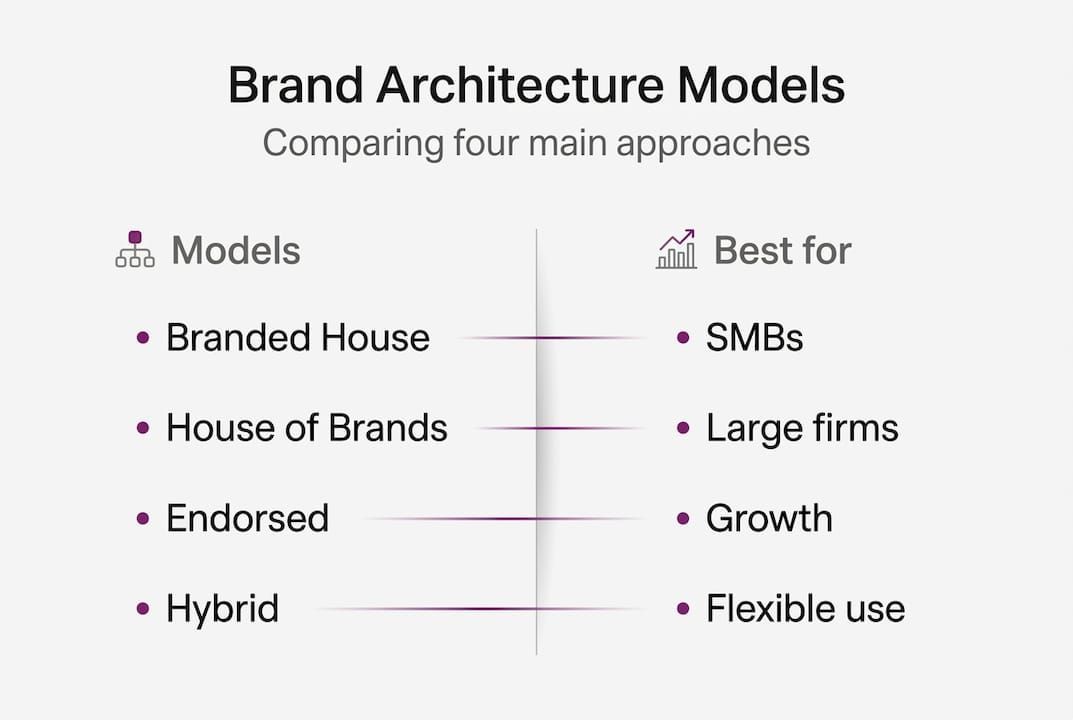
The data backs up the cost difference. A Branded House model carries 3 to 5 times lower management costs compared to a House of Brands approach. That's a significant number for any business watching its budget.
Pro Tip: If you're a smaller or growing business, start with Branded House or Endorsed. Both models reduce confusion for customers and keep your costs manageable. Adding complexity before you need it is one of the most common mistakes we see when choosing a brand model.
How to design and implement your brand architecture
Once you're clear on your options, the next challenge is building the right brand architecture and more importantly, making it work in real life.
The good news is that this process doesn't have to be overwhelming. Breaking it into five clear steps makes it manageable for any SMB team.
- Audit your current brand portfolio. List every brand, product, service, and sub-offering your business currently has. This inventory reveals overlap, gaps, and anything that may be pulling customers in conflicting directions. A thorough brand audit guide can help you structure this step.
- Analyze customer and audience overlap. Who buys what, and why? Look at whether your customer segments share similar needs or whether different offerings serve entirely different audiences. This shapes which model fits best.
- Select the right model. Use your audit findings and the comparison table above to match a model to your budget, market position, and growth goals.
- Draft governance rules. Governance means clear, documented rules for naming conventions, visual style, and messaging across every touchpoint. This step is where many businesses skip ahead and pay for it later.
- Implement and monitor. Launch your new structure and set KPIs to track performance over time.
The core implementation steps include auditing your portfolio, assessing overlap and risk, defining naming and messaging rules, implementing governance, and monitoring equity flow on an ongoing basis.
| KPI | Pre-architecture | Post-architecture |
|---|---|---|
| Cross-sell rate | 8% | 19% |
| Brand recognition score | 42% | 74% |
| Marketing cost per lead | $58 | $37 |
| Customer confusion rate | 31% | 11% |
These numbers reflect the kind of shift a structured approach can drive. Small improvements in recognition and cross-sell add up fast when you're working with a lean marketing budget.
Pitfalls and advanced scenarios: what to watch out for
Even with the best-laid frameworks, real-world branding isn't without its challenges. Here's what can go wrong and how smart SMBs avoid common traps.
The most frequent mistake is over-extension . Adding too many sub-brands too quickly dilutes the equity you've built in your core brand. Nivea is a well-known case study here. Their expansion into too many product categories made it harder for customers to know what Nivea actually stood for. The principle applies equally to a 10-person business.
Post-merger or acquisition situations create a different kind of pressure. When two businesses combine, there's often an overlap of brand names, visual systems, and customer promises. The smart move is to audit for brand equity immediately. Keep what's strong. Retire what creates confusion.
Hybrid models deserve a specific warning. As HBS research notes, hybrids require strict rules to avoid what gets called "architecture by politics," where internal preferences shape brand decisions instead of customer reality. Poor architecture causes confusion, and confusion kills conversions.
Here are the most common pitfalls we see with growing businesses:
- Unclear naming conventions across products or services that share a customer base
- Inconsistent visuals that make each offering look like it comes from a different company
- Ignoring customer perception in favor of internal preferences or organizational politics
- Skipping governance entirely after launching a new structure
Pro Tip: Set a calendar reminder to review your brand structure annually. Also schedule a review after any major event like a new product launch, a market expansion, or a business merger. Brand architecture isn't a one-time decision.
Looking at real SMB case studies reveals a consistent pattern: the businesses that scale well treat their brand structure as a living document, not a one-time project.
Why brand architecture is business strategy, not just marketing
After covering the models and real-world pitfalls, it's worth sharing a more opinionated take on why this topic is make-or-break for growing businesses.
Here's what most guides won't say directly: brand architecture fails when business owners treat it as a design exercise. We've worked with fast-scaling SMBs who had beautiful brand guides and still struggled because no one made the hard strategic decisions about which brand carried the most equity and why.
The businesses that get this right understand a few things clearly:
- Cross-sell rates improve when customers understand your full offering without confusion
- Lower marketing costs follow naturally from a clear, consolidated identity
- Risk is easier to manage when each brand has a defined lane
- Governance matters more than having a polished org chart
Brand architecture is really about making decisions rooted in customer reality, not internal preferences. Your customers don't care about your internal naming conventions. They care about whether they trust you and whether your offerings solve their problems.
If you're unsure where your brand currently stands, our brand readiness insights tool gives you a practical starting point based on your actual business situation, not a generic template.
Put your brand architecture into action with expert help
If you're ready to move from theory to powerful brand structure, here's how expert resources can help you act with confidence.
DIY brand architecture works up to a point. But as your business grows and your offerings expand, expert support saves time, cuts confusion, and accelerates results. At Mycali Designs, we help SMBs build brand structures that actually support growth, not just look good on paper. Explore our business branding services to see how we approach this work. You can also visit our brand architecture FAQs for answers to the most common questions, or check out our logo design insights if you're starting from the ground up. We're here to help you build something that lasts.
Frequently asked questions
How do I choose the right brand architecture model for my small business?
SMBs should typically start with Branded House or Endorsed models to minimize cost and confusion. Analyze your product audience overlap before adding sub-brands, and keep your governance simple at first.
When should an SMB update or change brand architecture?
Review your architecture annually or after major growth events like mergers, new market entries, or significant product expansions. Treat it as a living strategy, not a one-time project.
Is brand architecture only about logos and naming?
No. Brand architecture is a strategic blueprint that organizes how your business presents its brands, services, and messaging to customers. Logos and naming are just the visible outputs of deeper strategic decisions.
How does strong brand architecture impact sales and marketing costs?
A clear structure boosts cross-sell rates, improves recognition, and research shows it can cut marketing spend by 28% while delivering 3.5 times the brand visibility for businesses that implement it well.
Recommended
Recent Posts