




Why Invest in Website Redesign: SMB Growth Guide
Why Invest in Website Redesign: SMB Growth Guide

TL;DR:
- A website redesign is a strategic overhaul that aligns a site's structure, design, and performance with business goals. It improves user experience, SEO, mobile responsiveness, and conversion rates, leading to measurable growth. Outdated websites damage credibility, traffic, and revenue, making timely redesigns essential for competitiveness.
A website redesign is defined as a strategic overhaul of your site's structure, visual design, and technical performance to align with current business goals and user expectations. For small and medium-sized businesses, understanding why invest in website redesign matters is the difference between a site that generates leads and one that quietly loses them. Responsive mobile sites convert 11% better than non-responsive ones, and a one-second delay in load time cuts conversions by 7%. Those numbers make the business case before you even open a design brief. The industry term for this process is "website redesign," though practitioners also call it a "site refresh" or "digital rebrand" when the scope includes brand identity work alongside technical updates.
Why invest in website redesign: core benefits for smbs
A website redesign delivers measurable returns across four areas: user experience (UX), search engine optimization (SEO), mobile performance, and conversion rate optimization (CRO). Each one compounds the others. Fix your UX, and your bounce rate drops. Drop your bounce rate, and Google rewards you with better rankings. Better rankings bring more qualified traffic. More qualified traffic converts at higher rates. The cycle is real, and it starts with a deliberate redesign plan.
Here are the primary benefits you can expect from a well-executed site update:
- Improved UX and lower bounce rates. Clean navigation, logical page hierarchy, and fast load times keep visitors engaged longer. 88% of users will not return to a site after a poor experience. That statistic means one bad visit can permanently remove a potential customer from your pipeline.
- SEO gains from updated architecture. Updated site architecture and metadata during a redesign improve organic rankings and attract more qualified leads. Search engines reward sites that are technically sound, fast, and structured around clear content hierarchies.
- Mobile responsiveness. More than half of all web traffic now comes from mobile devices. A redesign that prioritizes mobile-first layouts directly increases the percentage of visitors who complete a purchase or fill out a contact form.
- Faster load times. Performance optimization is not cosmetic. Every second you shave off your load time has a direct, measurable impact on revenue. Pair this with site speed improvements and you address both SEO and conversion simultaneously.
- Stronger brand identity. A redesign gives you the chance to align your visual presentation with where your business is today, not where it was three years ago.
Pro Tip: Before starting a redesign, run a Google PageSpeed Insights report on your current site. That baseline score tells you exactly where performance investment will have the biggest impact on conversions.
The benefits of website redesign go beyond aesthetics. They translate directly into marketing ROI, customer trust, and competitive positioning.

How does an outdated website hurt your business?
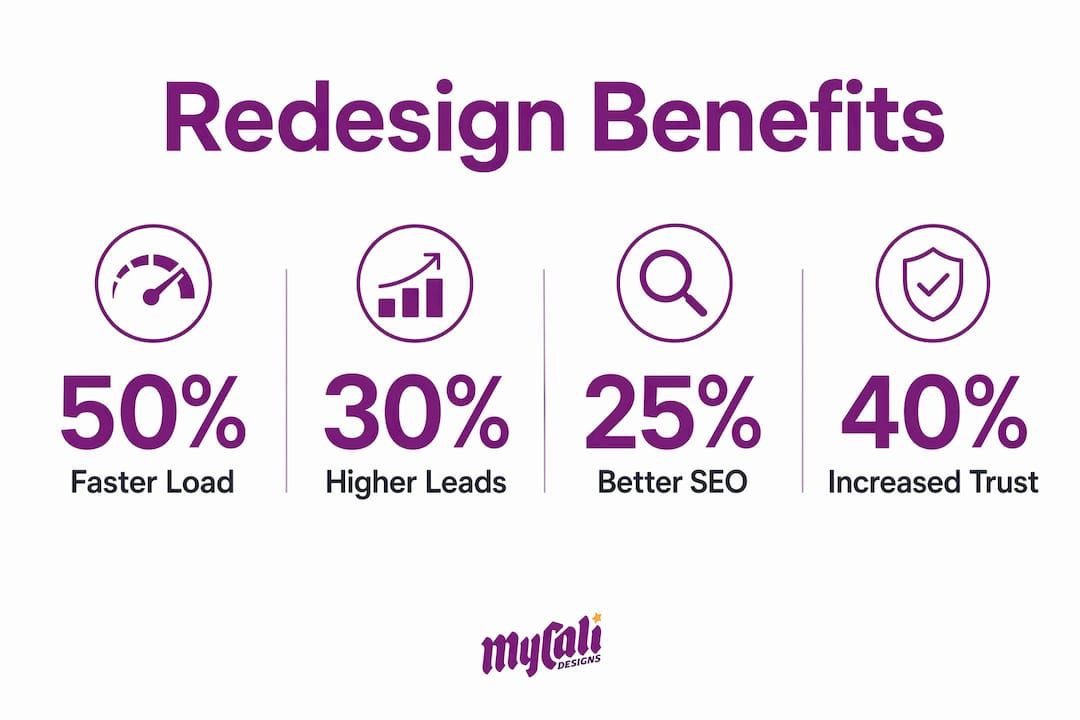
An outdated website does not just look old. It actively costs you customers, rankings, and revenue. The damage happens gradually, which is exactly why many SMB owners underestimate it until the losses are significant.
Here is how an aging site erodes your business performance:
- Brand credibility takes a hit. Visitors form an opinion about your business within seconds of landing on your site. A dated design signals that your company may not be current, attentive, or trustworthy. That perception is hard to reverse once it forms.
- Poor navigation frustrates users. When visitors cannot find what they need quickly, they leave. High exit rates on key pages like your services or contact page are a direct symptom of navigation problems that a redesign can fix.
- Non-mobile-friendly designs lose traffic. A site that does not render properly on smartphones and tablets is invisible to a large portion of your audience. Google's mobile-first indexing means poor mobile performance also suppresses your search rankings.
- Security vulnerabilities increase costs. Companies neglecting redesign face security risks from outdated software and rising maintenance costs. Older platforms accumulate technical debt, meaning small fixes become expensive patches over time.
- You fall behind competitors. While your site ages, competitors who invest in web improvement are capturing the leads you are missing. A modern, fast, well-structured site is a competitive asset, not just a digital brochure.
The compounding nature of these problems is what makes inaction so costly. Each issue reinforces the others, and the longer you wait, the more ground you give up.
What are the signs it's time to redesign your website?
Knowing when to act is as important as knowing why. Most SMB owners wait too long because the signals are gradual rather than sudden. Indicators like declining traffic, site age over 3–5 years, and poor mobile usability are reliable signals that a redesign is overdue.
Watch for these specific warning signs:
- Traffic or leads are declining without a clear cause. If your organic traffic is dropping and you have not changed your content strategy, your site's technical performance or outdated structure may be the problem.
- Your site is more than 3–5 years old. Web standards, user expectations, and search engine algorithms change fast. A site built five years ago was designed for a different internet.
- Bounce rates are high and session times are short. These metrics tell you that visitors are arriving but not engaging. That gap between arrival and action is a UX problem a redesign can address.
- Your business has changed but your site has not. New services, new markets, a rebrand, or a shift in your customer profile all require your site to reflect the current reality of your business.
- Mobile and tablet usability is poor. Test your site on three different devices right now. If the experience feels clunky, your customers are noticing too.
Pro Tip: Use Google Analytics to check your mobile vs. desktop conversion rates. A gap larger than 15% between the two is a strong signal that your mobile experience needs a redesign, not just a tweak.
If two or more of these apply to your business, the importance of site updates is not a future consideration. It is a present one. A small business rebranding guide can help you think through how a redesign fits into a broader brand refresh strategy.
How to maximize ROI from your website redesign investment
A redesign without a plan is just an expense. A redesign with clear goals, tracked KPIs, and a performance-focused approach is an investment that pays back measurably. Strategically planned redesigns can return approximately $100 in revenue per $1 spent. That ratio is achievable when you align every design decision with a specific business outcome.
The table below compares common redesign approaches and their impact on key business metrics:
| Redesign Focus | Primary Benefit | Key Metric to Track |
|---|---|---|
| Performance optimization | Faster load times, lower bounce rates | Page load speed, bounce rate |
| Mobile-first design | Higher mobile conversions | Mobile conversion rate |
| SEO architecture update | Better organic rankings | Organic traffic, keyword positions |
| UX and navigation overhaul | Longer sessions, more page views | Session duration, pages per visit |
| CTA placement and design | More form fills and purchases | Conversion rate, lead volume |
To get the most from investing in web improvement, follow this approach:
Start with a comprehensive redesign brief that maps your current performance against your business goals. Identify the gap between where you are and where you need to be. That gap defines your redesign scope.
Focus on performance from the start. Speed, mobile responsiveness, and clean code are not finishing touches. They are the foundation. Build them in from day one, not as afterthoughts.
Clear calls to action placed strategically in a redesigned site significantly increase conversion rates. Every page should have one clear next step for the visitor. Remove friction from that path. Make the action obvious and easy.
Use the redesign to strengthen your brand identity across every page. Consistent typography, color, and messaging build the kind of trust that turns first-time visitors into repeat customers. Pair your site update with website and SEO services to capture the full benefit of your new architecture.
Finally, set up KPI tracking before launch. Define what success looks like in numbers: a 20% increase in leads, a 15% drop in bounce rate, a 10% lift in mobile conversions. Post-launch monitoring tells you what is working and where to refine. How website redesign boosts sales is not a mystery when you track the right metrics from the beginning. For practical design decisions that support these goals, the essential website design tips from Mycalidesigns offer a solid starting framework.
Key takeaways
A well-planned website redesign is the highest-ROI investment most SMBs can make in their digital presence, with measurable gains in conversions, SEO, and brand credibility.
| Point | Details |
|---|---|
| Redesign drives direct revenue | Strategically planned redesigns can return $100 per $1 spent when goals are clearly defined. |
| Speed and mobile performance matter most | A one-second load delay cuts conversions by 7%; mobile-first design lifts them by 11%. |
| Outdated sites carry hidden costs | Security risks, technical debt, and lost traffic compound the longer a redesign is delayed. |
| Know your redesign triggers | Site age over 3–5 years, declining traffic, and high bounce rates are reliable signals to act. |
| Track KPIs from day one | Set measurable goals before launch so post-redesign improvements are data-driven, not guesswork. |
What i've learned after helping smbs redesign their sites
Most SMB owners come to us thinking a redesign is about making their site look better. That framing leads to the most common and costly mistake I see: treating the project as a visual update rather than a business performance project.
The businesses that get the best results from a redesign are the ones that start with a question: "What do we want this site to do differently?" Not "How do we want it to look?" That shift in framing changes everything. It means every design decision gets evaluated against a business outcome, not a personal preference.
The second mistake I see regularly is choosing a redesign partner based on price alone. A cheap redesign that ignores SEO architecture, mobile performance, and conversion structure will cost you far more in lost leads than you saved on the project. The right partner asks hard questions before they open a design tool.
One more thing worth saying directly: do not wait for a crisis to trigger a redesign. The businesses that redesign proactively, before traffic drops or a competitor pulls ahead, are the ones that use the project offensively rather than defensively. That is where the real competitive advantage lives.
— Cesar
Ready to turn your website into a growth asset?
At Mycalidesigns, we help small and medium-sized businesses grow through design that works. A website redesign is one of the most direct ways to improve how your brand looks, how customers find you, and how many of them take action when they arrive.
Our custom website development service is built specifically for SMBs that want a site aligned with their business goals, not just a template refresh. We pair every site project with brand development and SEO strategy so your redesign delivers results from day one. If you are ready to build a site that performs, we are ready to build it with you.
FAQ
What is a website redesign?
A website redesign is a strategic process of updating a site's design, structure, and technical performance to improve user experience and business results. It goes beyond visual changes to include SEO architecture, mobile responsiveness, and conversion optimization.
How much does a website redesign cost for an SMB?
Costs vary based on scope, but the ROI potential is significant. Strategically planned redesigns can return approximately $100 per $1 spent, making even a mid-range investment worthwhile for most small businesses.
How often should a business redesign its website?
Most businesses benefit from a full redesign every 3–5 years. Site age over 3–5 years, combined with declining traffic or poor mobile performance, is a reliable signal that a redesign is overdue.
Does a website redesign help with SEO?
Yes. Updated architecture and metadata during a redesign directly improve organic search rankings and attract more qualified traffic. SEO gains are one of the most consistent and measurable benefits of a site update.
How long does a website redesign take?
A typical SMB redesign takes 6–12 weeks depending on scope, content complexity, and how quickly stakeholders provide feedback. Projects with a clear brief and a single point of contact move significantly faster than those managed by committee.
Recommended
Recent Posts