




Optimize your social media workflow for better engagement
Optimize your social media workflow for better engagement
Managing social media for a small or medium-sized business often feels like spinning plates. You're creating content, responding to comments, tracking analytics, and trying to stay consistent, all while running the actual business. Without a clear process, things slip through the cracks and engagement suffers. A structured social media marketing workflow changes that. It gives your team a repeatable system that saves time, reduces errors, and keeps your brand voice consistent across every platform. This guide walks you through each phase of that workflow, from goal-setting and content creation to analytics and iteration, so you can stop guessing and start growing.
Table of Contents
- Core phases of the social media marketing workflow
- Preparation: Setting goals, tools, and content mix
- Execution: Content creation, approvals, scheduling, and publishing
- Monitoring, analytics, and refining your workflow
- What most SMBs get wrong about social media workflows
- Level up your workflow with expert support
- Frequently asked questions
Key Takeaways
| Point | Details |
|---|---|
| Follow a structured workflow | Use clear phases to organize your social media marketing and save time. |
| Focus your content mix | Keep 70-80% of content educational or community-focused and less than 15% promotional for best results. |
| Leverage the right tools | Scheduling, batching, and analytics tools can multiply your productivity and marketing impact. |
| Measure what matters | Track conversions and ROI instead of vanity metrics to boost your marketing effectiveness. |
Core phases of the social media marketing workflow
Now that you know why a workflow matters, let's break down each core phase a successful SMB should follow. Think of this as your operating system for social media. Without it, every week starts from scratch. With it, your team builds momentum.
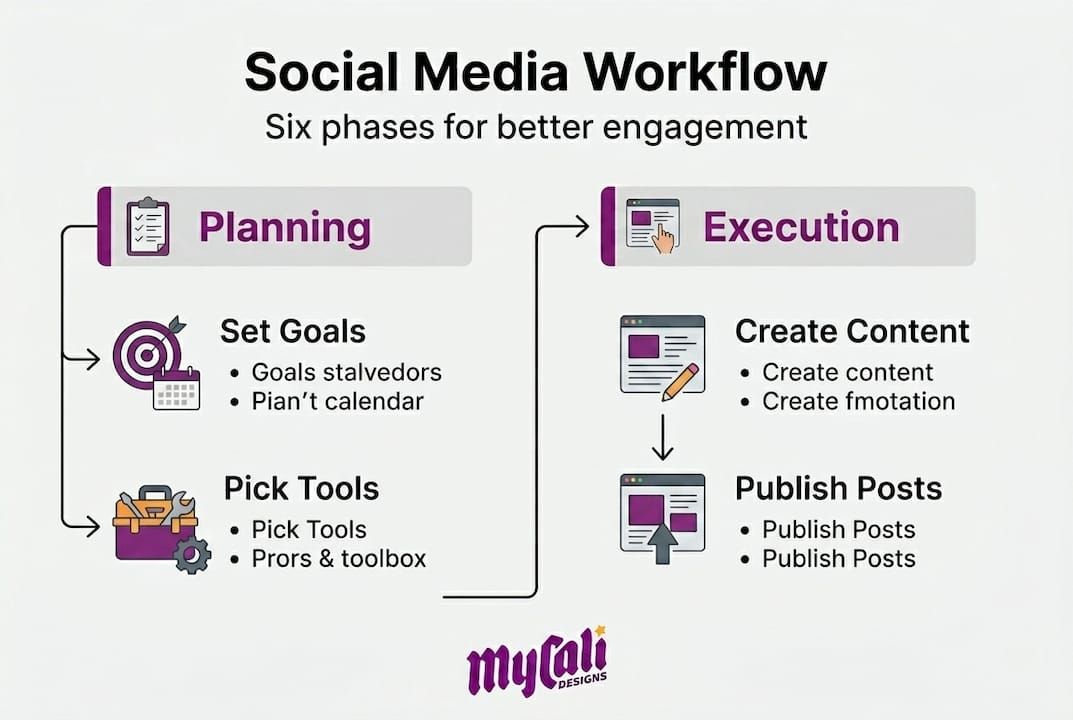
According to social media practitioners, the core workflow phases for SMBs cover six distinct stages: Strategy and planning, Ideation and content creation, Approval and collaboration, Scheduling and publishing, Monitoring engagement, and Analytics and iteration. Each phase feeds into the next, creating a cycle that gets stronger over time.
Here's a quick summary of what each phase achieves for a small team:
| Phase | SMB Objective |
|---|---|
| Strategy and planning | Define goals, target audience, and content themes |
| Ideation and content creation | Produce on-brand posts, graphics, and copy |
| Approval and collaboration | Catch errors, ensure compliance, align stakeholders |
| Scheduling and publishing | Automate posting at peak times |
| Monitoring engagement | Respond to comments, track mentions, build community |
| Analytics and iteration | Measure results and refine your approach |
Building a strong social media presence is not just about showing up. It's about showing up with intention. Small teams that skip phases, like approval or analytics, often find themselves producing content that looks busy but delivers little return.
Common friction points SMBs hit without a defined workflow include:
- No clear content calendar , leading to last-minute scrambling
- Missing approval steps , resulting in off-brand or inaccurate posts going live
- Skipping the analytics phase , so there's no learning loop to improve performance
- Inconsistent posting schedules , which erodes audience trust and algorithmic reach
- Siloed team communication , where no one knows who owns what task
A well-structured workflow also makes SEO for social media more effective. When your content follows a consistent structure and cadence, search engines and platform algorithms reward you with better visibility. Think of it like a well-run event workflow: every detail handled in order means a seamless experience for your audience.
Preparation: Setting goals, tools, and content mix
With the workflow structure in place, start with preparation by defining your goals, picking tools, and planning your content. This phase is where most SMBs either set themselves up for success or quietly doom their efforts before a single post goes live.
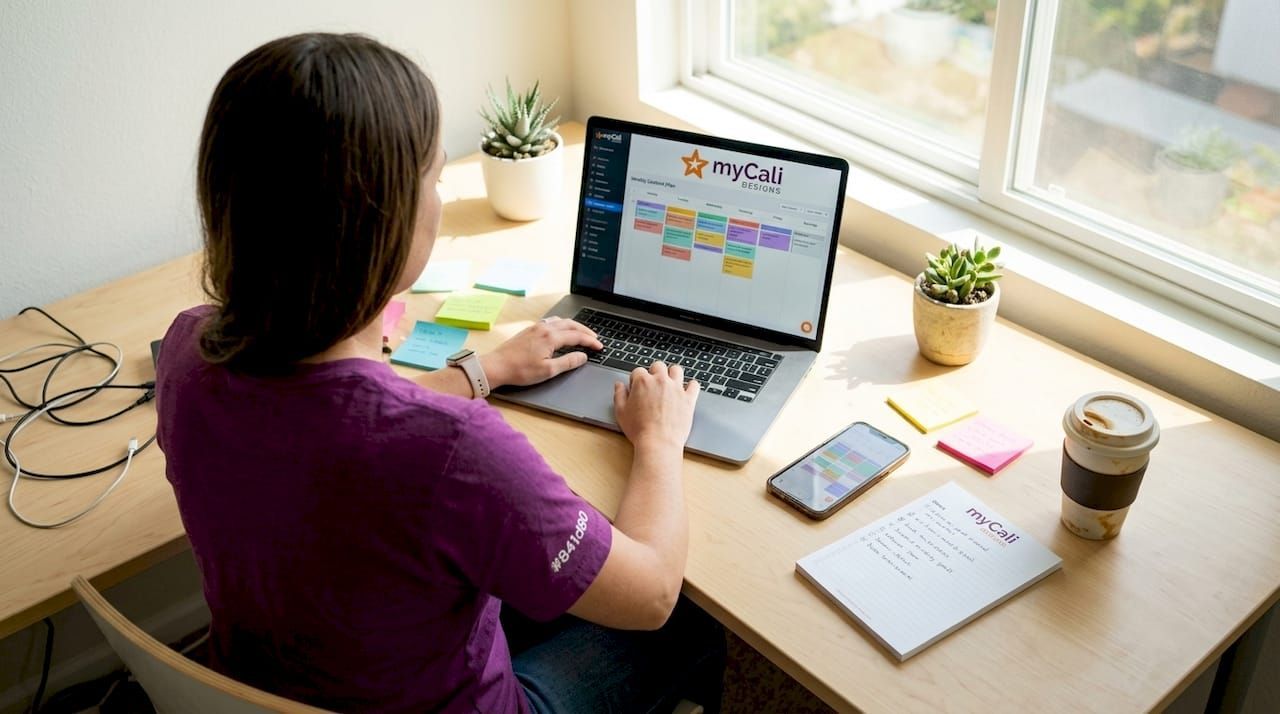
Step 1: Set clear, measurable goals. Examples for SMBs include growing Instagram followers by 20% in 90 days, increasing website traffic from social by 15%, or generating 10 qualified leads per month through LinkedIn.
Step 2: Choose the right tools. Not every platform needs an enterprise-level solution. SMB-friendly tools like Buffer and Hootsuite handle scheduling efficiently, with Buffer being the more budget-friendly option for lean teams. HubSpot and Sprout Social are better suited when you need integrated CRM and deeper analytics. Notably, batching your content creation in these tools can increase productivity by as much as 60%.
Here's a quick comparison to guide your choice:
| Tool | Best for | Starting price |
|---|---|---|
| Buffer | Simple scheduling, small budgets | Free / $6/mo per channel |
| Hootsuite | Teams needing compliance workflows | From $99/mo |
| HubSpot | CRM integration + social reporting | From $20/mo |
| Sprout Social | Agencies and growing SMBs | From $249/mo |
Step 3: Plan your content mix. The 80/20 content rule is a practical guide: aim for 70 to 80% educational or entertaining content, 20 to 30% community and engagement posts, and keep promotional content under 10 to 15% of your total output. Audiences disengage fast when every post feels like a sales pitch.
Here's how to choose your content pillars:
- Identify your top 3 to 5 audience pain points
- Map each pain point to a content theme (how-to, story, tip, behind-the-scenes)
- Assign each theme a percentage of your monthly content mix
- Build a 30-day calendar template around those themes
- Review and adjust every quarter based on what performed best
Pro Tip: Batch your content creation by theme. Spend one morning writing all your educational posts for the month, then another session on graphics. This approach protects your creative energy and keeps quality consistent. Pairing batching with workflow-supporting SEO strategies ensures your content reaches the right people, not just your existing followers.
Execution: Content creation, approvals, scheduling, and publishing
Once your prep is set, move on to actual execution. This is where content comes to life, gets approved, and reaches your audience. A lot of SMBs treat this phase casually, and that's exactly where quality and brand consistency break down.
Here's the execution sequence that keeps things moving without chaos:
- Brainstorm and draft. Use your content pillars and calendar template to write captions, design graphics, and film short videos in focused batches.
- Internal review. Have a second set of eyes check for typos, tone consistency, and accuracy before anything moves forward.
- Approval workflow. Route content to the appropriate stakeholder, whether that's a marketing lead, compliance officer, or business owner, for final sign-off. Tools like Hootsuite have built-in approval workflows that are especially useful for regulated industries or multi-person teams.
- Schedule and automate. Load approved content into your scheduling tool and set posting times based on platform analytics. Aim for consistency, not volume.
- Repurpose high performers. If a post gets strong engagement, adapt it into a different format. A popular Instagram carousel can become a blog summary, a short video, or a series of individual tips.
Quality over quantity. Posting 3 to 5 times per week with genuinely useful content consistently outperforms daily posting that's rushed or repetitive. Audience burnout is real, and recovering lost followers is far harder than keeping the ones you have.
Approval workflows do more than catch typos. They prevent off-brand messaging, protect you from compliance issues, and keep the whole team aligned. If you've ever dealt with a post that went live before it was ready, you know exactly how costly that can be. Our guide on avoiding creative bottlenecks covers how to build an approval process that moves fast without sacrificing oversight.
Pro Tip: Plan and batch content before busy seasons like the holidays or a product launch. Having 2 to 3 weeks of pre-approved content in the queue means you can stay present online even when things get hectic internally. And don't overlook the power of community-focused content in your publishing mix. It builds loyalty in ways promotional posts simply can't.
Monitoring, analytics, and refining your workflow
You've launched your content. Now, shift focus to tracking results and learning what actually moves the needle. This is where a good workflow separates itself from a great one.
Not all metrics are created equal. Vanity metrics like total followers or raw likes feel good but rarely translate to revenue. Focus instead on conversion metrics: click-through rates, lead form submissions, direct messages from prospects, and website traffic attributed to social.
For paid social campaigns, ROAS benchmarks give you a realistic performance target. SMBs can typically expect a 3.8:1 return on Instagram, 4.1:1 on TikTok, and 3.2:1 on Facebook. These numbers give you a baseline to evaluate whether your ad spend is working or needs reallocation.
When reviewing your analytics and reporting, look for patterns, not just individual post results. Which content pillars consistently drive engagement? What time slots produce the most clicks? Are there platforms where your audience is simply more active?
Here are the top workflow tweaks that consistently improve results:
- Shift posting times based on when your audience is actually online, not industry averages
- Double down on your top content pillar and reduce output from weaker categories
- A/B test captions with different calls to action to see which drives more clicks
- Review your content mix quarterly and adjust percentages based on performance data
- Assign a specific team member to own analytics review so it actually happens
Analytics and iteration are not optional phases. They are, as workflow research confirms, core workflow components for any SMB that wants to improve over time. A social media manager or dedicated team lead should review key metrics at least bi-weekly, with a deeper monthly report to guide strategic decisions.
What most SMBs get wrong about social media workflows
With the core steps covered, let's take a step back for a reality check on what really leads to workflow wins for smaller teams.
Here's the uncomfortable truth: most SMBs don't fail at social media because they lack creativity. They fail because they copy big-brand workflows that require teams of 10 to sustain. A solo founder or two-person marketing team cannot run a six-platform strategy and do it well. Trying to will burn you out fast.
The myth that more posts equals more results is still alive and doing damage. We've seen businesses post every day for months with minimal growth, then cut back to three focused, well-crafted posts per week and watch their engagement double. Consistency and quality compound. Random volume doesn't.
The other trap is chasing tools. Every few months, a new scheduling platform or AI content generator promises to solve everything. Some of these tools are genuinely useful. But no tool fixes a broken strategy. Before adding another subscription, ask whether your current process is actually being followed consistently.
Small improvements, applied with discipline, build sustainable presence the right way. A focused workflow beats a complex one every time for an SMB with limited bandwidth.
Level up your workflow with expert support
If you're ready to take your workflow from good to great, here's how we can help.
At Mycali Designs, we work with small and medium-sized businesses every day to build marketing systems that actually hold up under the pressure of running a real business. From strategy to execution, we know where SMB social media workflows break down, and we know how to fix them.
Our social media marketing services are built to integrate seamlessly with your existing operations. Need a stronger brand foundation to anchor your content? Our business branding solutions create the visual and messaging consistency that makes every post work harder. And if your website and search visibility need attention alongside your social strategy, our website and SEO support ties it all together. Reach out today and let's build a workflow that grows with you.
Frequently asked questions
What are the main steps in an effective social media marketing workflow?
The essential steps are strategy and planning, content creation, approval, scheduling, engagement monitoring, and analytics and iteration. Each phase builds on the last to create a repeatable system.
How often should a small business post on social media?
Posting 3 to 5 times per week with high-quality content consistently outperforms daily posting that sacrifices quality for volume.
Which tools are best for managing social media for SMBs?
Buffer and Hootsuite are strong choices for scheduling, while HubSpot and Sprout Social add CRM and in-depth analytics for growing teams.
How should SMBs balance promotional versus non-promotional content?
Follow the 80/20 content rule: keep promotions under 10 to 15% of posts and focus the majority on educational, entertaining, and community-driven content.
What ROI benchmarks can small businesses expect on paid social media campaigns?
Typical paid social returns for SMBs are 3.2:1 on Facebook, 3.8:1 on Instagram, and 4.1:1 on TikTok, making these platforms strong options for targeted ad spend.
Recommended
- The Power of Social Media: Why Your Business Needs a Strong Online Presence
- Growing the Reach of Your Community, One Tap at a Time
- Digital Marketing | Google ADS | Social Media | MyCali Designs
- 🎁 Your October Checklist: Get Ready to Win the Holiday Sales Rush!
- Optimisation des méthodes de travail grâce à la BI | BIWORKS
Recent Posts