



Service Industry Advertising Guide for Small Businesses
Service Industry Advertising Guide for Small Businesses

Start with local intent capture: claim your Google Business Profile, publish one conversion-ready service page, and layer on a retargeting campaign. That three-step foundation cuts wasted ad spend faster than any other move because it captures buyers who are already searching for what you sell, not buyers you have to convince from scratch.
Here is your first-week action checklist:
- Claim and fully optimize your Google Business Profile. Add service categories, photos, your hours, and a direct booking link. This is free and drives high-intent local traffic immediately.
- Publish one focused service landing page with a clear headline, a single call to action, and a short qualifying form. One tight page outperforms a generic homepage every time.
- Enable call and form tracking before you spend a dollar on paid ads. Without it, you cannot measure cost per qualified lead, and every budget decision becomes a guess.
The logic behind this order is straightforward. Services are invisible until purchased, so buyers rely on trust signals before they ever click an ad. Building that trust layer first means paid spend lands on a working system instead of a leaky funnel. Your primary KPI from day one: cost per qualified lead (CPQL), not raw clicks or impressions.
Pro Tip: Before you run a single paid campaign, Google your own business name and your top service category in your city. What you see is exactly what a new prospect sees. If the result looks thin or untrustworthy, fix that first.

How does your service type change your advertising approach?

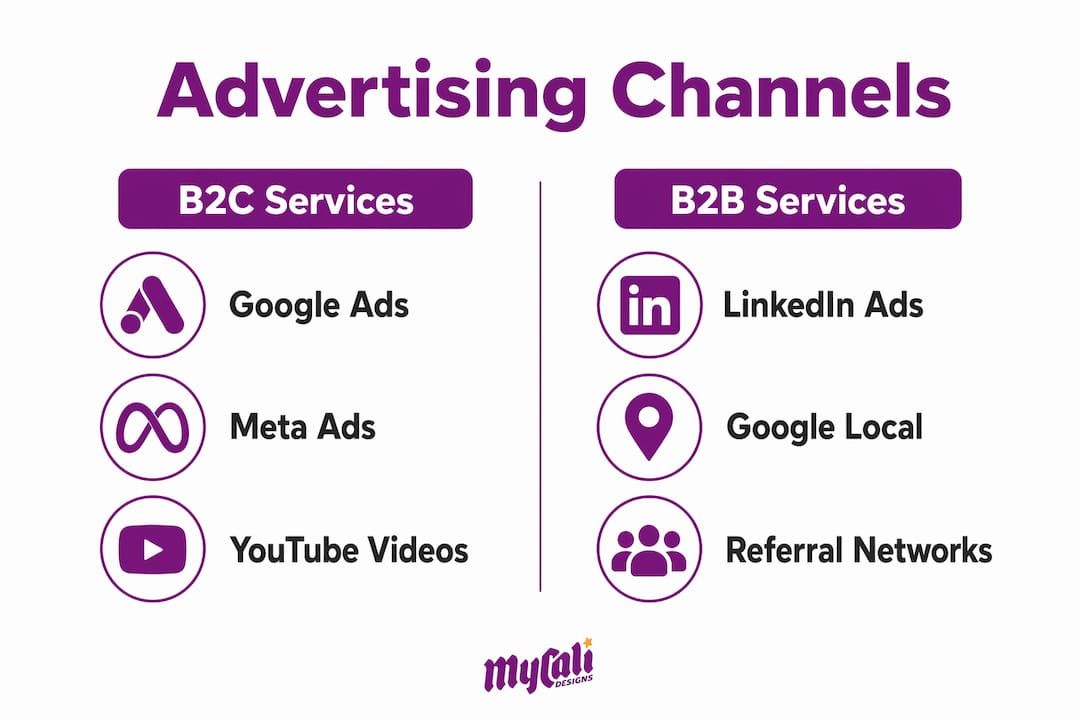
Not every service business advertises the same way. The channel mix that works for a residential HVAC company will frustrate a B2B IT consultancy, and vice versa. The two variables that matter most are buyer type (B2B vs. B2C) and ticket size relative to decision complexity.
Here is a practical breakdown:
- Low-ticket, low-touch B2C (lawn care, mobile detailing, house cleaning): Buyers decide fast, often on urgency. Google Local Services Ads (LSA) and Google Search capture immediate intent. Meta ads work well for seasonal promotions and neighborhood targeting.
- High-ticket, high-touch B2C (home remodeling, financial planning, cosmetic services): Buyers research for days or weeks. You need a trust-building sequence: Google Search for intent capture, retargeting for nurture, and strong review presence to close.
- Low-to-mid-ticket B2B (bookkeeping, IT support, cleaning contracts): Decision-makers search on Google but also respond to LinkedIn outreach. Email sequences and referral programs carry significant weight.
- High-ticket B2B (consulting, commercial construction, managed services): Sales cycles run 30–90 days or longer. LinkedIn Ads and account-based outreach are the primary paid channels. Google Search supports inbound, but the real work happens in the follow-up sequence.
| Segment | Primary Channel | Secondary Channel | Sales Cycle | Budget Priority |
|---|---|---|---|---|
| Low-touch B2C | Google LSA / Search | Meta Ads | Same day to 1 week | LSA first |
| High-touch B2C | Google Search + Retargeting | Meta / YouTube | 1–4 weeks | Landing page + reviews |
| Low-to-mid B2B | Google Search + Email | 2–6 weeks | CRM + email sequence | |
| High-ticket B2B | LinkedIn Ads + ABM | Google Search | 1–6 months | Content + outreach |
Google Local Services Ads surface above standard Search ads, charge per lead rather than per click, and carry the Google Guaranteed badge, which meaningfully increases conversion for emergency and immediate-intent searches. For local trades, that makes LSA the first paid channel to activate, not the last.
Ticket size also changes your creative approach. Lower-priced services need clear pricing and simple booking options, while higher-value contracts benefit from case studies, process overviews, and discovery calls to build trust. Matching your ad creative and landing page to the buyer's decision complexity is one of the most overlooked service advertising best practices.
What marketing assets do you need before scaling paid ads?
Paid ads amplify what is already working. If your funnel has holes, more traffic just means more wasted spend. Before you increase any budget, confirm you have these foundations in place.
Required assets checklist:
- ✅ A conversion-ready service page (not just a homepage)
- ✅ Google Business Profile fully claimed, verified, and optimized
- ✅ Site speed under 3 seconds on mobile (test with Google PageSpeed Insights)
- ✅ At least 10 Google reviews with a 4.5+ average rating
- ✅ A clear booking or contact flow (form, phone, or calendar link)
- ✅ Basic CRM or lead-tracking spreadsheet to record every inquiry
- ✅ Call tracking enabled (CallRail or a Google forwarding number)
Your service landing page needs these specific elements to qualify and convert:
- Headline that names the outcome, not the service ("Get your roof inspected and repaired in 48 hours," not "Roofing Services")
- Single-sentence value statement that addresses the buyer's primary concern
- Three supporting bullets covering scope, timeline, and what makes you different
- Social proof — at minimum, two or three named reviews or a short case result
- Process overview in three to four steps so buyers know what happens after they contact you
- One clear CTA with a qualifying form (more on form fields in the next section)
Building trust online before asking for a conversion is not optional for service businesses. The trust layer significantly impacts landing page conversion rates. Referral mechanics integrated into your post-job process can generate a meaningful share of new bookings when run consistently, making them one of the lowest-cost acquisition channels you can build.
For a deeper look at how to structure a service website that converts, the step-by-step framework covers page architecture, CTA placement, and mobile UX in detail.
Pro Tip: A short video on your service page explaining your process and target audience often outperforms a static page. It is a high-impact addition that many service businesses overlook.
Which advertising channels work best for service businesses?
Here is a channel-by-channel breakdown, matched to buyer type and funnel stage.
Google Ads (Search)
Search ads capture buyers who are actively typing in what they need. For most service businesses, this is the highest-intent paid channel available. Expect cost-per-click (CPC) to range from a few dollars for lower-competition local services to $20–$50+ for competitive professional services like legal or financial. Focus campaigns on bottom-funnel keywords ("emergency plumber Sacramento," "commercial cleaning quote") rather than broad category terms.
Google Local Services Ads
LSA sits above Search ads in results, charges per lead, and shows the Google Guaranteed badge for verified businesses. For local trades and home services, this is often the best first paid investment. Verification requires a background check and license confirmation, but the trust signal it creates is worth the setup time.
Google Business Profile
Free, high-intent, and compounding over time. A well-optimized Google Business Profile drives recurring leads from local searches without ongoing ad spend. Post updates weekly, respond to every review, and keep your service list current.
Meta (Facebook and Instagram) Ads
Meta excels at awareness and retargeting for B2C services. Cold audiences respond to before/after visuals, short video testimonials, and limited-time offers. Retargeting website visitors with a specific offer typically produces the best return. Boosting organic posts that over-perform and retargeting proven creative produces higher ROI than testing cold creative from scratch.
LinkedIn Ads
The right channel for B2B services targeting decision-makers by job title, company size, or industry. LinkedIn CPCs run higher than Google or Meta, but the audience quality for high-ticket B2B is unmatched. Lead Gen Forms (native LinkedIn forms) reduce friction and work well for gated content like guides or free assessments.
YouTube and Short-Form Video
Process walkthroughs, before/after results, and "day in the life" content build trust at scale. YouTube pre-roll ads work for high-ticket services where buyers need to see the work before committing. Short-form video on Instagram Reels or YouTube Shorts builds brand familiarity at low cost.
Retargeting
Every service business should run retargeting. Visitors who have already seen your site convert at dramatically higher rates than cold traffic. A simple retargeting campaign on Meta or Google Display Network, showing a specific offer or testimonial to past visitors, is one of the most cost-efficient campaigns you can run.
Referral and partnership channels
Structured referral programs, strategic partnerships with complementary businesses, and post-job review prompts are not "advertising" in the traditional sense, but they function as acquisition channels with the lowest cost per acquisition you will find. Build them in parallel with paid channels, not after.
On attribution: Call tracking (CallRail, Google call forwarding) and a CRM are non-negotiable for channel-level decisions. Without them, you cannot tell which channel produced a booked job versus a tire-kicker inquiry. Tracking three numbers — cost per qualified lead, cost per closed customer, and payback period — gives you everything you need to make confident budget decisions.
How do you design offers and landing pages that actually convert?
Most service landing pages fail for one of two reasons: they attract the wrong leads, or they fail to convert the right ones. A qualifying landing page solves both problems at once.
Reusable landing-page template:
- Headline: Outcome + timeframe + location (e.g., "Commercial HVAC Repair in Sacramento — Diagnosed and Fixed Within 24 Hours")
- Single-sentence value: One line that addresses the buyer's biggest concern
- Three supporting bullets: What is included, who it is for, and what makes you different
- Social proof block: Two to three reviews with first name, company (for B2B), and a specific result
- Process overview: Three to four numbered steps from "contact us" to "job complete"
- CTA with qualifying form: One button, one form, no distractions
Offer structures by ticket size:
- High-ticket ($2,000+): Free 15-minute discovery call or complimentary assessment. The offer lowers the barrier to entry while the form qualifies fit before the call.
- Mid-ticket ($200–$2,000): Limited-time discount or a bundled package with a clear deadline. Creates urgency without devaluing the service.
- Low-ticket (under $200): Fixed-price quick service with instant booking. Remove friction entirely — price, book, done.
Form field checklist (balance qualification with conversion):
- ✅ Name and phone or email (always)
- ✅ Service needed or category (qualifies intent)
- ✅ Service area or zip code (qualifies geography)
- ✅ Timeframe — "When do you need this?" (qualifies urgency)
- ✅ Budget range (for high-ticket B2B only — skip for low-ticket B2C)
- ❌ Avoid asking for more than five fields on a cold landing page
Design directly influences conversion rates, and a cluttered or visually inconsistent landing page signals low professionalism before a prospect reads a single word. The layout, typography, and visual hierarchy of your page carry as much weight as the copy.
Qualifying landing pages that explain process, fit, and expected outcomes mean your sales team spends time on high-value prospects instead of raw lead volume.
Pro Tip: Add two qualifying questions before the main form — something like "What is your biggest challenge right now?" and "What is your timeline?" A short pre-qualifier like this can double your qualified lead rate because unfit prospects self-select out before you spend time on a call.
How do you set objectives, budgets, and timelines for service ads?
Vague goals produce vague results. Before you spend anything, write a SMART objective: Specific, Measurable, Achievable, Relevant, and Time-bound.
SMART objective examples:
- "Generate 20 qualified consultation requests per month from Google Search at a CPQL under $75 within 90 days."
- "Book 10 new commercial cleaning proposals per quarter from LinkedIn Ads at a cost per closed customer under $500."
- "Increase Google Business Profile calls by 40% in 60 days through profile optimization and weekly posts."
Key performance indicators for service advertising
| KPI | Definition | Formula | Healthy Range (Services) |
|---|---|---|---|
| CPQL | Cost per qualified lead | Ad spend ÷ qualified leads | Varies by ticket; aim for under 10% of job value |
| Cost per closed customer | Total ad spend ÷ new clients won | Ad spend ÷ closed deals | Under 20% of first-year LTV |
| Conversion rate | Leads who become qualified | Qualified leads ÷ total leads | 20–40% for well-targeted campaigns |
| Payback period | Months to recover acquisition cost | CAC ÷ monthly gross margin per client | 3–6 months is a healthy target |
| LTV:CAC ratio | Lifetime value vs. acquisition cost | LTV ÷ CAC | 3:1 or higher |
90-day budget testing approach
A disciplined test does not require a large budget. It requires consistent spend over a long enough window to generate meaningful data.
- Days 1–30 (Setup and baseline): Allocate 60% of test budget to your highest-intent channel (Google Search or LSA). Spend the remaining 40% on retargeting. Track every lead source in your CRM.
- Days 31–60 (Measure and adjust): Review CPQL by channel and by campaign. Pause keywords or ad sets with zero qualified leads. Shift budget toward what is producing.
- Days 61–90 (Scale or pivot): If CPQL is within target, increase budget by 20–30%. If not, diagnose the funnel (landing page, offer, or targeting) before spending more.
Timeline expectations by channel:
- Google LSA: Leads within 1–2 weeks of verification
- Google Search Ads: Meaningful data within 30 days; optimization takes 60–90 days
- Meta Ads: Initial results in 2–4 weeks; audience learning phase takes 7–14 days
- LinkedIn Ads: Expect 60–90 days before reliable CPQL data
- Local SEO / Google Business Profile: Compounding results over 3–6 months
- Content / SEO: 6–12 months to meaningful organic traffic
Committing to a narrow set of marketing activities and measuring weekly is what separates service businesses that scale from those that churn through ad spend without results. The 90-day sprint is not a shortcut — it is the minimum viable test window.
How do you turn ad leads into booked clients?
Generating leads is only half the job. The other half is a fast, structured process that moves qualified prospects to a signed agreement before they cool off or call a competitor.
Lead scoring rubric
Score each inbound lead before assigning it to sales:
- Budget fit (0–3 points): Does the prospect's stated budget align with your service range?
- Timeframe (0–3 points): Are they ready to start within 30 days (3), 30–90 days (2), or "just exploring" (0)?
- Decision-maker (0–2 points): Are you speaking with the person who can approve the project?
- Service fit (0–2 points): Does their need match a service you deliver well?
Leads scoring 7–10 go directly to a sales call. Leads scoring 4–6 enter a nurture sequence. Leads scoring 3 or below get a polite disqualification and a referral if appropriate.
Follow-up cadence
Speed matters more than most service businesses realize. The first follow-up should happen within 15 minutes of a form submission or missed call during business hours.
- Touch 1 (0–15 min): Automated confirmation email or text with next steps and a calendar link.
- Touch 2 (2–4 hours): Personal phone call from the assigned team member.
- Touch 3 (Day 2): Email with a relevant case result or process overview.
- Touch 4 (Day 4): Second phone attempt plus a short video or testimonial link.
- Touch 5 (Day 7): Final check-in with a clear close or disqualification.
Sales handoff checklist
- ✅ Lead source recorded in CRM (which channel, which campaign)
- ✅ Lead score assigned
- ✅ Owner assigned with a follow-up deadline
- ✅ Next step defined (call, proposal, site visit)
- ✅ Outcome recorded after each touch
Shift your reporting from raw lead count to CPQL and cost per closed customer. A campaign that produces 50 raw leads at $10 each but closes zero is worse than a campaign that produces 10 qualified leads at $40 each and closes four. The email marketing guide for services covers nurture sequences in depth for leads that need more time before committing.
What advertising mistakes do service businesses make most often?
Most service ad campaigns fail for predictable reasons. Here is a quick diagnostic list with fixes you can apply this week.
- ❌ Broad targeting with no geographic or demographic filter. Fix: Add a radius around your service area and layer in job title or homeowner targeting where the platform allows.
- ❌ Sending ad traffic to the homepage. Fix: Every campaign needs a dedicated landing page matched to the ad's specific offer and keyword.
- ❌ No call tracking. Fix: Set up a Google forwarding number or CallRail before your next campaign goes live. Without it, you are flying blind on which ads produce real calls.
- ❌ Weak or generic offers ("Call us for a free quote"). Fix: Make the offer specific and outcome-focused ("Get your commercial kitchen hood inspected and certified in one visit").
- ❌ Chasing raw lead volume instead of qualified leads. Fix: Add qualifying fields to your form and review your lead scoring rubric weekly.
- ❌ Confusing or absent pricing signals. Fix: You do not have to publish exact prices, but give buyers a range or a "starting from" figure. Hiding price entirely increases bounce rate on high-intent pages.
- ❌ Stopping campaigns too early. Fix: Commit to the 90-day test window. Most campaigns need 30–60 days of data before optimization decisions are meaningful.
Red flags in early reporting: A high volume of leads with a low booking rate usually means one of three things — the targeting is too broad, the offer is attracting the wrong buyer, or the follow-up process is too slow. Diagnose in that order.
Emergency checklist when spend is spiraling: Pause the broadest match keywords first, then pause the lowest-performing ad sets, then review the landing page for obvious friction points (slow load, unclear CTA, broken form). Do not increase budget until you have identified the leak.
Three campaign templates you can copy right now
These templates are built around the channel combinations that produce the most consistent results for service businesses. Adapt the copy to your specific service and geography.
Template 1: Local trades (LSA + retargeting)
- Objective: Booked service calls from local, immediate-intent searches
- Channel mix: Google LSA (primary) + Google Display retargeting (secondary)
- Creative hook: "Licensed and Google Guaranteed — [Service] in [City] Available Today"
- CTA: "Request a callback" or "Book online"
- Measurement: CPQL from LSA dashboard; retargeting conversion rate in Google Ads
- First 30 days: Track lead volume, booking rate, and average job value per LSA lead
Template 2: B2B consultative service (LinkedIn + landing page)
- Objective: Discovery call bookings from decision-makers in target industries
- Channel mix: LinkedIn Lead Gen Form ads (primary) + email nurture sequence (secondary)
- Creative hook: "Is your [problem] costing you [specific outcome]? Here is how [Company Type] fixes it in 30 days."
- CTA: "Book a 15-minute call" or "Download the process guide"
- Measurement: Cost per booked call, show rate, proposal rate
- First 30 days: Track lead quality score, show rate on calls, and proposal-to-close ratio
Template 3: Consumer service (short-form video + booking page)
- Objective: Direct bookings from a warm social audience
- Channel mix: Meta Reels or Instagram Stories (primary) + retargeting to booking page (secondary)
- Creative hook: A 15–30 second before/after video or a "day in the life" process clip
- CTA: "Book now — spots this week available"
- Measurement: Cost per booking, retargeting conversion rate, return on ad spend (ROAS)
- First 30 days: Test two creative variations; measure click-through rate and booking rate separately
The principle behind all three templates: Test creative organically before paying to amplify it. A post that earns strong organic engagement is already validated by your audience — boosting it with paid spend produces better ROI than launching cold creative you have never tested. This approach, recommended consistently in service marketing guidance, reduces wasted creative spend and shortens the learning phase on every platform.
Anonymized example — residential service company, mid-size market:
A home services business ran Template 1 for several months with a modest test budget split between LSA and retargeting. Initially, they received a modest number of leads with a smaller share qualified. After improvements, the number of qualified leads increased, and the booking rate from qualified leads remained strong.
What to collect in the first 30 days:
- Total leads by channel
- Qualified leads by channel (using your scoring rubric)
- Booking rate from qualified leads
- Average job value of booked clients
- Source of every booked job (CRM field)
Key Takeaways
Service businesses that build trust assets first and measure cost per qualified lead from day one consistently outperform those that scale paid spend onto unoptimized funnels.
| Point | Details |
|---|---|
| Start with local intent capture | Claim your Google Business Profile, publish one service landing page, and enable call tracking before any paid spend. |
| Match channels to buyer type | Google LSA for local trades, LinkedIn for high-ticket B2B, Meta for consumer services — the wrong channel wastes budget regardless of creative quality. |
| Measure CPQL, not raw leads | Cost per qualified lead and payback period (target: 3–6 months) are the two numbers that tell you whether a campaign is working. |
| Run a 90-day test sprint | Commit to a narrow channel set, measure weekly, and scale only what produces qualified leads within your target CPQL. |
| Mycalidesigns builds the assets | Mycalidesigns designs conversion-ready service pages, manages Google Ads, and handles Local SEO so your ad spend lands on a working system. |
Where should your first ad dollars actually go?
Most of the advice you will read about service advertising focuses on channel tactics. What it underestimates is the sequence problem: spending money on ads before your trust layer is in place is like turning up the water pressure on a hose full of holes. The spend accelerates the leak, it does not fix it.
My recommendation for a first test budget is a deliberate split that prioritizes local intent capture, followed by a social test aligned with your buyer type, and baseline retargeting to past website visitors. That split gives you data from three different funnel stages without spreading budget so thin that none of the tests reach statistical significance.
Where to be conservative: LinkedIn cold audiences and YouTube pre-roll for service businesses under $500K in annual revenue. Both channels can work, but they require more creative investment and longer learning windows than most small service businesses can sustain in a first quarter.
Where to be bold: your landing page and your offer. A well-designed, qualifying service page and a specific, outcome-focused offer will do more for your CPQL than any platform optimization. Most service businesses underinvest here and overinvest in ad spend. Flip that ratio in your first 90 days.
The service industry marketing tips that produce compounding results are not the flashiest ones. They are the ones that build a system — trust assets, qualifying pages, CRM tracking, and a consistent follow-up process — that paid ads can amplify rather than prop up.
Mycalidesigns helps you build the system behind your ads
If this guide has shown you anything, it is that effective service advertising is less about picking the right platform and more about having the right assets in place before you spend. That is exactly where Mycalidesigns works.
Mycalidesigns designs and builds the conversion-ready infrastructure that makes ad spend productive: service landing pages that qualify leads, Google Ads campaigns managed for CPQL, Local SEO that builds compounding visibility, and tracking integrations that close the measurement loop. We work with small and medium-sized service businesses that are ready to grow with a system, not just a campaign.
Services that map directly to this guide:
- Conversion-ready service pages — built to qualify leads and reduce unfit inquiries
- Google Ads and Local SEO setup — campaign management and local search visibility for service businesses
- Digital marketing strategy and paid media management — Google Ads, Meta, and retargeting campaigns managed end-to-end
- Custom website development — full-service web builds designed around your sales process
Ready to put this guide into practice with a team that handles the build? Contact Mycalidesigns to discuss your first 90-day advertising plan.
Useful sources and further reading
These are the primary references and platform resources worth bookmarking as you build and refine your service advertising program.
- Google Local Services Ads overview — Official setup guide for LSA verification, Google Guaranteed badge, and lead management. Start here before activating LSA for any local trade or home service.
- Google Business Profile Help Center — The authoritative source for GBP setup, category selection, and policy compliance. Consult this for verification issues and feature updates.
- Meta Ads Manager basics — Meta's own documentation for campaign structure, audience targeting, and ad policy. Use it to confirm targeting options and creative specs before launching.
- LinkedIn Ads documentation — Official guide to LinkedIn campaign types, Lead Gen Forms, and audience targeting by job title and company size.
- Why local SEO matters for service businesses — A practical breakdown of local search benefits and tactics, useful for understanding why GBP and local citations compound over time.
- U.S. Small Business Administration — Marketing and Sales — SBA guidance on marketing planning, budgeting, and customer acquisition for small businesses. A reliable reference for foundational business marketing decisions.
- What is service marketing? — A foundational overview of service marketing concepts, including how intangibility and trust affect buyer decisions.
Recommended
Recent Posts