




Digital branding strategies to drive trust and growth
Digital branding strategies to drive trust and growth
Most small business owners think digital branding means having a logo and a Facebook page. That's like saying a restaurant only needs a sign on the door. Your digital brand is the entire experience someone has with your business online, from the first Google search to the last email they open. Consistent digital branding can boost revenue by 23% for SMBs, and strong digital brands grow 2.5x faster than competitors. If you've ever wondered why some businesses seem to attract loyal customers effortlessly while others struggle to stand out, the answer usually lives in their digital branding strategy. This guide will show you exactly what digital branding is, what it takes to build it well, and how to measure whether it's actually working.
Table of Contents
- Understanding digital branding and its impact
- Core elements of digital branding: What SMBs need
- Balancing consistency and authenticity online
- Measuring digital branding ROI: Metrics and strategies
- Our take: What most SMBs miss about digital branding
- Level up your digital branding with expert support
- Frequently asked questions
Key Takeaways
| Point | Details |
|---|---|
| Digital branding drives growth | Consistent branding can boost SMB revenue and accelerate long-term business success. |
| Consistency builds trust | Maintaining brand identity across platforms is crucial for trust and loyalty. |
| Branding and marketing differ | Branding shapes perception and connection, while marketing drives actions and ROI. |
| Measure more than sales | Track awareness, recall, and customer values to truly evaluate branding effectiveness. |
| Adapt for authenticity | Tailor messaging and visuals to fit different channels without losing brand uniqueness. |
Understanding digital branding and its impact
Digital branding is the practice of shaping how your business is perceived across every online touchpoint. That includes your website, social media profiles, email newsletters, online reviews, and even how your content sounds when someone reads it. It's not a one-time project. It's an ongoing commitment to presenting a clear, consistent identity that builds trust over time.

Many SMB owners confuse digital branding with digital marketing, and that confusion leads to wasted budget. Here's the key difference: digital branding focuses on long-term perception, identity, and emotional connections, while digital marketing drives short-term actions like sales and leads. Think of branding as the foundation of your house and marketing as the furniture inside. You can swap out the furniture anytime, but if the foundation is weak, nothing holds up.
| Digital branding | Digital marketing |
|---|---|
| Builds identity over time | Drives immediate results |
| Emotional, perception-based | Tactical and ROI-focused |
| Measured by awareness and loyalty | Measured by clicks and conversions |
| Stable and consistent | Adjustable and campaign-driven |
| Foundation for all marketing efforts | Built on top of a strong brand |
For SMBs specifically, the impact of strong digital branding is hard to ignore. When your brand looks and feels consistent, customers recognize you faster, trust you sooner, and stay loyal longer. Those aren't soft benefits. They translate directly into lower customer acquisition costs, higher repeat purchase rates, and stronger word-of-mouth referrals.
Key benefits of strong digital branding for SMBs:
- ✅ Faster customer recognition across platforms
- ✅ Higher trust levels before a single sale is made
- ✅ More referrals from satisfied, loyal customers
- ✅ Lower marketing costs over time as brand equity builds
- ✅ Stronger positioning against larger competitors
Our visual branding guide walks through how visual identity fits into this bigger picture, and our branding checklist gives you a practical starting point for auditing where your brand stands right now.
Core elements of digital branding: What SMBs need
With a clear understanding of digital branding's scope, let's explore the foundational elements that set successful SMB digital brands apart.
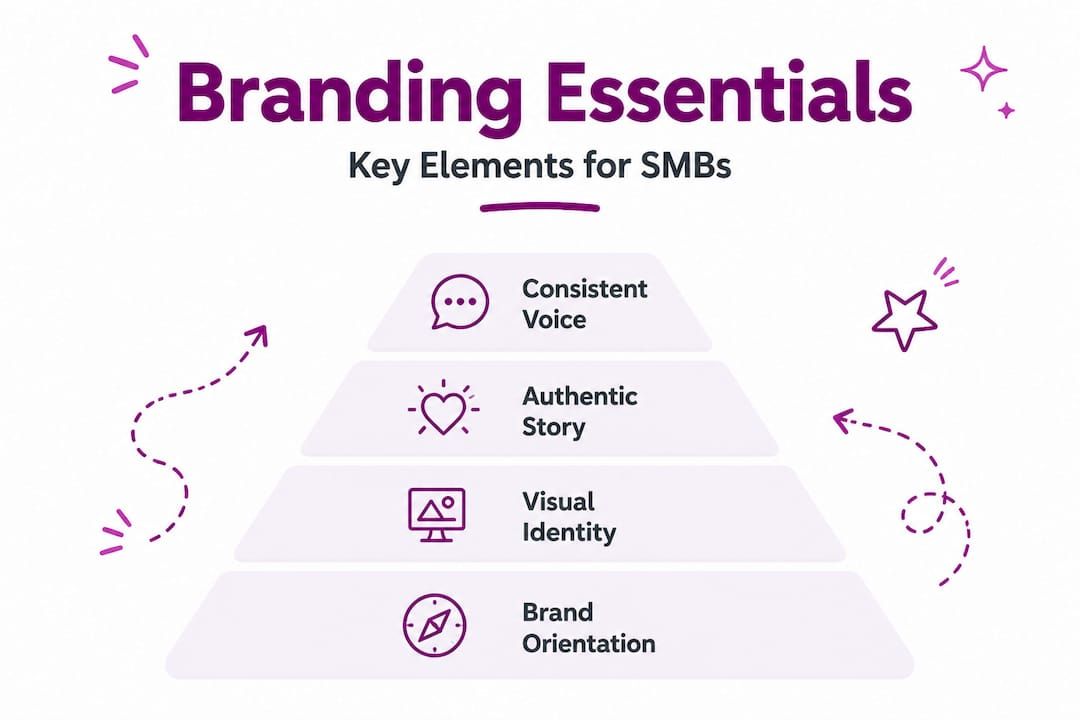
Not all branding elements carry equal weight. Some are foundational and must be established first. Others layer on top as your presence grows. Knowing the right sequence prevents the common mistake of running ads before your brand is ready to receive the attention.
Defining brand orientation first is the recommended starting point. This means identifying your positioning, your core values, your audience, and the promise you make to customers. Without this clarity, every design and content decision becomes a guessing game.
Here's a practical sequence for building your SMB digital brand:
- Define your brand orientation. Who are you, who do you serve, what do you stand for, and how are you different from competitors? This is your north star for every decision that follows.
- Document your brand guidelines. Colors, fonts, logo usage, tone of voice, and image style should all be written down and shared with anyone creating content for your business. Consistency is impossible without documentation.
- Build your core visual assets. Your logo, color palette, and typography form the visual backbone of your brand. A strong logo is not just pretty. It signals professionalism and helps customers remember you. Our branding checklist covers which assets to prioritize first.
- Establish your brand voice and tone. How your business writes and speaks is just as important as how it looks. Friendly and casual? Authoritative and precise? Warm and community-focused? Define it, then apply it everywhere.
- Integrate across all platforms. Your website, social profiles, email signatures, and online listings should all feel like they belong to the same family. Platform flexibility matters here. What you post on LinkedIn will look different from what you share on Instagram, but the underlying identity should be unmistakably yours.
- Create SEO-aligned content and storytelling. Content that ranks well AND tells your brand story builds both visibility and trust simultaneously. Our article on SEO and branding explains how these two work together to compound your results over time.
- Engage actively on social media. Branding isn't just broadcasting. It's conversation. Responding to comments, sharing behind-the-scenes content, and celebrating customer success stories all reinforce your brand's human side. Read our social media branding tips for platform-specific strategies.
Pro Tip: Before investing heavily in paid advertising, make sure your brand guidelines are documented and your visual assets are consistent across your top three platforms. Ads drive traffic, but your brand is what converts that traffic into customers.
| Brand element | Why it matters | Common SMB mistake |
|---|---|---|
| Brand orientation | Guides all decisions | Skipping this step entirely |
| Visual identity | Creates recognition | Using inconsistent logos or colors |
| Brand voice | Builds emotional connection | Switching tones between platforms |
| Content and SEO | Drives organic visibility | Treating content as a separate function |
| Platform integration | Ensures cohesive experience | Treating each channel as isolated |
Balancing consistency and authenticity online
Having established the basic elements, the next challenge is maintaining consistency and authenticity, especially across diverse digital platforms.
Here's a misconception we see often: business owners think consistency means posting the exact same content everywhere. It doesn't. Consistency means your identity stays recognizable even when the format, tone, or style adapts to fit the platform.
Think of it like a professional who dresses differently for a board meeting versus a casual team lunch. The person hasn't changed. Their values, personality, and expertise are exactly the same. Only the presentation shifts to suit the context. Your brand works the same way.
"Prioritize authenticity over perfection. Brands that feel real outperform brands that feel polished but hollow."
How to balance consistency with platform adaptation:
- ✅ Use the same logo, color palette, and core messaging across all channels
- ✅ Adjust tone to match platform culture (professional on LinkedIn, relaxed on Instagram, conversational on Facebook)
- ✅ Match image style to platform expectations without abandoning your visual identity
- ✅ Adapt content format (short-form video for TikTok/Reels, long-form for LinkedIn or your blog)
- ❌ Don't copy-paste identical captions everywhere
- ❌ Don't create a completely different persona for each platform
- ❌ Don't chase every new platform trend if it pulls you away from your brand identity
Balancing consistency with platform adaptation is one of the most nuanced challenges in digital branding, and SMBs that master it gain a significant edge. Brands that feel warm, human, and genuine tend to outperform those that look polished but distant.
One important sequencing note: establish your brand before you go heavy on digital tactics. We've seen businesses run aggressive ad campaigns before their brand is coherent. The result is always the same. Traffic arrives, looks around, and leaves because nothing feels trustworthy or memorable. Building your visual branding process first means every campaign you run after has a strong foundation to land on.
Pro Tip: Add a touch of warmth or nostalgia to your brand story without changing your core identity. Sharing the "why" behind your business, a founder story, or a behind-the-scenes moment can create emotional resonance that polished product photos simply cannot. A strong social media presence amplifies this authenticity when it's genuine and consistent.
Measuring digital branding ROI: Metrics and strategies
Once consistency is mastered, the final step is understanding how to measure branding impact using the right metrics, ensuring efforts translate into actual growth.
Many SMB owners avoid measuring branding because it feels less tangible than counting sales. But here's the truth: unmeasured branding is unmanaged branding. And unmanaged branding either stagnates or drifts in the wrong direction.
The good news is that digital branding ROI compounds over time. Strong branding lowers your customer acquisition cost (CAC), which is what you spend to win each new customer, and raises your lifetime value (LTV), which is the total revenue a customer generates over their relationship with you. Both of those metrics directly improve profitability.
Here's a practical framework for measuring brand performance across awareness, sentiment, CAC, and LTV:
- Brand awareness. Track how many people recognize your brand without being prompted. You can measure this through direct traffic to your website, branded search volume in Google Search Console, and social media follower growth over time.
- Brand sentiment. Monitor the tone of what people say about you online. Review platforms, social media comments, and customer feedback surveys all reveal whether your brand is generating positive or negative associations.
- Net Promoter Score (NPS). Ask customers a simple question: "How likely are you to recommend us to a friend?" NPS is one of the clearest indicators of brand loyalty and customer satisfaction.
- Brand recall. Periodic surveys asking target customers whether they remember your brand, your tagline, or your core promise give you a direct read on how well your branding is sticking in people's minds.
- Customer acquisition cost (CAC). As your brand grows stronger, it should cost less to acquire each new customer because awareness and trust do part of the selling for you. Track this monthly and watch for the downward trend that signals your brand is gaining momentum.
Key metrics to track for digital branding:
- 📊 Direct website traffic (brand awareness signal)
- 📊 Branded search volume (recognition and recall)
- 📊 Social media engagement rate (audience connection)
- 📊 NPS score (loyalty and satisfaction)
- 📊 Customer acquisition cost (branding efficiency)
- 📊 Customer lifetime value (loyalty and retention)
- 📊 Online review ratings and volume (reputation health)
The most effective approach blends these branding metrics with your standard marketing KPIs. Neither tells the full story alone. Our branding measurement steps walk through how to set up a simple tracking system, and our guide on SEO and brand visibility shows how organic search performance connects to branding outcomes.
Our take: What most SMBs miss about digital branding
Most SMBs treat digital branding like a checkbox. Design a logo. Build a website. Post on social media a few times a week. Done. But that approach misses what branding actually does at a deeper level.
We've worked with enough businesses to see a clear pattern. The ones that grow consistently aren't the ones with the most ad budget. They're the ones whose brand feels coherent, trustworthy, and human at every touchpoint. That coherence is not accidental. It comes from treating branding as a strategic foundation, not a creative afterthought.
Here's the perspective most people miss: branding is not about looking good. It's about reducing the mental friction your customer feels when deciding whether to trust you. Every time your visual identity is inconsistent, your tone shifts unexpectedly, or your website looks disconnected from your social profiles, you create a small moment of doubt. Those small moments add up, and they cost you sales without you ever knowing why.
We also see SMBs fall into the trap of thinking branding is a quick fix. Spend a few hundred dollars on a logo refresh, update the colors, and expect a surge in sales. That's not how it works. Strong branding compounds. The returns grow the longer you maintain it consistently. The businesses that commit to it for twelve to twenty-four months see the compounding effect most clearly in their CAC numbers and their word-of-mouth growth.
The most underutilized tool in digital branding for SMBs is storytelling. Visual branding insights matter, but stories are what make people stay, share, and come back. Your origin story, your customer success stories, your "why" as a business owner, these are assets that no competitor can copy. And they work across every platform without requiring a big ad budget.
Our honest advice: start with the foundation before you scale. A clear brand identity, documented guidelines, and a consistent visual presence will make every marketing dollar you spend go further.
Level up your digital branding with expert support
Building a strong digital brand takes clarity, consistency, and the right creative partnership. If you've read this far, you already understand the strategy. Now it's time to put it into practice.
At Mycali Designs, we help SMBs build brand systems that work. From identity development and visual assets to digital marketing that amplifies your brand's reach, our team brings both strategy and execution together in one place. Explore our business branding services to see how we approach brand development, or visit our branding FAQ to get answers to common questions before you take the next step. When you're ready to attract more customers and build lasting trust online, our digital marketing support is here to help you grow with confidence.
Frequently asked questions
How is digital branding different from digital marketing?
Digital branding builds your identity and emotional connection over time, while digital marketing drives short-term sales and leads through tactical campaigns.
What are the key elements of a strong digital brand?
Brand orientation, visual consistency, platform-specific adaptation, storytelling, and performance measurement are the essential building blocks for any SMB digital brand.
Can digital branding increase sales and growth for small businesses?
Yes. Consistent digital branding can boost revenue up to 23% and helps strong brands grow 2.5x faster than competitors in the same market.
How should SMBs measure their digital branding efforts?
Track awareness, sentiment, NPS, CAC, and LTV together for a holistic view. Brand ROI compounds over time, so measuring consistently matters more than measuring perfectly.
How can businesses make their digital branding authentic?
Focus on resonance over polish, adapt your tone for each platform, and prioritize storytelling that reflects your brand's real values rather than chasing a perfectly curated image.
Recommended
Recent Posts